Why English?
- English is a global language.
- Studying English can help you get a job.
- Learning English can help you meet new people.
- Many scientific papers are written in English.
- English is the language of the Internet.
- Travelling is a lot easier with a good knowledge of English.
- English is one of the most important languages for business.
- With English, you can study all over the world.
- English gives you access to multiple cultures.

Alphabet vs. Letters
Alphabet
The word alphabet means the set of letters in a language.
In English, there is only one alphabet, and it has 26 letters.
Example: The English alphabet has 26 letters.
Letters
Each symbol in the alphabet (A, B, C, … Z) is called a letter.
Example: A, B, C are the first three letters of the English alphabet.
✅ So, it’s incorrect to say “26 alphabets”.
The correct way is: “26 letters of the English alphabet.”
⚡ Remember:
❌ Wrong → 26 alphabets
✅ Right → 26 letters of the English alphabet

What is a Word?
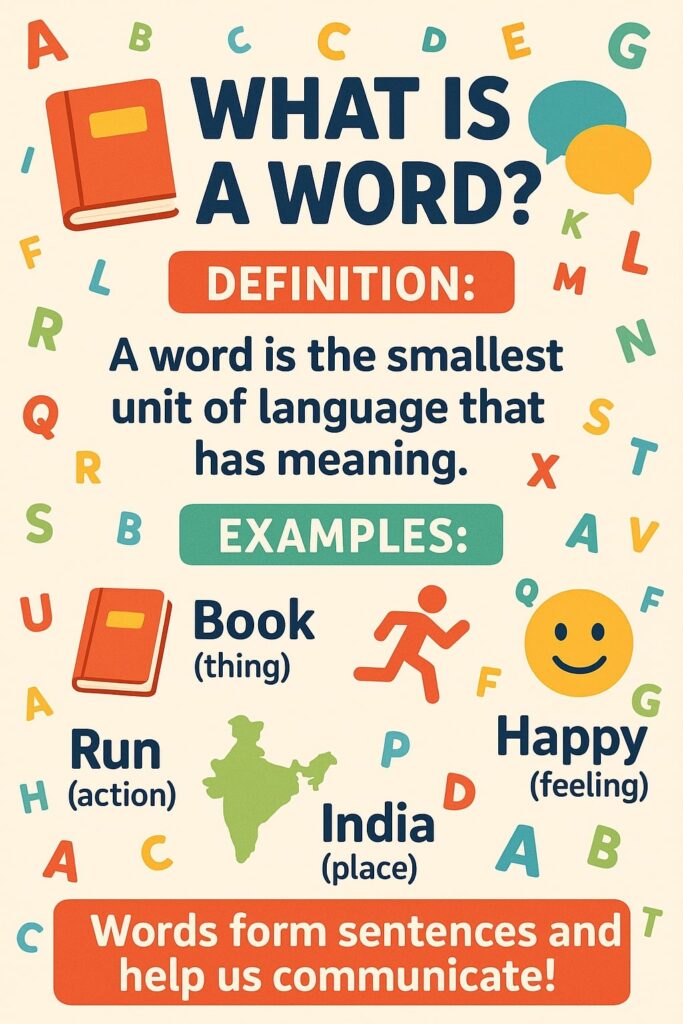
What is a Word?
A word is the smallest unit of language that has meaning and can be spoken or written.
Words are made up of letters and are used to form sentences.
Each word usually represents an object, action, idea, or description.
Sentence Vs. Phrase
1. Phrase
A phrase is a group of words that work together but do not have a subject and a verb. or A phrase is a group of words that gives some meaning but not a complete sense.
It cannot express a complete thought.
Example:
In the garden
Running fast
A beautiful girl
👉 These groups of words make sense but they do not form a complete idea.
2. Sentence
A sentence is a group of words that has a subject and a verb and expresses a complete thought.
Example:
She is reading a book.
The sun rises in the east.
I like playing cricket.
👉 Every sentence begins with a capital letter and ends with a full stop (.), question mark (?), or exclamation mark (!).
✅ Key Difference:
Phrase = incomplete thought (no subject + verb)
Sentence = complete thought (subject + verb)

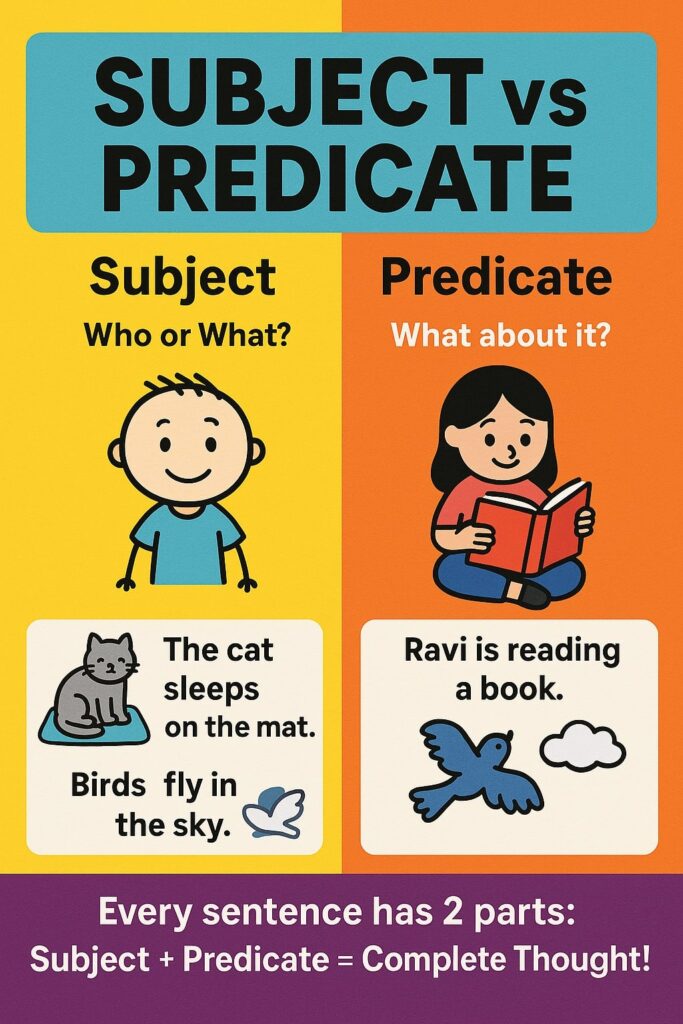
Subject vs Predicate
1. Subject
The subject is the part of the sentence that tells us who or what the sentence is about.
Usually a noun, pronoun, or noun phrase.
👉 Example:Ravi plays cricket.
The big dog barked loudly.
Here, “Ravi” and “The big dog” are subjects.
2. Predicate
The predicate is the part of the sentence that tells us something about the subject.
It always contains a verb and may include objects, complements, or modifiers.
👉 Example:Ravi plays cricket.
The big dog barked loudly.
Here, “plays cricket” and “barked loudly” are predicates.
3. Subject + Predicate Together
Every complete sentence is made up of two main parts:
Subject + Predicate
👉 Example:Birds (Subject) fly in the sky (Predicate).
The teacher (Subject) is explaining the lesson (Predicate).
🔑 Quick Tip:
Subject = “Who or what?”
Predicate = “What about it?”
What is an Object?
In English Grammar, an object is the word or group of words that receives the action of a verb.
In simple terms — the object is the “doer’s target” — the person or thing that something is done to.
💡 Example:
👉 Ravi eats an apple.
Subject: Ravi (who does the action)
Verb: eats
Object: an apple (what Ravi eats — receives the action)
🧩 Types of Objects:
1. Direct Object
It receives the action of the verb directly.
Example: She wrote a letter.
(“Letter” receives the action of writing.)
2. Indirect Object
It shows to whom or for whom the action is done.
Example: She gave Ravi a gift.
(“Ravi” is the indirect object — the receiver of the gift.)
(“Gift” is the direct object — the thing given.)
3. Object of a Preposition
It comes after a preposition in a sentence.
Example: She sat on the chair.
(“Chair” is the object of the preposition “on.”)
✅ Quick Summary:
| Type | Function | Example |
|---|---|---|
| Direct Object | Receives action of the verb | He bought a car. |
| Indirect Object | Tells to/for whom the action is done | He gave me a gift. |
| Object of Preposition | Follows a preposition | She looked at the sky. |
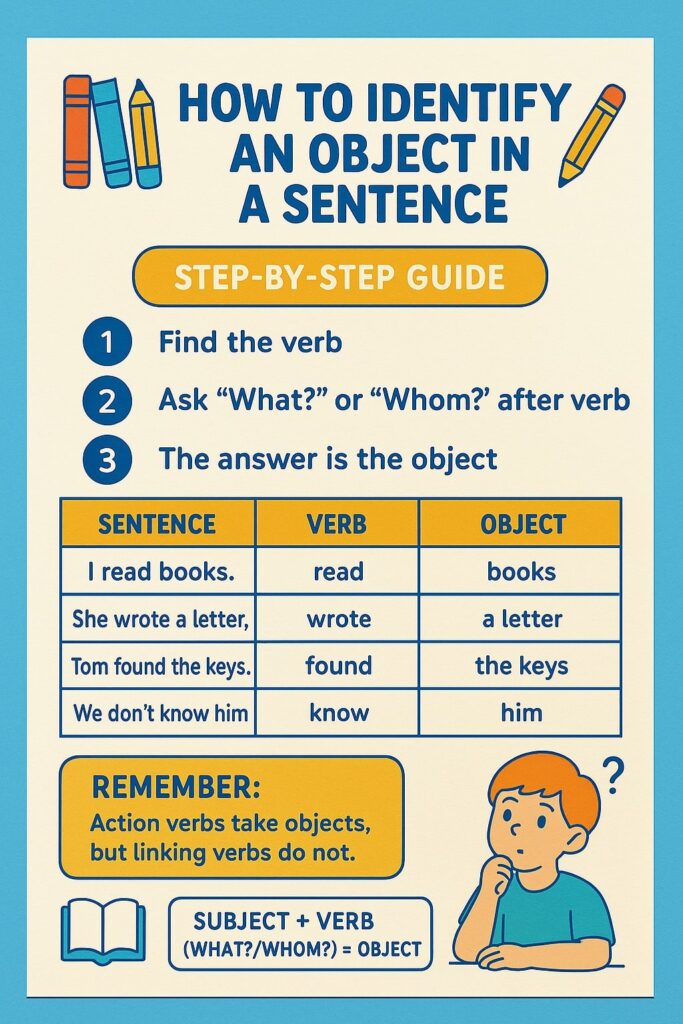
🎯 How to Identify an Object in a Sentence
🪄 Step-by-Step Trick:
Find the Verb – What is the action?
Ask “What?” or “Whom?” after the verb
→ The answer is usually the object.
✨ Examples:
| Sentence | Verb | Ask “What/Whom?” | Object |
|---|---|---|---|
| He reads a book. | reads | reads what? → a book | ✅ book |
| She helped her friend. | helped | helped whom? → her friend | ✅ friend |
| They built a bridge. | built | built what? → a bridge | ✅ bridge |
| I gave Ravi a pen. | gave | gave whom? → Ravi → (Indirect Object) gave what? → a pen → (Direct Object) | ✅ Ravi, pen |
| The cat sat on the mat. | sat | sat on what? → on the mat | ✅ mat (object of preposition) |
💡 Remember:
Action verbs (like eat, buy, make, write) often have objects.
Linking verbs (like am, is, are, seem, become) don’t take objects — they link to a complement instead.
Example:
He is a teacher. → (“teacher” is not an object; it’s a complement.)
🧠 Quick Formula:
👉 Subject + Verb + (What?/Whom?) = Object
What are Parts of Speech?
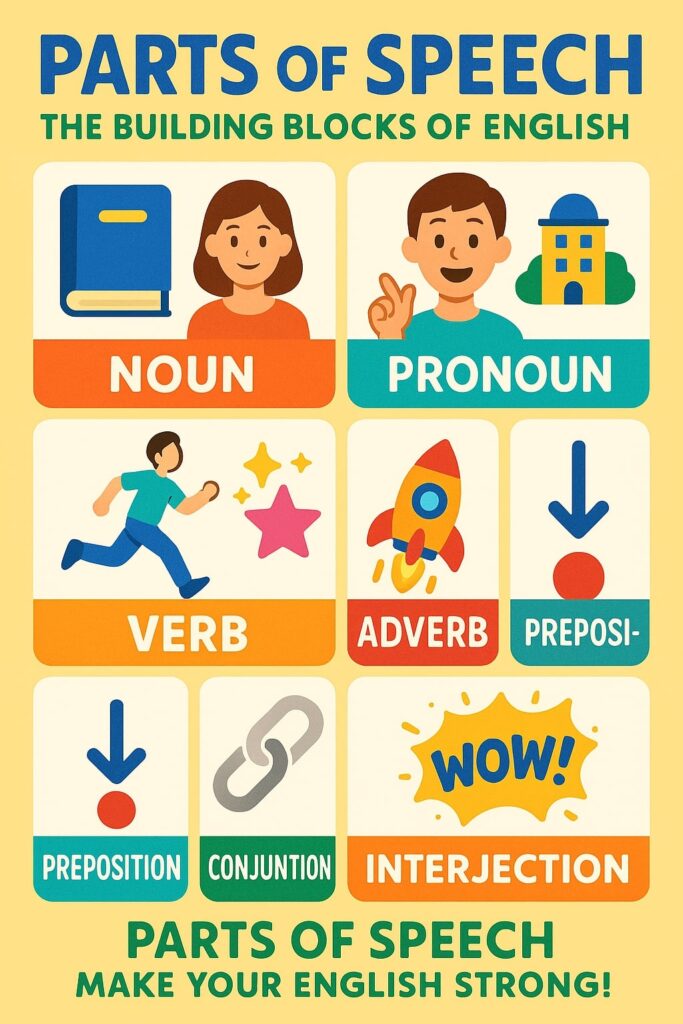
🌟 What are Parts of Speech?
In English grammar, Parts of Speech are the basic types of words that make up sentences. They show how each word functions in a sentence – whether it names something, shows action, describes, or connects.
Think of them like the building blocks of a language.
📝 The 8 Main Parts of Speech:
Noun – Names a person, place, thing, or idea.
Example: Ramesh, school, book, happinessPronoun – Replaces a noun.
Example: he, she, it, theyVerb – Shows action or state of being.
Example: run, eat, is, playAdjective – Describes a noun or pronoun.
Example: big, red, smart, beautifulAdverb – Describes a verb, adjective, or another adverb. (Usually answers: how, when, where, how much)
Example: quickly, very, yesterday, outsidePreposition – Shows relationship between a noun/pronoun and another word.
Example: in, on, under, betweenConjunction – Joins words or sentences.
Example: and, but, or, becauseInterjection – Shows sudden feeling or emotion.
Example: Oh!, Wow!, Hurray!
👉 In short: Parts of Speech are like the roles actors play in a movie – each has a different job, but together they make the story complete.
What is a Noun?
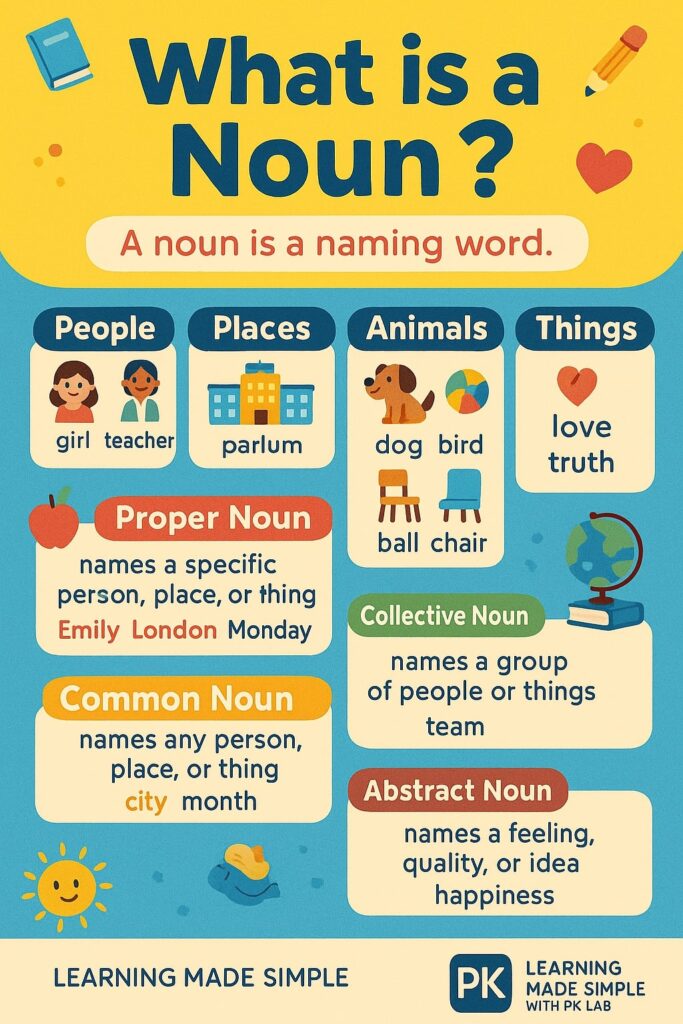
A Noun is a naming word.
It is the name of a person, place, animal, thing, or idea.
✅ Examples:
Person: Ramesh, Teacher, Doctor
Place: School, Cuttack, India
Animal: Dog, Cow, Tiger
Thing: Book, Chair, Pen
Idea: Honesty, Happiness, Love
🧩 Types of Nouns
Proper Noun – The specific name of a person, place, or thing.
👉 Example: Smrutirupa, Cuttack, India, MondayCommon Noun – The general name for people, places, or things.
👉 Example: Girl, City, Country, DayCollective Noun – The name of a group of people, animals, or things.
👉 Example: Team, Class, Herd, BunchMaterial Noun – The name of a substance or material things are made of.
👉 Example: Gold, Water, Wood, IronAbstract Noun – The name of an idea, feeling, or quality (something you cannot touch or see).
👉 Example: Kindness, Joy, Wisdom, BeautyCountable Noun – Things you can count.
👉 Example: Apple, Book, ChairUncountable Noun – Things you cannot count.
👉 Example: Milk, Sugar, Air, Rice
🌈 In short:
👉 A Noun is a naming word.
It tells who, what, or where.
What is a Pronoun?
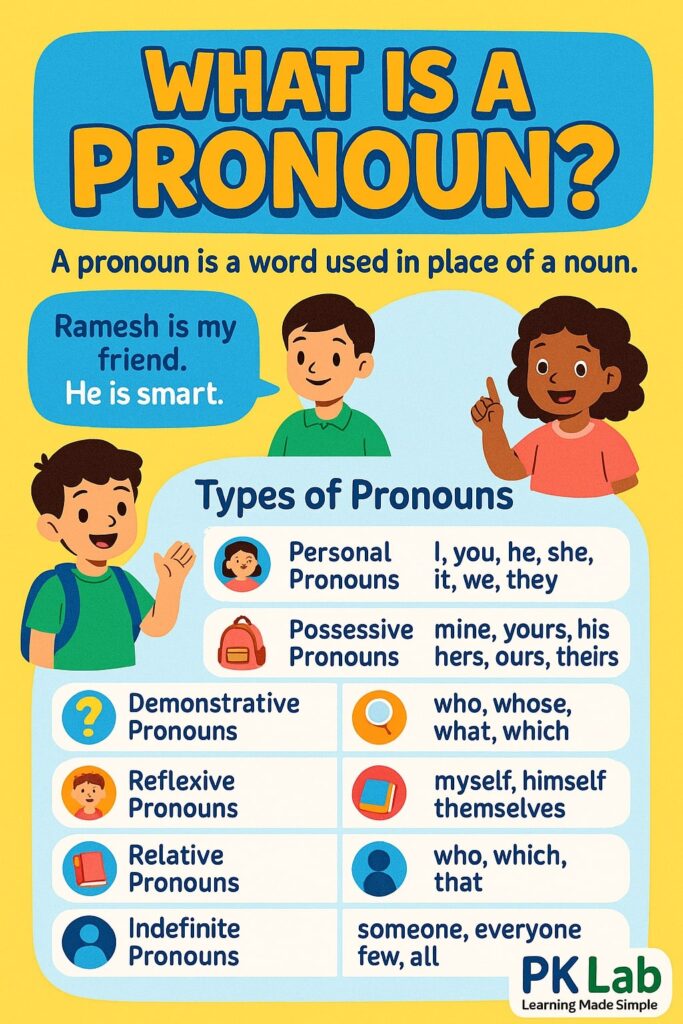
A Pronoun is a word that we use in place of a Noun to avoid repeating the same noun again and again.
✅ In short:
A pronoun replaces a name (noun).
🧩 Examples:
Ramesh is my friend. He is very smart.
👉 Here, He is a pronoun used instead of “Ramesh.”The book is on the table. It is new.
👉 It replaces “book.”
🗂️ Types of Pronouns:
Personal Pronouns – Used for people or things.
👉 I, You, He, She, It, We, TheyPossessive Pronouns – Show ownership or possession.
👉 Mine, Yours, His, Hers, Ours, TheirsDemonstrative Pronouns – Point to something.
👉 This, That, These, ThoseInterrogative Pronouns – Used to ask questions.
👉 Who, Whom, Whose, Which, WhatReflexive Pronouns – Refer back to the subject.
👉 Myself, Yourself, Himself, Herself, Itself, Ourselves, ThemselvesRelative Pronouns – Connect two sentences or clauses.
👉 Who, Whom, Whose, Which, ThatIndefinite Pronouns – Refer to people or things in general.
👉 Someone, Everyone, Anybody, Nothing, All, Few
🌈 Remember:
A Noun names, and a Pronoun replaces that name.
What is an Adjective?
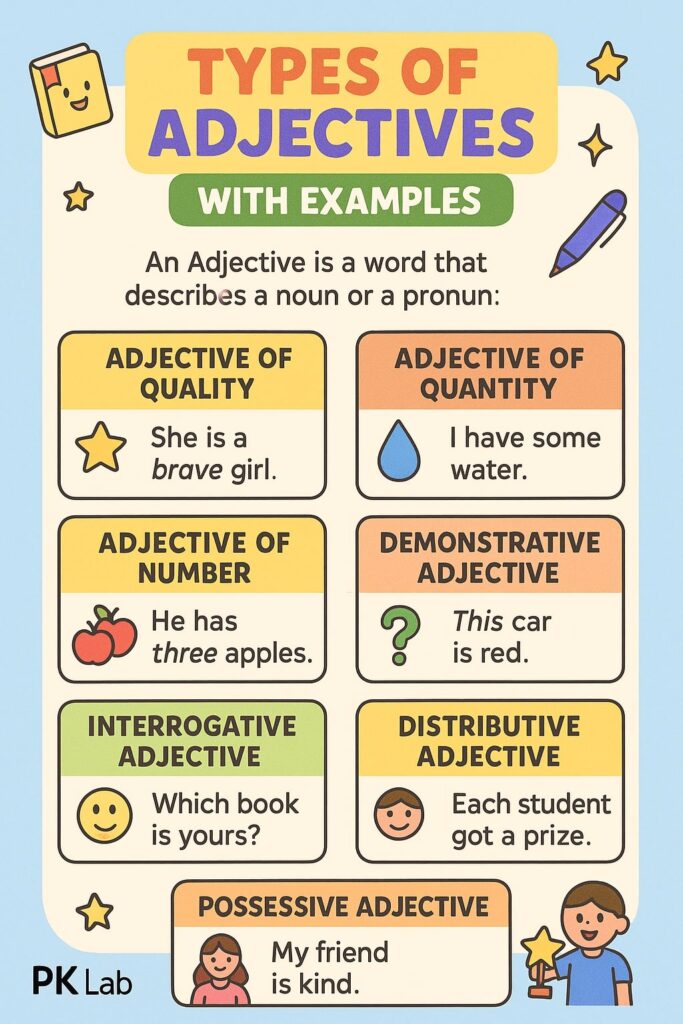
An Adjective is a word that describes a noun or a pronoun.
It tells us how someone or something is — like its quality, quantity, color, size, number, or type.
👉 In simple words:
An adjective tells us more about a person, place, animal, or thing.
🧩 Examples:
Rani is a beautiful girl. 👧
(“Beautiful” describes Rani — it’s an adjective.)This is a big house. 🏠
He has five apples. 🍎
The sky is blue. 🌤️
🧩 Types of Adjectives with Examples
| Type of Adjective | What It Tells | Examples |
|---|---|---|
| 1. Adjective of Quality | Tells what kind of person or thing | She is a brave girl. It’s a beautiful park. |
| 2. Adjective of Quantity | Tells how much (not countable) | I have some rice. There is little milk in the cup. |
| 3. Adjective of Number | Tells how many or in what order | He has three pens. This is my first car. |
| 4. Demonstrative Adjective | Points out a person or thing | This book is mine. Those apples are fresh. |
| 5. Interrogative Adjective | Used to ask questions | Which color do you like? Whose bag is this? |
| 6. Possessive Adjective | Shows ownership | My dog is friendly. Their school is big. |
| 7. Distributive Adjective | Refers to each or every one in a group | Each student got a gift. Every child must learn. |
What is an Adverb?
🌟 What is an Adverb?
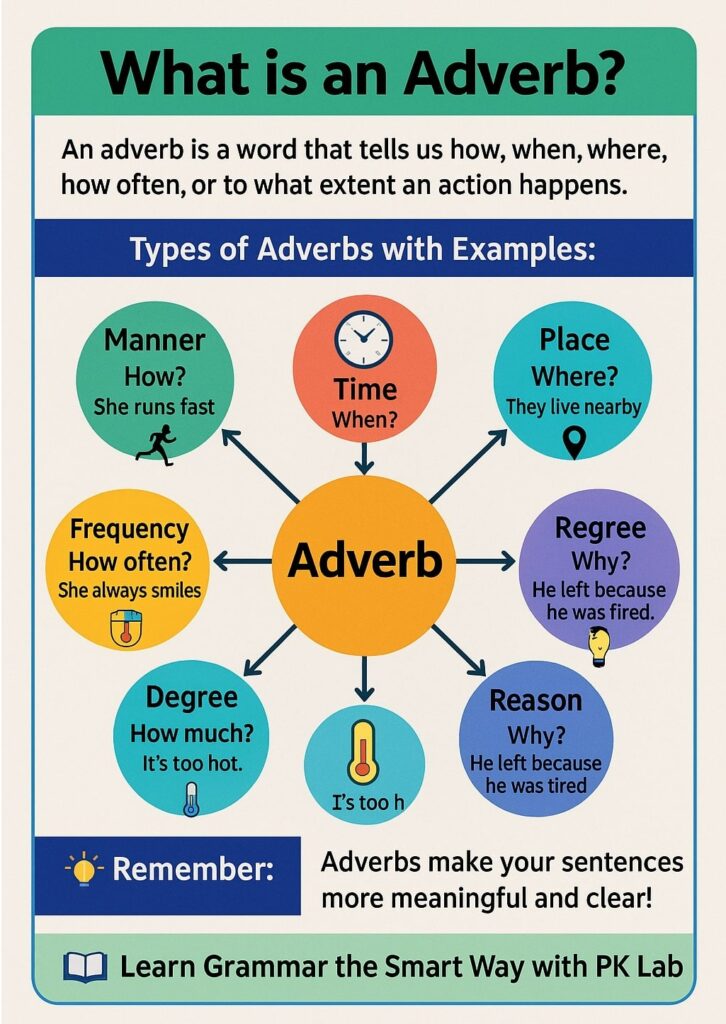
An adverb is a word that describes or adds more meaning to a verb, adjective, or another adverb.
It tells us how, when, where, or to what extent something happens.
🔹 Example:
She runs quickly. → (“quickly” tells how she runs)
He came yesterday. → (“yesterday” tells when he came)
The cat is sitting outside. → (“outside” tells where it is sitting)
She is very tall. → (“very” adds meaning to the adjective “tall”)
🧩 Types of Adverbs (in Simple Language)
Adverb of Manner – tells how something happens.
👉 Example: She sings beautifully.Adverb of Time – tells when something happens.
👉 Example: I will call you tomorrow.Adverb of Place – tells where something happens.
👉 Example: They are playing outside.Adverb of Frequency – tells how often something happens.
👉 Example: He always wakes up early.Adverb of Degree – tells how much or to what extent.
👉 Example: It is too hot today.Adverb of Reason – tells why something happens.
👉 Example: He was late because of traffic.
🏁 Summary:
| Type | Tells us | Example |
|---|---|---|
| Manner | How | She dances gracefully. |
| Time | When | He came early. |
| Place | Where | The dog sleeps here. |
| Frequency | How often | I sometimes read at night. |
| Degree | How much | It’s very cold. |
| Reason | Why | He left because he was tired. |
What is a Preposition?
What is a Preposition?
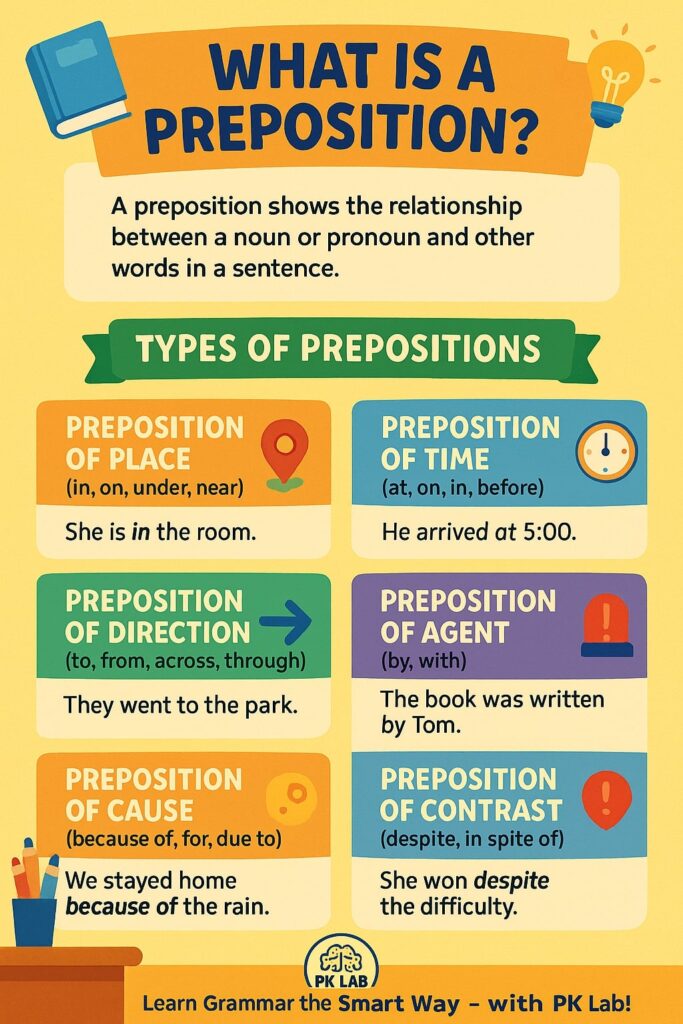
A Preposition is a word that shows the relationship between a noun or pronoun and other words in a sentence.
It tells us where, when, or how something happens.
👉 In simple words:
A preposition shows the position, place, time, or direction of something.
💡 Examples:
The book is on the table.
She is sitting under the tree.
The cat jumped over the wall.
He will come at 5 o’clock.
🧩 Types of Prepositions (in Simple Language):
Preposition of Place – Tells where something is.
🏠 Examples: in, on, under, near, between, behind, beside
➤ The cat is under the chair.Preposition of Time – Tells when something happens.
🕒 Examples: at, on, in, before, after, during
➤ We go to school in the morning.Preposition of Direction / Movement – Tells where something is going.
🚗 Examples: to, into, towards, across, through, from
➤ He is going to the park.Preposition of Agent / Instrument – Shows who or what does the action.
🧰 Examples: by, with
➤ The letter was written by Riya.
➤ He cut the apple with a knife.Preposition of Cause / Reason / Purpose – Shows why something happens.
🌦️ Examples: for, from, because of, due to
➤ She was late because of the rain.Preposition of Condition / Contrast – Shows a contrast or condition.
⚖️ Examples: despite, in spite of, according to
➤ In spite of the rain, we went out.
🌈 Easy Trick to Remember:
Preposition = Pre + Position → a word that tells the position or relation of something in a sentence.
What is a Conjunction?
🌈 What is a Conjunction?
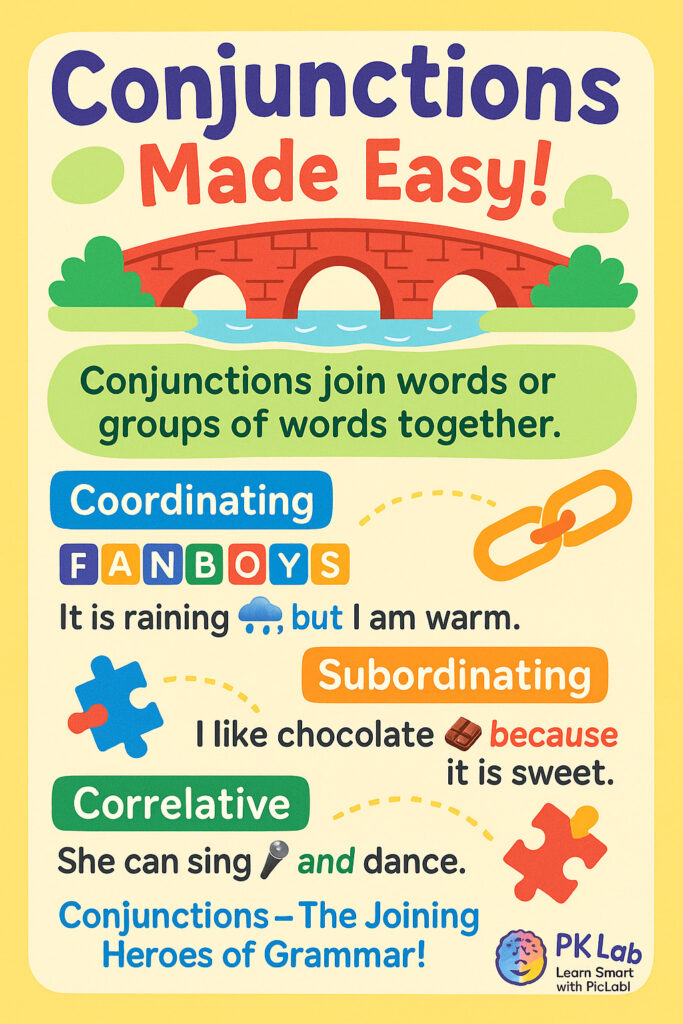
A conjunction is a joining word.
It helps to connect words, phrases, or sentences together — just like glue! 🧩
Example:
I like tea and coffee.
Here, the word “and” joins two things — tea and coffee.
So, conjunctions make our sentences smoother and more meaningful!
💡 Types of Conjunctions
There are three main types of conjunctions:
1. Coordinating Conjunctions
These conjunctions join two equal parts — like two words or two sentences that are similar in importance.
The easiest way to remember them is the word FANBOYS:
For, And, Nor, But, Or, Yet, So
Examples:
I wanted to play, but it started raining. ☔
You can have ice cream or chocolate. 🍦🍫
She is smart and hardworking. 💪
2. Subordinating Conjunctions
These conjunctions join a main sentence with a dependent (smaller) sentence.
They show cause, time, condition, or reason.
Common words: because, although, if, when, since, until, unless, while
Examples:
I stayed home because it was raining. 🌧️
When the bell rings, we will go home. 🏫
You can’t go out unless you finish your homework. 📚
3. Correlative Conjunctions
These are pairs of words that work together to join parts of a sentence.
Common pairs:
either…or, neither…nor, both…and, not only…but also
Examples:
Either Riya or Tiya will sing today. 🎤
Both my parents and my teachers are proud of me. 🥰
Not only did he study well, but also helped his friends. 🙌
🎯 Quick Recap:
| Type | What It Does | Example |
|---|---|---|
| Coordinating | Joins equal parts | I like apples and mangoes. |
| Subordinating | Joins a main and a smaller sentence | I slept because I was tired. |
| Correlative | Joins using pairs | Either you come or I’ll go alone. |
🌟 Fun Tip:
You can think of conjunctions as bridges 🪄 — they connect one idea to another, making your sentences strong and complete!
What is an Interjection?
What is an Interjection?
Hey! Wow! Oops! — Have you ever said words like these when you were surprised, happy, or hurt?
These words are called Interjections.
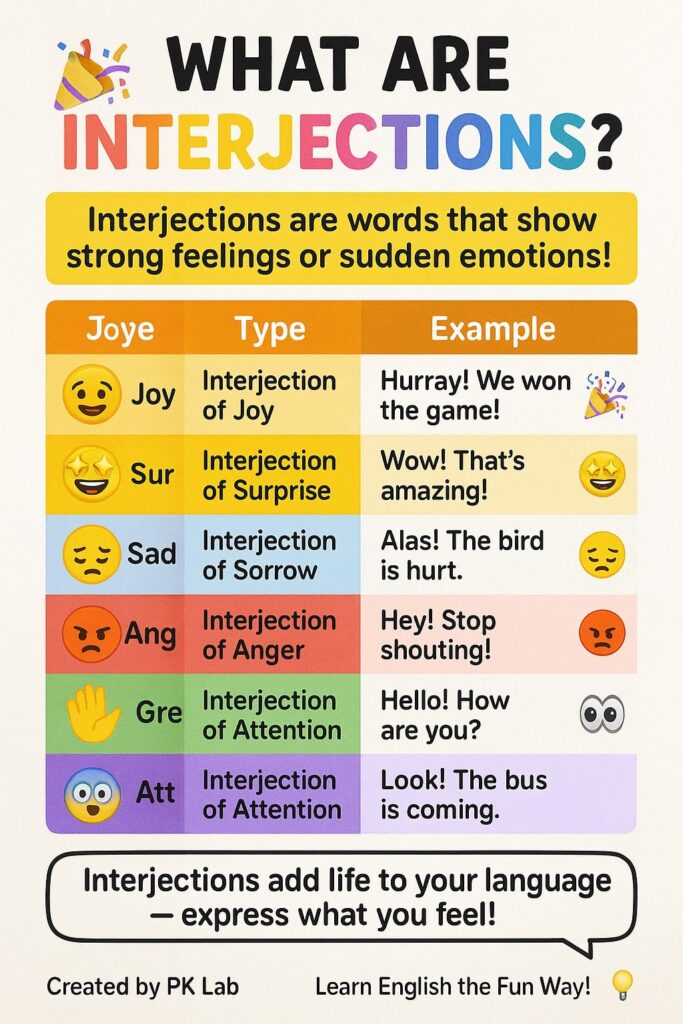
👉 Interjections are words we use to express strong feelings or sudden emotions — like joy, surprise, anger, or pain.
They usually come at the beginning of a sentence and are followed by an exclamation mark (!).
💬 Examples:
Wow! That’s a beautiful painting!
Oh no! I forgot my homework.
Hurray! We won the match!
Ouch! That hurts.
🎈 Types of Interjections with Examples
Let’s see the main types —
1. Interjection of Joy 😊
Used when we are happy or excited.
👉 Examples:
Hurray! We are going on a picnic.
Yippee! It’s my birthday today.
2. Interjection of Surprise 😲
Used when something unexpected happens.
👉 Examples:
Wow! You did a great job.
Oh! I didn’t see you there.
3. Interjection of Sorrow 😢
Used when we feel sad or upset.
👉 Examples:
Alas! The old man is no more.
Oh no! I broke my favorite toy.
4. Interjection of Anger 😡
Used when we are angry or annoyed.
👉 Examples:
Hey! Stop fighting.
Ugh! This is so irritating.
5. Interjection of Greeting 👋
Used to greet or meet someone.
👉 Examples:
Hello! How are you?
Hi! Nice to see you again.
6. Interjection of Attention 👀
Used to call someone’s attention.
👉 Examples:
Listen! The teacher is speaking.
Look! There’s a rainbow in the sky.
🌈 Quick Tip:
An interjection is like an emotional reaction in words!
They make our sentences more lively and expressive.
✨ Summary:
| Feeling/Emotion | Type of Interjection | Example |
|---|---|---|
| Happiness | Joy | Hurray! Yippee! |
| Surprise | Surprise | Wow! Oh! |
| Sadness | Sorrow | Alas! Oh no! |
| Anger | Anger | Hey! Ugh! |
| Greeting | Greeting | Hello! Hi! |
| Calling Attention | Attention | Listen! Look! |
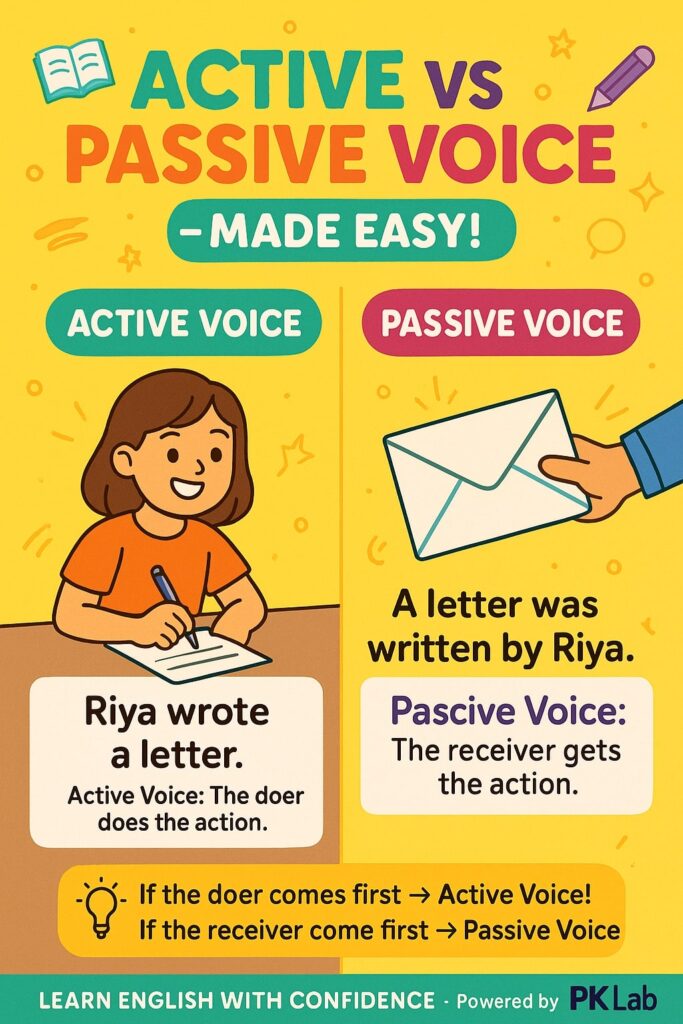
Active Voice or Passive Voice
🌟 What is Voice in English Grammar?
When we write or speak a sentence, we can say it in two ways — Active Voice or Passive Voice.
It all depends on who is doing the action and who is receiving the action.
💪 1. Active Voice
In Active Voice, the subject (the doer) performs the action.
This is the normal way we speak most of the time.
👉 Structure:
Subject + Verb + Object
Examples:
Riya (subject) wrote (verb) a letter (object).
The dog (subject) chased (verb) the cat (object).
Rahul (subject) kicked (verb) the ball (object).
🟢 In all these sentences, the doer (subject) is doing something directly.
✅ It’s clear and direct!
🕊️ 2. Passive Voice
In Passive Voice, the subject receives the action instead of doing it.
We use it when we want to focus on the action or the receiver of the action — not who did it.
👉 Structure:
Object + is/am/are/was/were + Past Participle (V3) + by + Subject
Examples:
A letter was written by Riya.
The cat was chased by the dog.
The ball was kicked by Rahul.
🟣 Here, the focus is on the object — the thing receiving the action.
✅ It sounds more formal and less direct.
🎯 How to Remember Easily:
Think of it like this:
| Active Voice | Passive Voice |
|---|---|
| The doer comes first. | The receiver comes first. |
| Riya wrote a letter. | A letter was written by Riya. |
| Clear and simple. | Polite or formal tone. |
💡 Fun Trick:
If your sentence starts with “Who did it?” → it’s Active Voice.
If it starts with “What happened?” → it’s Passive Voice.
✨ Quick Practice:
Change these to passive voice:
The teacher teaches English.
→ English is taught by the teacher.The boy painted the wall.
→ The wall was painted by the boy.
🗣️ In Short:
Active Voice: The subject does the action.
Passive Voice: The subject receives the action.