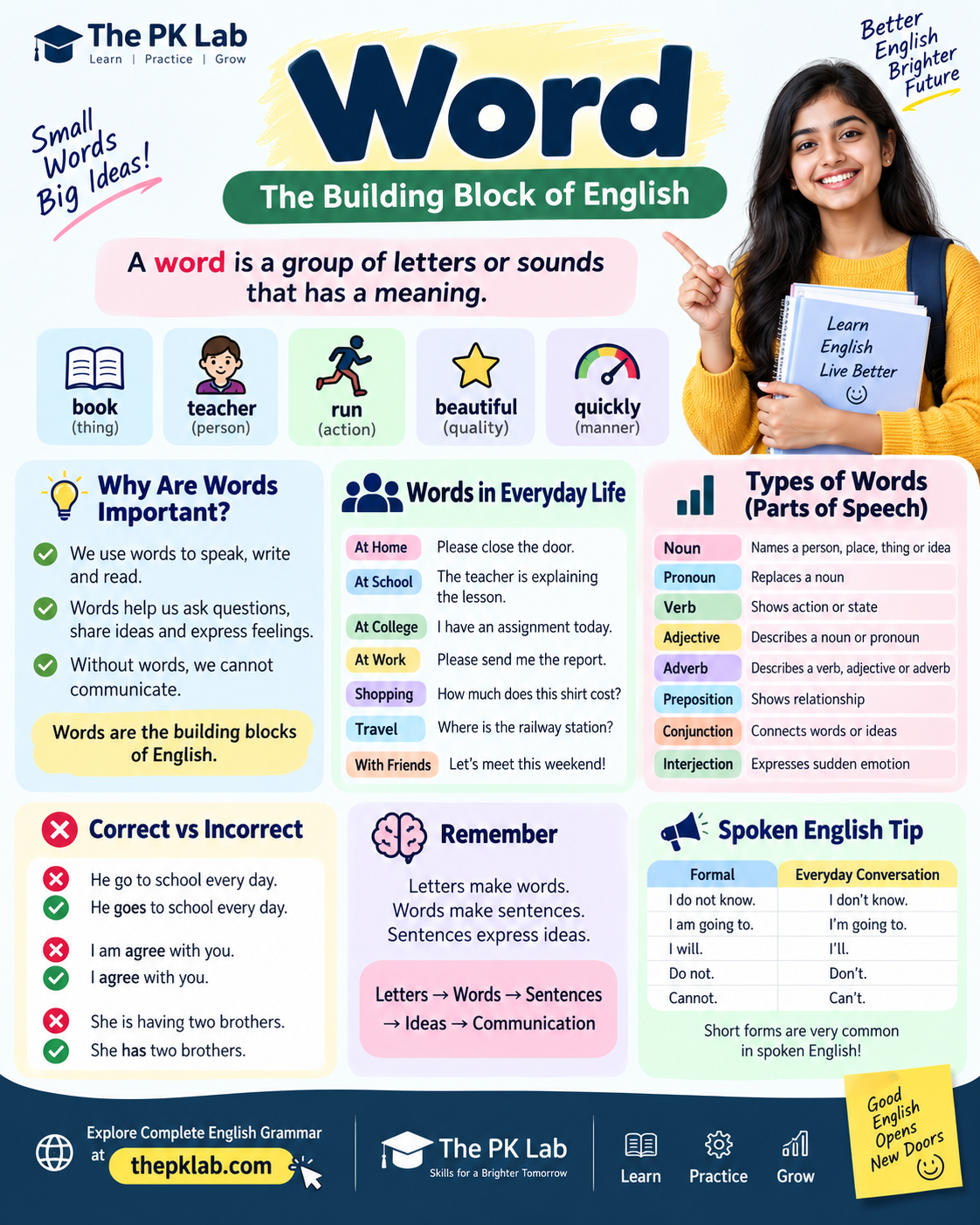
Word: Meaning, Types & Usage in English
A word is one of the smallest meaningful units we use to communicate in English.
Simply put:
A word is a group of letters or sounds that has a meaning.
For example:
- book → something we read
- teacher → a person who teaches
- run → to move quickly on foot
- beautiful → pleasing to look at
- quickly → at a fast speed
When we put words together in the right order, we can form phrases, sentences, and complete ideas.
1. What Is a Word?
A word is a meaningful unit of language that we use to express a person, place, thing, action, quality, feeling, idea, or relationship.
Easy Examples
| Word | What it tells us |
|---|---|
| Rahul | Person |
| Bhubaneswar | Place |
| Mobile | Thing |
| Run | Action |
| Happy | Feeling/quality |
| Quickly | Manner |
| Under | Position/relationship |
| And | Connection |
Remember
Letters make words. Words make sentences. Sentences express ideas.
For example:
Letters → W + O + R + D
Words → I + like + English.
Sentence → I like English.
2. Why Are Words Important?
Words are the building blocks of English.
Think of English like building a house:
Letters → Words → Phrases → Sentences → Paragraphs → Communication
Without words, we cannot:
- Speak
- Write
- Read
- Ask questions
- Express feelings
- Give information
- Communicate our ideas
Real-Life Example
Imagine you want to buy something from a shop.
You may say:
I want a bottle of water.
This sentence contains several words:
I + want + a + bottle + of + water
Each word contributes something to the meaning.
3. How Are Words Formed?
Words are generally made from letters in written English.
For example:
C + A + T = CAT
S + C + H + O + O + L = SCHOOL
F + R + I + E + N + D = FRIEND
However, a word is not simply a collection of letters. The letters must form a meaningful unit.
For example:
cat ✅ — meaningful word
tac ❌ — not normally an English word
4. Words Can Have Different Jobs
One of the most important things to understand is that words can perform different jobs in a sentence.
This leads us to the concept of Parts of Speech.
Example:
Rahul runs quickly.
- Rahul → Noun
- runs → Verb
- quickly → Adverb
Another example:
She is a beautiful girl.
- She → Pronoun
- is → Verb
- beautiful → Adjective
- girl → Noun
So, understanding words is the first step toward understanding English Grammar.
5. Main Types of Words
In English grammar, words are commonly classified according to their function.
The major Parts of Speech are:
| Part of Speech | Main Function | Example |
|---|---|---|
| Noun | Names a person, place, thing, or idea | teacher, Odisha, book |
| Pronoun | Replaces a noun | he, she, it, they |
| Verb | Shows action or state | go, eat, is |
| Adjective | Describes a noun/pronoun | good, tall, beautiful |
| Adverb | Describes a verb, adjective, or adverb | slowly, very, quickly |
| Preposition | Shows relationship | in, on, under, beside |
| Conjunction | Connects words or ideas | and, but, because |
| Interjection | Expresses sudden emotion | Wow!, Oh!, Hurrah! |
Example Sentence
Wow! Rahul quickly opened the new book on the table.
Several different types of words are working together to create meaning.
6. Words in Everyday English
We use thousands of words in our daily lives.
At Home
Please close the door.
At School
The teacher is explaining the lesson.
At College
I have an assignment today.
At Work
Please send me the report.
While Shopping
How much does this shirt cost?
While Travelling
Where is the railway station?
These sentences may look simple, but they are all created by putting words together in meaningful ways.
7. One Word Can Have Different Meanings
Some English words have more than one meaning depending on the context.
Example: “Bank”
I deposited money in the bank.
Here, bank means a financial institution.
But:
We sat near the bank of the river.
Here, bank means the land beside a river.
So, we should understand a word in context, not always in isolation.
8. One Word Can Have Different Forms
Many words can change their form.
For example:
play → plays → played → playing
Example:
- I play cricket.
- He plays cricket.
- They played cricket yesterday.
- We are playing cricket.
The basic word remains connected to the idea of play, but its form changes according to grammar and meaning.
9. Correct vs Incorrect Usage
Learning a word is not enough. We also need to learn how to use it correctly.
Example 1
❌ He go to school every day.
✅ He goes to school every day.
Example 2
❌ I am agree with you.
✅ I agree with you.
Example 3
❌ She is having two brothers.
For standard English, prefer:
✅ She has two brothers.
The important lesson is:
Learn words together with their natural usage.
10. Word vs Sentence
A word and a sentence are not the same.
Word
Beautiful
It has meaning, but it does not express a complete thought by itself.
Sentence
The garden is beautiful.
Now we have a complete idea.
Simple Comparison
Word: book
Phrase: a good book
Sentence: I bought a good book.
This progression is important:
Word → Phrase → Sentence
11. Common Mistakes Learners Make
Mistake 1: Learning only the meaning
For example, learning:
Depend = নির্ভর করা
But not learning how to use it.
Better:
It depends on the situation.
The learner should understand both meaning + usage.
Mistake 2: Translating word-by-word
Regional-language learners sometimes translate every word directly from their first language.
This can produce unnatural English.
Instead of translating every word, learn natural English expressions and sentence patterns.
Mistake 3: Using a word in the wrong context
A word may have several meanings or uses.
Therefore, always look at:
Meaning + Context + Grammar + Example
12. Spoken English Tip
In everyday conversation, English speakers often use short and natural expressions.
Formal
I do not understand what you are saying.
Natural conversation
I don’t understand what you’re saying.
Both are grammatically correct. The second is more common in casual conversation.
Similarly:
I am going to → I’m going to
I will → I’ll
Do not → Don’t
Cannot → Can’t
These shortened forms are called contractions and are very common in spoken English.
13. Quick Memory Trick
Remember:
Letters → Words → Sentences → Ideas → Communication
And remember:
A word has meaning, but its meaning and function can depend on the context in which it is used.
14. Practice Exercise
A. Identify the words
Identify the individual words in this sentence:
My brother plays cricket every evening.
How many words are there?
B. Identify the type of word
Identify the Parts of Speech of the highlighted words:
- Riya is my friend.
- He runs every morning.
- She is beautiful.
- He speaks slowly.
- The book is on the table.
C. Complete the sentences
Choose a suitable word:
- I ___ to college every day.
- She ___ a beautiful dress.
- Please ___ the door.
- He speaks English ___.
- The book is ___ the table.
15. Answers
A.
My | brother | plays | cricket | every | evening
There are 6 words.
B.
- Riya → Noun
- runs → Verb
- beautiful → Adjective
- slowly → Adverb
- on → Preposition
C.
Possible answers:
- I go to college every day.
- She has a beautiful dress.
- Please close the door.
- He speaks English slowly.
- The book is on the table.
16. FAQs About Words
What is a word in English?
A word is a meaningful unit of language used to communicate an idea, object, action, quality, feeling, or relationship.
What is the difference between a letter and a word?
A letter is a single written symbol, such as A or B. A word is made from one or more letters and carries meaning, such as book.
How are words used in grammar?
Words perform different functions in sentences. These functions are classified into Parts of Speech such as nouns, pronouns, verbs, adjectives, and adverbs.
Can one word have multiple meanings?
Yes. The meaning of a word can change according to its context.
What should I learn after Words?
After understanding Words, the recommended learning sequence is:
Words → Parts of Speech → Noun → Pronoun → Verb → Adjective → Adverb → Preposition → Conjunction → Sentence Formation