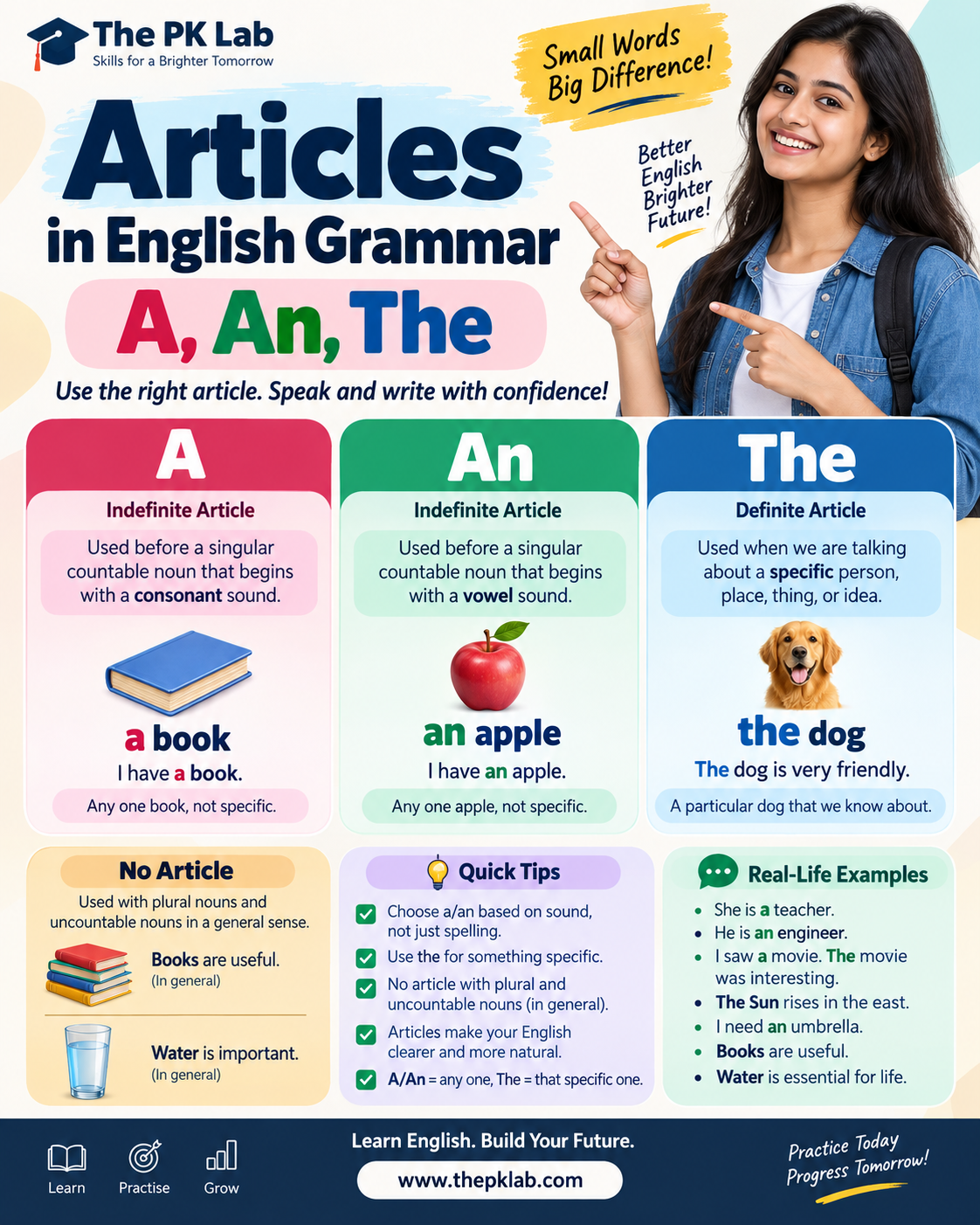
1. What Are Articles?
Articles are small words used before nouns to tell us whether we are talking about something general or something specific.
English has three articles:
- A
- An
- The
Simple Example
- I saw a dog. → Any dog; not a specific dog.
- I saw an elephant. → Any elephant; not a specific elephant.
- The dog was very friendly. → A particular dog that we already know about.
Think of articles as small words that help us understand the noun more clearly.
2. Why Are Articles Important?
Articles make our English clearer and more natural.
Compare:
I bought book. ❌
I bought a book. ✅
The second sentence sounds complete because English usually needs an appropriate determiner before a singular countable noun.
Articles are important in:
- Everyday conversation
- Writing
- School and college
- Interviews
- Workplace communication
- Presentations
- Formal writing
3. The Three Articles
| Article | Type | Example |
|---|---|---|
| A | Indefinite Article | a book |
| An | Indefinite Article | an apple |
| The | Definite Article | the book |
There is also an important concept called the Zero Article, where we use no article.
Example:
Books are useful.
Water is important.
4. Indefinite Articles: A and An
A and An are called indefinite articles.
We use them when we talk about one person, animal, place, or thing in a general or non-specific way.
A
Use a before a word that begins with a consonant sound.
Examples:
- a book
- a teacher
- a student
- a car
- a university
- a European country
An
Use an before a word that begins with a vowel sound.
Examples:
- an apple
- an elephant
- an umbrella
- an engineer
- an hour
- an honest person
Important Rule
Choose A or An according to the sound, not simply the first letter.
For example:
a university ✅
Although university begins with U, its sound is /juː/ (“you”), which begins with a consonant sound.
an hour ✅
Although hour begins with H, the H is silent, so the word begins with a vowel sound.
5. When Do We Use “A”?
Rule 1: One person or thing
I have a pen.
She bought a dress.
He is a teacher.
Rule 2: When mentioning something for the first time
I saw a man outside my office.
We don’t know which man yet.
Later:
The man was waiting for his friend.
Now we know which man we mean.
Rule 3: Jobs and professions
She is a doctor.
He is an engineer.
My brother is a teacher.
6. When Do We Use “An”?
Use an before a word beginning with a vowel sound.
an apple
an orange
an umbrella
an actor
an engineer
Special Examples
an hour
an honest man
an MBA
an MLA
Why?
Because we pronounce them with vowel sounds:
- an hour → “our”
- an honest → “onest”
- an MBA → “em-bee-ay”
7. The Definite Article: “The”
The is called the definite article.
We use the when we are talking about a specific person, place, animal, thing, or idea.
Example
I bought a phone yesterday.
Which phone? We don’t know yet.
The phone is very expensive.
Now we know which phone—the phone you bought yesterday.
8. Common Uses of “The”
1. Something already mentioned
I saw a dog.
The dog was barking.
2. Something specific
Please close the door.
We know which door is being discussed.
3. Unique things
the Sun
the Moon
the Earth
Example:
The Sun rises in the east.
4. Superlative forms
the best
the biggest
the most beautiful
the fastest
Example:
She is the best student in the class.
5. Ordinal numbers
the first
the second
the third
Example:
He came the first in the race.
6. Certain geographical names
the Himalayas
the Ganges
the Indian Ocean
the Arabian Sea
the Pacific Ocean
Example:
The Ganges is one of India’s major rivers.
9. A vs An vs The
| Situation | Article | Example |
|---|---|---|
| General, singular | A | I need a pen. |
| General, singular + vowel sound | An | I need an umbrella. |
| Specific | The | Give me the pen on the table. |
| Already mentioned | The | I saw a movie. The movie was excellent. |
| Unique | The | The Sun is shining. |
| Profession | A/An | He is a doctor. |
| Superlative | The | She is the best player. |
10. When Do We Use No Article?
Sometimes we don’t use a, an, or the.
This is called the Zero Article.
General plural nouns
Books are useful.
Students need practice.
Here, we are talking about books and students in general.
Uncountable nouns in a general sense
Water is essential for life.
Knowledge is powerful.
Education is important.
But when we mean something specific, we can use the:
The water in this bottle is cold.
11. Countable and Uncountable Nouns
This is important for understanding articles.
Countable
Things we can count:
- one book
- two books
- three books
We can say:
a book
an apple
the book
Uncountable
Things we don’t normally count individually:
- water
- milk
- information
- advice
- knowledge
We generally don’t say:
an information ❌
an advice ❌
Instead:
some information ✅
some advice ✅
a piece of information ✅
a piece of advice ✅
12. Correct vs Incorrect
| ❌ Incorrect | ✅ Correct |
|---|---|
| I bought book. | I bought a book. |
| He is a engineer. | He is an engineer. |
| She is an teacher. | She is a teacher. |
| Give me a water. | Give me some water. |
| I have an university nearby. | I have a university nearby. |
| I saw a dog. The dog was friendly. | ✅ Correct |
| Sun is hot. | The Sun is hot. |
13. Common Mistakes by English Learners
Mistake 1: Using “an” before every word beginning with a vowel letter
an university ❌
a university ✅
Remember: sound matters more than spelling.
Mistake 2: Forgetting the article
He is doctor. ❌
He is a doctor. ✅
Mistake 3: Using “the” unnecessarily
The honesty is important. ❌
Honesty is important. ✅
When speaking generally about an abstract idea, we often don’t need an article.
Mistake 4: Using “a/an” with uncountable nouns
an advice ❌
some advice ✅
an information ❌
some information ✅
14. Articles in Spoken English
In everyday conversation, articles are usually spoken quickly and naturally.
Formal
I do not have a car.
Natural conversation
I don’t have a car.
The article a remains important even though it is pronounced very lightly.
Another example:
I’m looking for a job.
I need an umbrella.
Where is the station?
Articles may be small, but they play an important role in making spoken English sound natural.
15. Easy Memory Trick
Remember:
A = Any One
a book = any one book
AN = Any One + Vowel Sound
an apple = any one apple
THE = That Specific One
the book = that particular book
NO ARTICLE = General Idea
Books are useful.
16. Practice Exercise
Fill in the blanks with a, an, the, or no article (—).
- I saw ___ elephant at the zoo.
- She is ___ teacher.
- He bought ___ new mobile phone.
- ___ Sun rises in the east.
- I need ___ umbrella.
- I saw ___ movie yesterday. ___ movie was interesting.
- ___ water is essential for life.
- He is ___ honest person.
- She studies at ___ university.
- ___ books are useful for learning.
Answers
- an
- a
- a
- the
- an
- a, the
- —
- an
- a
- —
17. Quick Revision
A → one, non-specific noun + consonant sound
a book, a car, a student
An → one, non-specific noun + vowel sound
an apple, an engineer, an hour
The → specific or already-known noun
the book, the teacher, the Sun
No Article → general plural or uncountable nouns
Books are useful.
Water is important.
The Golden Rule
A/An = one but not specific
The = specific
No article = general idea
18. Frequently Asked Questions
Is “A” used before vowels?
Not necessarily. A is used before a consonant sound.
a university ✅
Is “An” used before every word beginning with a vowel?
No. It depends on the sound.
an hour ✅
a university ✅
Can we use “a” with plural nouns?
No.
a books ❌
a book ✅
Can we use “a/an” with uncountable nouns?
Normally, no.
an information ❌
some information ✅
Why is it “the Sun”?
Because the Sun is treated as a unique object in our context.
Rules for Using “The”
1. For something specific
Use the when we are talking about a particular person or thing.
- Please close the door.
- Where is the book I gave you?
2. When something has already been mentioned
Use the when a noun is mentioned for the second time.
- I saw a dog.
- The dog was very friendly.
3. For unique things
Use the for things that are considered unique.
- the Sun
- the Moon
- the Earth
- the sky
- the world
4. For superlative adjectives
Use the before superlatives.
- the best student
- the tallest building
- the most beautiful place
5. With ordinal numbers
Use the before ordinal numbers.
- the first chapter
- the second floor
- the third student
6. With rivers
Use the before the names of rivers.
- the Ganges
- the Mahanadi
- the Nile
- the Amazon
7. With seas and oceans
Use the before seas and oceans.
- the Indian Ocean
- the Arabian Sea
- the Pacific Ocean
8. With mountain ranges
Use the before mountain ranges.
- the Himalayas
- the Alps
- the Rocky Mountains
But usually not with individual mountains:
- Mount Everest ✅
- the Mount Everest ❌
9. With groups of islands
Use the with groups or chains of islands.
- the Andaman and Nicobar Islands
- the Maldives
- the Philippines
10. With deserts
Use the before the names of deserts.
- the Sahara Desert
- the Thar Desert
- the Gobi Desert
11. With directions
Use the when referring to geographical directions or regions.
- the north
- the south
- the east
- the west
Example:
Odisha is in the eastern part of India.
12. With certain geographical regions
Use the with some regions.
- the Middle East
- the Arctic
- the Equator
13. With names of some countries
Use the when the country name contains words such as Kingdom, States, Republic, or is plural.
- the United States
- the United Kingdom
- the United Arab Emirates
- the Netherlands
- the Philippines
But:
- India ✅
- Odisha ✅
- Japan ✅
14. With newspapers
Traditionally, the is used with many newspaper names.
- The Times of India
- The Hindu
- The New York Times
15. With famous buildings, monuments, and institutions
Many established names take the.
- the Taj Mahal
- the Eiffel Tower
- the Red Fort
16. With musical instruments
Use the when talking about playing a musical instrument in the general sense.
- She plays the piano.
- He plays the guitar.
- My brother plays the tabla.
17. With inventions or species in a general sense
The + singular noun can sometimes represent a whole class or species.
- The smartphone has changed communication.
- The tiger is an endangered animal.
However, plural forms are often more natural in modern English:
Tigers are endangered animals.
18. With a specific adjective + noun
Use the when the adjective identifies a particular group or category.
- the rich
- the poor
- the elderly
- the unemployed
Example:
The government should support the unemployed.
19. With a family name referring to the whole family
Use the + plural family name.
- the Sharmas
- the Patels
- the Smiths
Example:
The Patels live next door.
20. With a particular place or object known to both people
Use the when both speaker and listener know what is being discussed.
Let’s meet at the station.
Please switch off the fan.
⭐ Easy Rule to Remember
“The” = We know exactly which one we mean.
A book → any one book
The book → a particular book
A teacher → any teacher
The teacher → a particular teacher