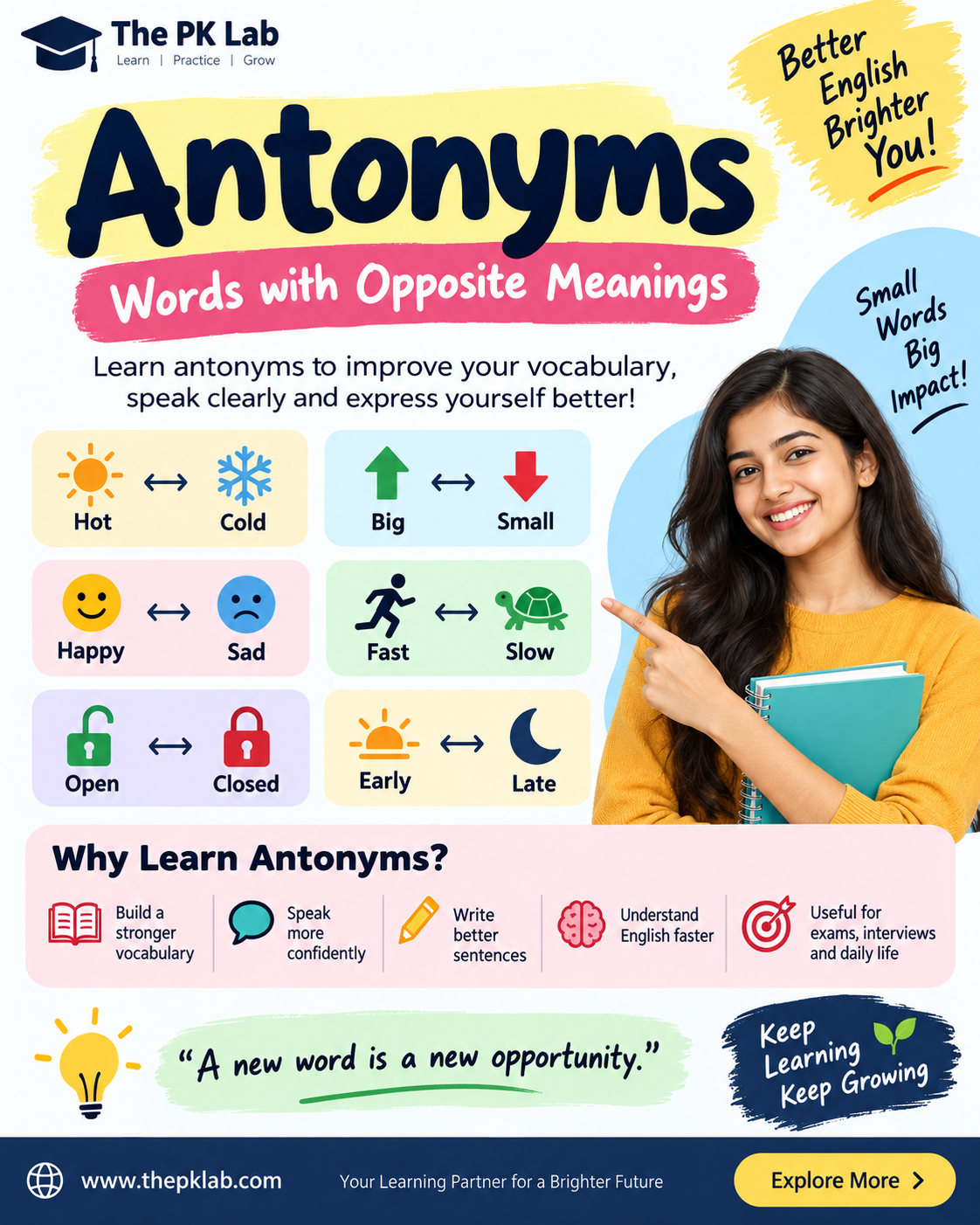
1. What are Antonyms?
Antonyms are words that have opposite or nearly opposite meanings.
Simply put:
An antonym is a word that means the opposite of another word.
Easy Examples
| Word | Antonym |
|---|---|
| Hot | Cold |
| Big | Small |
| Happy | Sad |
| Fast | Slow |
| Easy | Difficult |
| Early | Late |
| Rich | Poor |
| Old | Young |
| Open | Closed |
| Near | Far |
For example:
- The tea is hot. → The water is cold.
- Rahul is happy. → Rahul is sad.
- This bag is heavy. → This bag is light.
2. Why are Antonyms Important?
Learning antonyms helps you:
- Improve your vocabulary
- Understand words more quickly
- Speak English more confidently
- Write better sentences
- Avoid repeating the same words
- Understand conversations and reading passages
- Perform better in school and college exams
- Prepare for competitive examinations
- Improve your spoken and professional English
For example, instead of learning only “increase”, learning its opposite “decrease” helps you understand both ideas.
3. Common Types of Antonyms
Not all opposite words work in exactly the same way. Here are some useful types.
A. Gradable Antonyms
These describe opposite ends of a scale. There can be different degrees between them.
Examples:
- Hot ↔ Cold
- Big ↔ Small
- Rich ↔ Poor
- Fast ↔ Slow
- Easy ↔ Difficult
There can be something between the two:
Hot → Warm → Cool → Cold
Example:
The room is hot.
The room is cold.
B. Complementary Antonyms
These represent two opposite conditions where one generally excludes the other.
Examples:
- Alive ↔ Dead
- True ↔ False
- Present ↔ Absent
- Legal ↔ Illegal
- On ↔ Off
Example:
The light is on.
The light is off.
C. Relational Antonyms
These words describe opposite relationships. One relationship usually depends on the other.
Examples:
- Buy ↔ Sell
- Give ↔ Take
- Teacher ↔ Student
- Employer ↔ Employee
- Borrow ↔ Lend
- Parent ↔ Child
Example:
I bought a book from the shopkeeper.
The shopkeeper sold me a book.
4. Antonyms Can Be Different Parts of Speech
Antonyms can be nouns, verbs, adjectives, or adverbs.
Adjectives
- Good ↔ Bad
- Tall ↔ Short
- Strong ↔ Weak
Verbs
- Come ↔ Go
- Start ↔ Stop
- Accept ↔ Reject
Nouns
- Love ↔ Hate
- Success ↔ Failure
- Friend ↔ Enemy
Adverbs
- Slowly ↔ Quickly
- Always ↔ Never
- Here ↔ There
5. Antonyms in Everyday English
Antonyms are used naturally in daily conversations.
At Home
Please open the door.
Please close the door.
At School
The question is easy.
The question is difficult.
At Work
We need to increase production.
We should decrease unnecessary costs.
While Shopping
This shirt is cheap.
That shirt is expensive.
While Travelling
The railway station is near.
The airport is far.
6. Common Antonyms You Should Know
| Word | Antonym | Example |
|---|---|---|
| Accept | Reject | She accepted the offer. |
| Add | Subtract | Add five and subtract two. |
| Arrive | Depart | The train arrived at 8 AM. |
| Begin | End | The class begins at 10 AM. |
| Buy | Sell | I want to buy a phone. |
| Cheap | Expensive | This bag is cheap. |
| Clean | Dirty | Keep your room clean. |
| Difficult | Easy | This question is easy. |
| Early | Late | Don’t come late. |
| Empty | Full | The bottle is full. |
| Fast | Slow | This car is fast. |
| Friend | Enemy | He is my friend. |
| Give | Take | Give me the book. |
| Happy | Sad | She looks happy. |
| Inside | Outside | Please wait outside. |
| Kind | Cruel | He is kind to everyone. |
| Light | Heavy | This bag is light. |
| Love | Hate | I love my family. |
| Near | Far | My office is near my home. |
| Old | New | I bought a new phone. |
| Open | Closed | The shop is closed. |
| Remember | Forget | Don’t forget your keys. |
| Right | Wrong | Your answer is right. |
| Strong | Weak | He is physically strong. |
| Win | Lose | We hope to win the match. |
| Young | Old | The child is young. |
7. Prefixes Can Sometimes Create Antonyms
Some words form their opposites by adding a prefix.
Common Prefixes
| Word | Antonym |
|---|---|
| Happy | Unhappy |
| Possible | Impossible |
| Regular | Irregular |
| Honest | Dishonest |
| Agree | Disagree |
| Legal | Illegal |
| Patient | Impatient |
| Responsible | Irresponsible |
Important Note
Do not assume that adding a prefix always creates the correct antonym.
For example:
❌ Unexpensive
✅ Cheap / Inexpensive
So, learn common antonyms as vocabulary rather than trying to create every opposite yourself.
8. Correct vs Incorrect Usage
Example 1
❌ The opposite of hot is unhot.
✅ The opposite of hot is cold.
Example 2
❌ He is unrich.
✅ He is poor.
Example 3
❌ This question is uneasy.
✅ This question is difficult.
The opposite of a word is not always formed by simply adding un-, dis-, im-, in-, or il-.
9. Common Mistakes
Mistake 1: Confusing Similar Words
Borrow ↔ Lend are often confused.
- Borrow = take something from someone temporarily.
- Lend = give something to someone temporarily.
Can I borrow your pen?
Can you lend me your pen?
Mistake 2: Using the Wrong Opposite
Buy ↔ Sell
Not:
❌ Buy ↔ Purchase
“Purchase” is similar to “buy,” not its opposite.
Mistake 3: Assuming Every Word Has One Exact Opposite
Some words can have different antonyms depending on the context.
For example:
Light can mean:
- Not heavy → heavy
- Brightness → darkness
- Not dark → dark
So context matters.
10. Antonyms for Spoken English
Using opposite words can make your English more expressive.
Instead of saying:
“The weather changed.”
You can say:
“The weather changed from hot to cold.”
Instead of:
“The price changed.”
You can say:
“The price increased instead of decreasing.”
Useful Spoken-English Pairs
- Come ↔ Go
- Give ↔ Take
- Start ↔ Stop
- Enter ↔ Exit
- Ask ↔ Answer
- Remember ↔ Forget
- Agree ↔ Disagree
- Accept ↔ Refuse
- Win ↔ Lose
- Rise ↔ Fall
11. Quick Memory Trick
Think in pairs.
Instead of memorising:
Hot
learn:
Hot ↔ Cold
Instead of:
Early
learn:
Early ↔ Late
Instead of:
Success
learn:
Success ↔ Failure
Learning words in pairs makes vocabulary easier to remember and use.
12. Practice Exercise
A. Write the antonym of each word.
- Big → ________
- Happy → ________
- Early → ________
- Strong → ________
- Open → ________
- Cheap → ________
- Accept → ________
- Remember → ________
- Near → ________
- Win → ________
B. Choose the correct answer.
1. The antonym of “difficult” is:
a) Hard
b) Easy
c) Heavy
d) Slow
2. The antonym of “arrive” is:
a) Come
b) Reach
c) Depart
d) Enter
3. The antonym of “increase” is:
a) Grow
b) Decrease
c) Add
d) Rise
13. Answers
A.
- Big → Small
- Happy → Sad
- Early → Late
- Strong → Weak
- Open → Closed
- Cheap → Expensive
- Accept → Reject
- Remember → Forget
- Near → Far
- Win → Lose
B.
- b) Easy
- c) Depart
- b) Decrease
14. Frequently Asked Questions
What is an antonym?
An antonym is a word that has an opposite or nearly opposite meaning to another word.
What is the antonym of “good”?
Bad is the common antonym of good.
What is the difference between synonyms and antonyms?
Synonyms have similar meanings.
Happy → Joyful
Antonyms have opposite meanings.
Happy → Sad
Does every English word have an antonym?
No. Some words do not have a natural or commonly used opposite.
How can I learn antonyms easily?
Learn them in pairs, use them in sentences, and practise them in everyday conversations.
15. Quick Revision
Remember:
Antonyms = Opposite Meanings
Examples:
Hot ↔ Cold
Big ↔ Small
Happy ↔ Sad
Fast ↔ Slow
Early ↔ Late
Open ↔ Closed
Accept ↔ Reject
Win ↔ Lose
Key Takeaway
Don’t just memorise an antonym. Learn both words in a sentence and understand the situation in which each word is used.