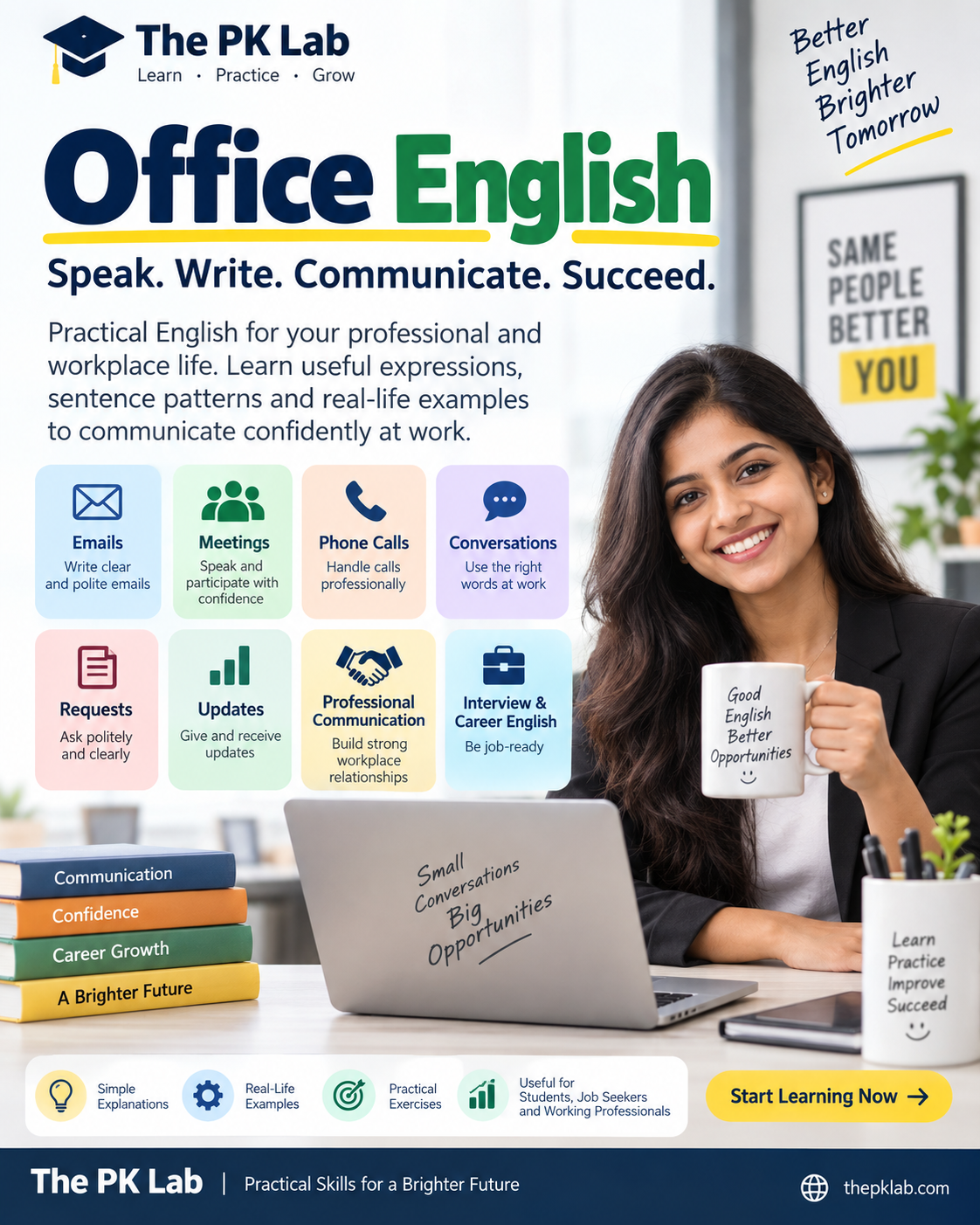
1. What Is Office English?
Office English means practical English used in professional and workplace situations.
It includes English used for:
- Talking to colleagues
- Speaking with managers
- Writing emails
- Attending meetings
- Making phone calls
- Giving presentations
- Asking for information
- Giving updates
- Making requests
- Discussing deadlines
- Handling customers
- Reporting problems
- Giving feedback
- Taking leave
- Participating in interviews
Simple Example
Instead of saying:
“Give me that file.”
In a professional situation, you could say:
“Could you please share that file with me?”
The meaning is similar, but the second sentence sounds more polite and professional.
2. Why Is Office English Important?
Good workplace communication helps you:
Communicate clearly
Your colleagues understand what you mean.
Sound professional
The way you communicate affects how others perceive your professionalism.
Avoid misunderstandings
Clear communication reduces confusion about tasks, deadlines, and responsibilities.
Participate confidently
You can contribute during meetings, discussions, and presentations.
Build professional relationships
Polite and respectful communication helps create positive workplace relationships.
Handle difficult situations
You can raise problems, disagree, or give feedback without sounding rude.
3. Basic Principles of Office English
Remember these 5 principles:
| Principle | What it means |
|---|---|
| Clear | Say exactly what you mean |
| Concise | Avoid unnecessary words |
| Polite | Use respectful language |
| Professional | Choose workplace-appropriate expressions |
| Confident | Speak clearly without being aggressive |
Example
❌ “You didn’t send the report.”
Better:
✅ “I haven’t received the report yet. Could you please check and share it?”
The second version communicates the problem without sounding confrontational.
4. Common Office English Sentences
Greeting Colleagues
- Good morning.
- Good afternoon.
- How are you doing?
- How’s your day going?
- Hope you’re doing well.
- Nice to see you.
- Good to see you again.
Example
A: Good morning. How are you doing?
B: Good morning. I’m doing well, thank you. How about you?
5. Introducing Yourself
When meeting someone professionally, you can say:
“Hi, I’m Prakash. I work with the Training Team.”
Other useful expressions:
- I’m part of the HR team.
- I work in the Operations Department.
- I handle training and development.
- I’m responsible for project coordination.
- I joined the organisation recently.
- I’ve been working here for three years.
Professional Introduction
“Good morning. I’m Rahul. I work with the Operations Team and I’m responsible for coordinating training activities across our locations.”
6. Asking for Help
Avoid direct commands when asking colleagues for assistance.
Less Professional
❌ “Help me with this.”
Better
✅ “Could you please help me with this?”
Other Useful Expressions
- Could you please help me?
- Would you mind helping me with this?
- Could you guide me on this?
- Could you please explain this to me?
- I need some help with this task.
- Could you please assist me with this?
7. Making Requests
One of the most important skills in Office English is making polite requests.
| Direct | More Professional |
|---|---|
| Send me the report. | Could you please send me the report? |
| Give me the details. | Could you please share the details? |
| Call me. | Could you please give me a call? |
| Check this. | Could you please check this? |
| Do this today. | Could you please complete this today? |
Useful Pattern
Could you please + base verb…?
Could you please share the document?
Could you please check the report?
Could you please confirm the meeting time?
8. Asking for Information
Useful expressions include:
- Could you please provide more information?
- Could you clarify this point?
- Could you please share the details?
- May I know the status of the project?
- Could you please confirm the deadline?
- Do you have any updates?
- Could you explain this further?
Example
“Could you please clarify the deadline for submitting the report?”
9. Giving Updates
At work, you will frequently need to provide updates.
Useful Sentences
- I would like to give you a quick update.
- Here’s the latest update.
- The work is in progress.
- We have completed the first phase.
- The task has been completed.
- We are currently working on it.
- We are facing a few challenges.
- We expect to complete it by Friday.
- I’ll keep you updated.
Example
“Here’s a quick update on the project. The first phase has been completed, and we are currently working on the second phase.”
10. Talking About Deadlines
Important workplace expressions:
- The deadline is Friday.
- We need to complete this by Friday.
- Could we extend the deadline?
- We are on schedule.
- We are behind schedule.
- We are ahead of schedule.
- We need some additional time.
- I’ll complete it by tomorrow.
- I’ll share the final version by EOD.
What does EOD mean?
EOD = End of Day
“Please share the report by EOD.”
Usually means the report should be shared before the end of the working day.
11. Office English for Meetings
Meetings require specific expressions.
Starting a Meeting
Good morning, everyone.
Shall we get started?
Let’s begin the meeting.
Thank you everyone for joining.
Sharing an Opinion
I think we should consider this option.
In my opinion, this approach could work better.
I would like to suggest an alternative.
Agreeing
I agree with you.
That’s a good point.
I completely agree.
I think that’s a practical approach.
Disagreeing Politely
Avoid:
❌ “You’re wrong.”
Instead:
✅ “I understand your point, but I have a slightly different view.”
or
✅ “I see it differently. Could we consider another approach?”
12. Asking Questions in Meetings
Useful expressions:
- May I ask a question?
- Could you please clarify that?
- Could you explain this point?
- What do you think about this?
- Could you elaborate on that?
- May I add something here?
Example
“Could you please clarify how this change will affect the project timeline?”
13. Office English for Phone Calls
Answering a Call
Good morning, this is Rahul speaking.
Hello, Rahul speaking. How may I help you?
Asking Someone to Wait
Could you please hold for a moment?
Please give me a moment.
If the Person Is Unavailable
I’m sorry, she’s currently unavailable.
He’s in a meeting at the moment.
Taking a Message
Would you like to leave a message?
May I take your message?
14. Office English for Emails
Professional emails should generally be clear, concise, polite, and structured.
Common Email Expressions
Opening
Dear Sir/Madam,
Dear Mr. Sharma,
Hello Team,
Hi Rahul,
Purpose
I am writing to inform you that…
I am writing regarding…
I would like to request…
Request
Could you please…
Kindly share…
I would appreciate it if you could…
Closing
Thank you for your support.
I look forward to hearing from you.
Best regards,
Rahul
15. Correct vs Incorrect Office English
| ❌ Less Appropriate | ✅ Better |
|---|---|
| Give me the file. | Could you please share the file? |
| I don’t understand. | Could you please explain that again? |
| You made a mistake. | There seems to be an error here. |
| Send it quickly. | Could you please share it at the earliest? |
| What? | Sorry, could you please repeat that? |
| I want leave tomorrow. | I would like to request leave for tomorrow. |
| Tell me the status. | Could you please provide an update? |
| I can’t do it. | I’m afraid I won’t be able to complete it within the current timeline. |
16. Common Mistakes Made by Indian English Learners
Mistake 1
❌ “Please revert back.”
Better:
✅ “Please reply.”
or
✅ “Please get back to me.”
Why? “Revert” already means to return to a previous state in standard English. In professional communication, “reply” or “get back to me” is usually clearer.
Mistake 2
❌ “Discuss about the issue.”
✅ “Discuss the issue.”
Discuss normally takes the object directly.
Mistake 3
❌ “Kindly do the needful.”
This expression is common in Indian workplace communication, but it can sound vague or old-fashioned in international professional English.
Better:
✅ “Please complete the required action.”
or, even better, specify the action:
✅ “Please review the document and share your confirmation.”
Mistake 4
❌ “I am having a meeting at 3 PM.”
In many contexts, natural English is:
✅ “I have a meeting at 3 PM.”
Mistake 5
❌ “Myself Rahul.”
Better:
✅ “I’m Rahul.”
or
✅ “My name is Rahul.”
17. Formal Grammar vs Natural Spoken English
Professional English does not always mean using long or complicated sentences.
| Formal | Natural Workplace English |
|---|---|
| I would like to inform you that… | I wanted to let you know that… |
| I do not know. | I don’t know. |
| I cannot attend the meeting. | I can’t attend the meeting. |
| We are unable to complete the task. | We can’t complete the task. |
| Would you be able to assist me? | Could you help me? |
Remember
Professional ≠ Complicated
Good professional English is usually:
Simple + Clear + Polite + Appropriate
18. How to Disagree Professionally
Disagreement is normal in a workplace. The goal is to disagree with the idea, not attack the person.
Useful Expressions
- I understand your point, but…
- I see your perspective; however…
- I have a slightly different view.
- Could we consider another option?
- I’m not sure that approach would work in this situation.
- Perhaps we could look at it from another perspective.
Example
❌ “Your idea won’t work.”
✅ “I understand the idea. However, we may face some challenges during implementation. Could we consider an alternative?”
19. Handling Workplace Problems
When reporting a problem, follow this simple structure:
Problem → Impact → Suggested Action
Example
“We are currently facing a network issue in the training room. As a result, the online session is being interrupted. Could we arrange technical support to resolve the issue?”
This sounds much more professional than:
❌ “The internet isn’t working. Please fix it.”
20. Quick Memory Trick
Remember C-P-C-C:
C – Clear
Say exactly what you mean.
P – Polite
Use respectful language.
C – Concise
Avoid unnecessary words.
C – Confident
Speak clearly and confidently.
21. Practice Exercise
Choose the more professional sentence.
1.
A. Give me the report.
B. Could you please share the report?
2.
A. You’re wrong.
B. I have a slightly different view.
3.
A. Tell me the meeting time.
B. Could you please confirm the meeting time?
4.
A. I don’t understand this.
B. Could you please explain this again?
5.
A. Send it immediately.
B. Could you please share it at the earliest?
Answers
1 – B
2 – B
3 – B
4 – B
5 – B
22. Quick Revision
Office English is about using English effectively and appropriately in professional situations.
Remember:
- Be clear.
- Be polite.
- Be concise.
- Use professional vocabulary.
- Avoid unnecessarily direct or rude expressions.
- Ask questions respectfully.
- Give clear updates.
- Learn useful workplace sentence patterns.
- Adapt your language to the situation.
- Professional English does not have to be complicated.
The goal is not to speak “big English.” The goal is to communicate clearly, confidently, and professionally.
23. FAQs
What is Office English?
Office English is the practical English used for communication in professional and workplace situations.
Is Office English different from Spoken English?
Yes, but they overlap. Spoken English covers everyday conversations, while Office English focuses specifically on professional situations such as meetings, emails, presentations, phone calls, and workplace discussions.
How can I improve my Office English?
Learn common workplace expressions, practise speaking regularly, read professional emails, participate in meetings, and practise real-life workplace conversations.
Do I need advanced grammar to speak Office English?
No. A strong foundation in basic grammar combined with practical vocabulary and regular speaking practice is enough to begin.
How can I sound professional in English?
Focus on clarity, politeness, appropriate vocabulary, and confident delivery rather than using complicated words.
Key Takeaway
Office English is not about using difficult English. It is about using the right English at the right time.
Whether you are a student preparing for your first job, a job seeker attending an interview, or a working professional communicating with your team, practical Office English can help you communicate more effectively.