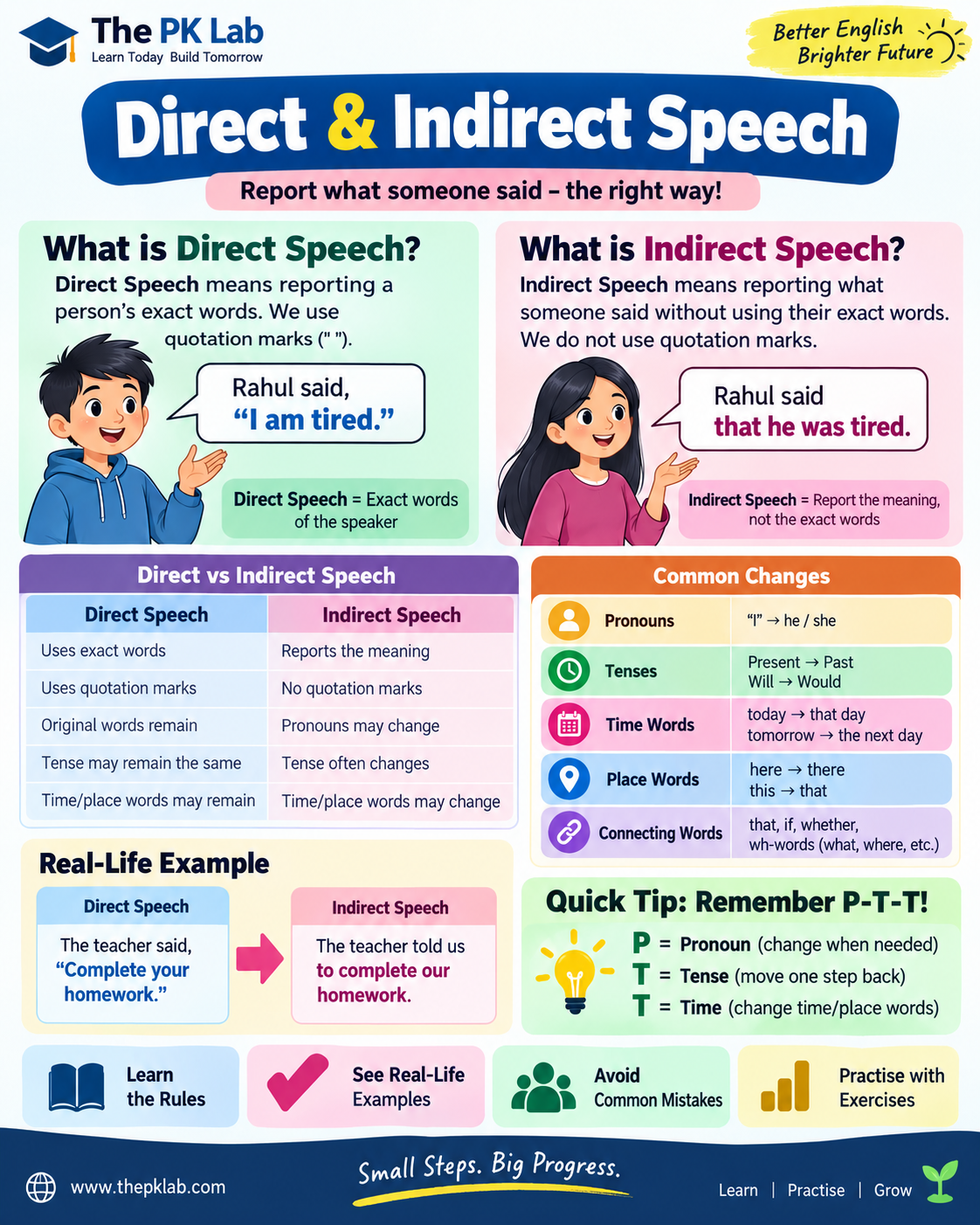
1. What is Direct Speech?
Direct Speech means reporting a person’s exact words.
We put the exact words inside quotation marks (” “).
Examples
- Rahul said, “I am tired.”
- The teacher said, “Complete your homework.”
- Priya said, “I will call you tomorrow.”
The words inside quotation marks are exactly what the person said.
Easy way to remember
Direct Speech = Exact words of the speaker
2. What is Indirect Speech?
Indirect Speech means reporting what someone said without using their exact words.
Quotation marks are not used.
Example
Direct:
Rahul said, “I am tired.”
Indirect:
Rahul said that he was tired.
The meaning remains the same, but the sentence structure changes.
Easy way to remember
Indirect Speech = Report the meaning, not the exact words
3. Direct vs Indirect Speech
| Direct Speech | Indirect Speech |
|---|---|
| Uses exact words | Reports the meaning |
| Uses quotation marks | No quotation marks |
| Speaker’s original words remain | Pronouns may change |
| Tense may remain original | Tense often changes |
| Time/place words may remain | Time/place words may change |
Example
Direct:
Ravi said, “I am busy today.”
Indirect:
Ravi said that he was busy that day.
4. Parts of Reported Speech
Consider:
Rahul said, “I am happy.”
There are two important parts:
Reporting Verb
Rahul said
Reported Speech
“I am happy.”
When we convert Direct Speech into Indirect Speech, we generally change the reported speech according to the required rules.
5. Basic Rules for Changing Direct to Indirect Speech
There are several important changes.
Rule 1: Remove Quotation Marks
Direct:
She said, “I am happy.”
Indirect:
She said that she was happy.
Quotation marks are removed.
Rule 2: Use a Suitable Connecting Word
Depending on the sentence type, we may use:
- that
- if
- whether
- wh-word such as what, where, when, why, how
Statement
He said, “I am ready.”
He said that he was ready.
Yes/No Question
She asked, “Are you ready?”
She asked if I was ready.
Wh-question
He asked, “Where do you live?”
He asked where I lived.
6. Pronoun Changes
Pronouns often change according to the speaker and the person being spoken to.
Example
Direct:
Ravi said, “I am busy.”
Indirect:
Ravi said that he was busy.
I → he
Another example:
Sita said, “I like my new phone.”
→ Sita said that she liked her new phone.
Remember
Pronouns do not change randomly. They change according to who is speaking and who is being talked about.
7. Tense Changes
When the reporting verb is in the past tense, the tense of the reported speech often moves one step back.
Common Tense Changes
| Direct Speech | Indirect Speech |
|---|---|
| Present Simple | Past Simple |
| Present Continuous | Past Continuous |
| Present Perfect | Past Perfect |
| Present Perfect Continuous | Past Perfect Continuous |
| Past Simple | Past Perfect |
| Past Continuous | Past Perfect Continuous |
| Will | Would |
| Can | Could |
| May | Might |
Examples
Present Simple → Past Simple
He said, “I work in Bhubaneswar.”
He said that he worked in Bhubaneswar.
Present Continuous → Past Continuous
She said, “I am studying.”
She said that she was studying.
Will → Would
Rahul said, “I will help you.”
Rahul said that he would help me.
8. When Does the Tense NOT Change?
The tense does not always have to change.
General Truth
The teacher said, “The Earth revolves around the Sun.”
→ The teacher said that the Earth revolves around the Sun.
Because this is a universal truth, the present tense can remain.
Still True
She said, “I live in Cuttack.”
If she still lives in Cuttack, depending on context:
She said that she lives in Cuttack.
So, don’t change tense mechanically. Meaning and context matter.
9. Changes in Time and Place Words
Some words may change when we report speech later.
| Direct | Indirect |
|---|---|
| now | then |
| today | that day |
| yesterday | the previous day |
| tomorrow | the next day |
| last week | the previous week |
| next week | the following week |
| ago | before |
| here | there |
| this | that |
| these | those |
Example
Direct:
Amit said, “I will come here tomorrow.”
Indirect:
Amit said that he would go there the next day.
10. Direct and Indirect Speech for Statements
For ordinary statements, said that or told + object is commonly used.
With “said”
Direct: She said, “I am happy.”
Indirect: She said that she was happy.
With “told”
Direct: She said to me, “I am happy.”
Indirect: She told me that she was happy.
Important
❌ She told that she was happy.
✅ She told me that she was happy.
Tell usually needs an object.
11. Direct and Indirect Speech for Questions
Questions require a different structure.
Yes/No Questions
Use if or whether.
Direct:
He asked me, “Are you ready?”
Indirect:
He asked me if I was ready.
Important
In indirect speech, we do not keep the question word order.
❌ He asked me if was I ready.
✅ He asked me if I was ready.
Wh-Questions
Keep the question word but change the sentence into statement order.
Direct:
She asked me, “Where do you live?”
Indirect:
She asked me where I lived.
Direct:
He asked, “Why are you late?”
Indirect:
He asked why I was late.
12. Commands and Instructions
For commands, we commonly use:
told + object + to + verb
Example
Direct:
The teacher said to Rahul, “Open your book.”
Indirect:
The teacher told Rahul to open his book.
Negative Command
Use:
told + object + not to + verb
Direct:
Mother said to me, “Don’t waste your time.”
Indirect:
Mother told me not to waste my time.
13. Requests
For requests, we can use:
- asked
- requested
- begged
Example
Direct:
She said to me, “Please help me.”
Indirect:
She asked me to help her.
Another example:
The student said to the teacher, “Please explain this topic.”
→ The student requested the teacher to explain that topic.
14. Advice
For advice, we can use:
advised + object + to + verb
Direct:
The doctor said to him, “Take rest.”
Indirect:
The doctor advised him to take rest.
Direct:
Father said to me, “Work hard.”
Indirect:
Father advised me to work hard.
15. Exclamatory Sentences
For exclamations, we may use verbs such as:
- exclaimed with joy
- exclaimed with surprise
- exclaimed with sorrow
- exclaimed with admiration
Example
Direct:
He said, “What a beautiful place!”
Indirect:
He exclaimed with admiration that it was a very beautiful place.
16. Common Mistakes
Mistake 1
❌ Rahul said that “I am busy.”
✅ Rahul said that he was busy.
Don’t use quotation marks after converting to indirect speech.
Mistake 2
❌ She told that she was tired.
✅ She told me that she was tired.
Mistake 3
❌ He asked me where did I live.
✅ He asked me where I lived.
Mistake 4
❌ Mother told me don’t go outside.
✅ Mother told me not to go outside.
17. Direct & Indirect Speech in Real Life
We use reported speech every day.
At Home
Direct:
Mother said, “Dinner is ready.”
Indirect:
Mother said that dinner was ready.
At College
Direct:
The teacher said, “Submit your assignment tomorrow.”
Indirect:
The teacher told us to submit our assignment the next day.
At Work
Direct:
The manager said, “The meeting will start at 10 AM.”
Indirect:
The manager said that the meeting would start at 10 AM.
On the Phone
Direct:
Ravi said, “I will call you later.”
Indirect:
Ravi said that he would call me later.
18. Direct & Indirect Speech in Spoken English
In everyday English, we frequently use reporting verbs:
- He said…
- She told me…
- They asked…
- My manager said…
- My friend told me…
- The teacher explained…
Natural Conversation
A: What did Rahul say?
B: He said that he would come tomorrow.
A: What did your manager tell you?
B: She told me to finish the report today.
This is how reported speech naturally appears in conversations.
19. Quick Memory Trick
Remember P-T-T:
P = Pronoun
Change the pronoun when necessary.
T = Tense
Move the tense back when required.
T = Time
Change time/place expressions when the context requires it.
Pronoun + Tense + Time = PTT
20. Practice Exercise
Change the following into Indirect Speech.
1. Rahul said, “I am tired.”
2. Sita said, “I will call you tomorrow.”
3. The teacher said to the students, “Open your books.”
4. He asked me, “Are you ready?”
5. She asked me, “Where do you work?”
6. Father said to me, “Work hard.”
7. Mother said to me, “Don’t waste your time.”
8. Ravi said, “I have completed my work.”
9. The manager said, “The meeting will start at 10 AM.”
10. Priya said, “What a beautiful dress!”
21. Answers
- Rahul said that he was tired.
- Sita said that she would call me the next day.
- The teacher told the students to open their books.
- He asked me if I was ready.
- She asked me where I worked.
- Father advised me to work hard.
- Mother told me not to waste my time.
- Ravi said that he had completed his work.
- The manager said that the meeting would start at 10 AM.
- Priya exclaimed with admiration that it was a very beautiful dress.
22. Quick Revision
Direct Speech
Exact words of the speaker.
He said, “I am busy.”
Indirect Speech
Reported meaning of the speaker.
He said that he was busy.
Remember:
- Remove quotation marks.
- Change pronouns when necessary.
- Change tense when required.
- Change time/place expressions when the context requires it.
- Use that for many statements.
- Use if/whether for Yes/No questions.
- Keep the wh-word in Wh-questions.
- Use to + verb for many commands and requests.
- Use not to + verb for negative commands.
- Always consider meaning and context.
FAQs
What is Direct Speech?
Direct Speech reports the speaker’s exact words using quotation marks.
What is Indirect Speech?
Indirect Speech reports what someone said without repeating their exact words.
Is Direct Speech the same as Reported Speech?
Not exactly. Reported Speech is the broader term; Indirect Speech is the common form used to report someone’s words.
Does tense always change in Indirect Speech?
No. Tense commonly changes when the reporting verb is in the past, but there are important exceptions, such as universal truths and situations that remain true.
What is the difference between “said” and “told”?
Said can be used without an object: He said that he was busy.
Told normally takes an object: He told me that he was busy.