1. What is a Phrase?
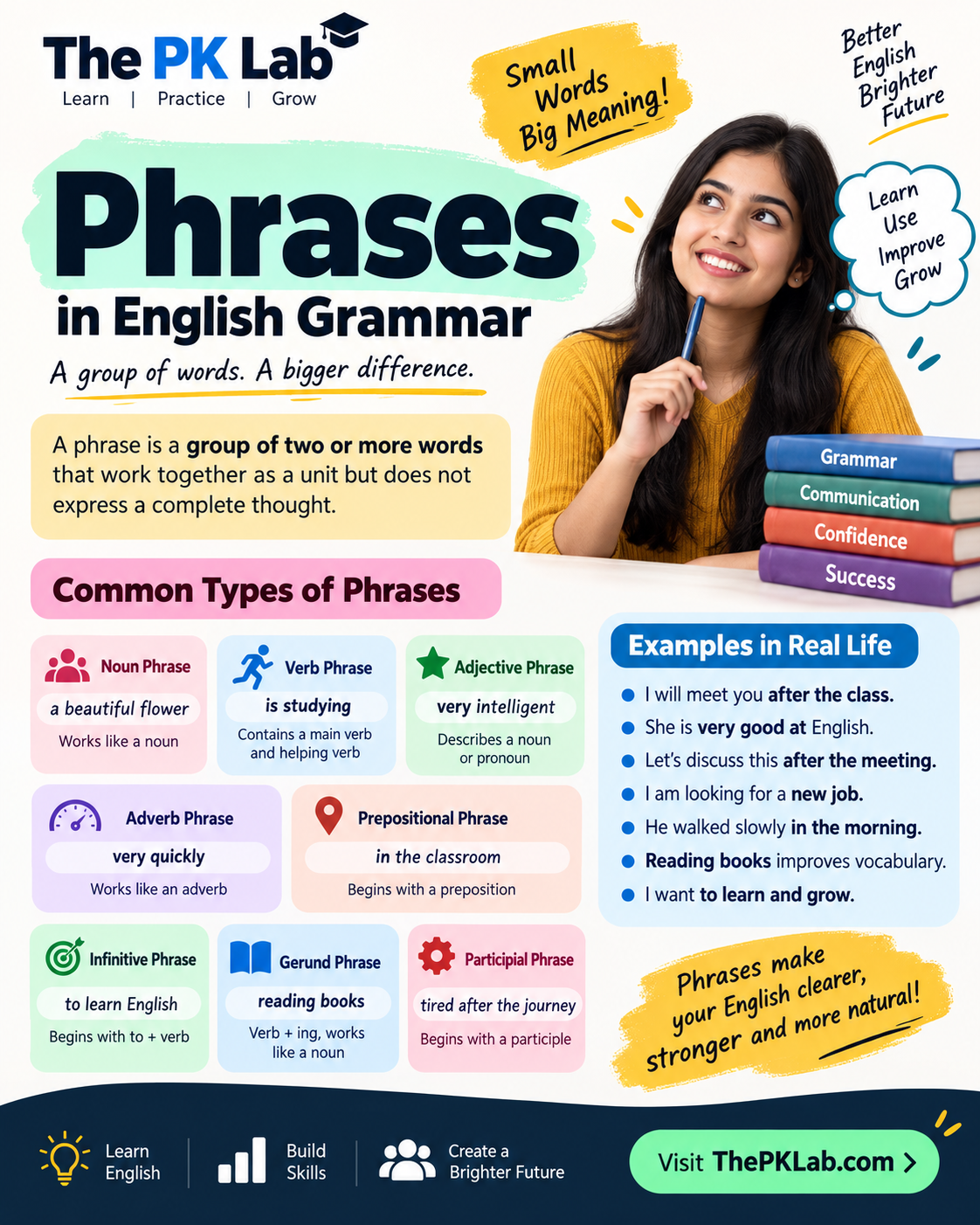
A phrase is a group of two or more words that work together as a unit but does not contain a complete subject–verb combination and does not express a complete thought by itself.
Simply put:
A phrase is a group of words that gives us some meaning, but it is not a complete sentence.
Examples
- in the morning
- a beautiful flower
- very quickly
- after the class
- to learn English
- the boy in the blue shirt
Look at this:
The boy in the blue shirt
It tells us something about a boy, but it does not tell us a complete action or thought. Therefore, it is a phrase.
2. Why is a Phrase Important?
We use phrases everywhere in English.
They help us:
- Give more information
- Describe people and things
- Tell us when, where, how, or why something happens
- Make sentences more interesting
- Speak and write more naturally
- Build longer and clearer sentences
Compare:
Riya is sitting.
with:
Riya is sitting in the classroom near the window.
The second sentence gives us much more information.
The words “in the classroom” and “near the window” are phrases.
3. Phrase vs Sentence
A phrase is not a complete sentence.
| Phrase | Complete Sentence |
|---|---|
| in the classroom | She is in the classroom. |
| after the meeting | We will talk after the meeting. |
| a smart student | Rahul is a smart student. |
| very slowly | He walked very slowly. |
| near my house | There is a shop near my house. |
Easy Trick
Ask:
“Does this group of words express a complete thought?”
If No, it may be a phrase.
4. Basic Structure of a Phrase
A phrase can contain several words working together.
Examples:
a beautiful girl
- a → article
- beautiful → adjective
- girl → noun
Together, they form a noun phrase.
Another example:
very quickly
- very → adverb
- quickly → adverb
Together, they form an adverb phrase.
5. Types of Phrases
There are several important types of phrases in English.
Main Types
- Noun Phrase
- Verb Phrase
- Adjective Phrase
- Adverb Phrase
- Prepositional Phrase
- Infinitive Phrase
- Gerund Phrase
- Participial Phrase
Let’s understand them one by one.
6. Noun Phrase
A noun phrase is a group of words that works like a noun.
Examples
- a beautiful flower
- the tall boy
- my new mobile phone
- the students of our class
In sentences:
The tall boy is my brother.
I bought a new mobile phone.
The students of our class are preparing for the exam.
Remember:
Noun Phrase = A group of words that acts like a noun.
7. Verb Phrase
A verb phrase contains a main verb and one or more helping verbs.
Examples
- is studying
- has finished
- will go
- was playing
- have been working
In sentences:
Rahul is studying English.
She has finished her homework.
We will go to Bhubaneswar tomorrow.
They have been working since morning.
Easy Formula
Helping Verb + Main Verb = Verb Phrase
8. Adjective Phrase
An adjective phrase is a group of words that describes a noun or pronoun.
Examples
- very beautiful
- extremely intelligent
- full of energy
- interested in English
In sentences:
She is very beautiful.
Rahul is extremely intelligent.
The children are full of energy.
I am interested in English.
The phrase gives us more information about a person or thing.
9. Adverb Phrase
An adverb phrase is a group of words that works like an adverb.
It can tell us:
- How?
- When?
- Where?
- To what extent?
Examples
He runs very quickly.
She completed the work in a hurry.
We will meet after the class.
They live near the railway station.
10. Prepositional Phrase
A prepositional phrase begins with a preposition and is followed by its object.
Common Prepositions
in, on, at, under, over, beside, near, behind, before, after, with, without, from, to
Examples
- in the room
- on the table
- under the chair
- near my house
- after the meeting
- with my friends
In sentences:
The book is on the table.
She is waiting at the bus stop.
We went there with our friends.
I will call you after the meeting.
11. Infinitive Phrase
An infinitive phrase usually begins with to + base form of a verb.
Examples
- to learn English
- to get a job
- to help my parents
- to improve my communication skills
In sentences:
I want to learn English.
She works hard to get a good job.
He joined the course to improve his communication skills.
Memory Trick
to + verb = Infinitive
Example:
to learn, to speak, to work, to study
12. Gerund Phrase
A gerund is an -ing form of a verb that functions as a noun.
A gerund phrase contains the gerund and other words connected to it.
Examples
- learning English
- speaking English fluently
- playing cricket
- reading books
In sentences:
Learning English takes practice.
Reading books improves vocabulary.
I enjoy playing cricket.
Here, learning, reading, and playing function as nouns.
13. Participial Phrase
A participial phrase begins with a present or past participle and works like an adjective.
Examples
Walking down the road, Rahul saw his friend.
The girl wearing a blue dress is my sister.
Tired after the journey, he went to bed.
The phrases describe a person or thing.
14. Phrase vs Clause
This is one of the most important differences to understand.
Phrase
A phrase does not have a complete subject + finite verb combination.
in the classroom
after the meeting
a beautiful house
Clause
A clause contains a subject and a verb.
She is in the classroom.
After the meeting ended
The house is beautiful.
Quick Comparison
| Phrase | Clause |
|---|---|
| in the room | when she entered the room |
| after the class | after the class ended |
| a beautiful girl | the girl is beautiful |
| playing cricket | when he was playing cricket |
Easy Rule
Phrase → incomplete word group without a subject–verb combination
Clause → contains a subject and a verb
15. Phrase vs Sentence
Don’t confuse a phrase with a complete sentence.
Phrase
After the meeting
This gives an idea but does not express a complete thought.
Sentence
We will discuss it after the meeting.
This gives a complete thought.
16. Correct vs Incorrect
Example 1
❌ After the class.
This is only a phrase, not a complete sentence.
✅ We will meet after the class.
Example 2
❌ In the classroom.
This is a phrase.
✅ The students are in the classroom.
Example 3
❌ To improve my English.
This is an infinitive phrase.
✅ I practise every day to improve my English.
17. Common Mistakes
Mistake 1: Thinking every group of words is a sentence
❌ In the morning.
A group of words does not automatically make a sentence.
✅ I go for a walk in the morning.
Mistake 2: Confusing phrases with clauses
❌ Because of the rain → calling it a clause.
It is a prepositional phrase.
Compare:
Because of the rain → Phrase
Because it was raining → Clause
Mistake 3: Thinking a phrase cannot contain a verb
Some phrases can contain verb forms.
For example:
to learn English
learning English
having finished the work
These are phrases even though they contain verb forms.
18. Phrases in Spoken English
Phrases are extremely common in everyday conversation.
At Home
In the morning, I usually have tea.
Please keep it on the table.
At College
I will meet you after the class.
She is very good at English.
At Work
Let’s discuss this after the meeting.
He is responsible for the project.
During an Interview
I am interested in this position.
I am looking for an opportunity to learn and grow.
Shopping
I am looking for a black shirt.
Do you have this in a larger size?
19. Formal vs Natural Spoken English
Grammar is not only about writing. We use phrases constantly while speaking.
More formal
I would like to speak with you after the meeting.
Natural conversation
Can I talk to you after the meeting?
The phrase “after the meeting” works naturally in both situations.
The difference comes from the overall sentence and level of formality.
20. Quick Tips to Identify a Phrase
When you see a group of words, ask:
Question 1
Does it express a complete thought?
If no → it may be a phrase.
Question 2
Does it have a subject + finite verb?
If no → it is likely a phrase.
Question 3
Does the group of words work together as one unit?
If yes → it may be a phrase.
Memory Trick
Phrase = Group of words, but not a complete thought.
21. Practice Exercise
A. Identify the phrases
Identify the phrase in each sentence.
- The boy in the blue shirt is my brother.
- She speaks very slowly.
- We will meet after the class.
- I want to learn English.
- Reading books improves your vocabulary.
B. Identify the Type
Identify whether the highlighted phrase is a Noun Phrase, Verb Phrase, Adjective Phrase, Adverb Phrase, or Prepositional Phrase.
- The beautiful red car is mine.
- She is studying English.
- He speaks very quickly.
- The book is on the table.
- She is very intelligent.
22. Answers
A.
- in the blue shirt
- very slowly
- after the class
- to learn English
- Reading books
B.
- beautiful red car → Noun Phrase
- is studying → Verb Phrase
- very quickly → Adverb Phrase
- on the table → Prepositional Phrase
- very intelligent → Adjective Phrase
23. Quick Revision
Remember these key points:
- A phrase is a group of words.
- A phrase does not normally express a complete thought.
- A phrase functions as a unit within a sentence.
- A phrase is different from a clause.
- Phrases make sentences clearer and more informative.
- Common types include noun, verb, adjective, adverb, prepositional, infinitive, gerund, and participial phrases.
- Phrases are used constantly in everyday spoken English.
One-Line Definition
A phrase is a group of words that works together as a unit but does not express a complete thought by itself.
24. FAQs
What is a phrase in English grammar?
A phrase is a group of words that works together but does not express a complete thought by itself.
Is a phrase a sentence?
No. A phrase is generally not a complete sentence.
What is the difference between a phrase and a clause?
A phrase does not contain a complete subject–verb combination, while a clause contains a subject and a verb.
Can a phrase contain a verb?
Yes. For example, “to learn English” and “learning English” are phrases containing verb forms.
What are the main types of phrases?
Common types include noun phrases, verb phrases, adjective phrases, adverb phrases, prepositional phrases, infinitive phrases, gerund phrases, and participial phrases.