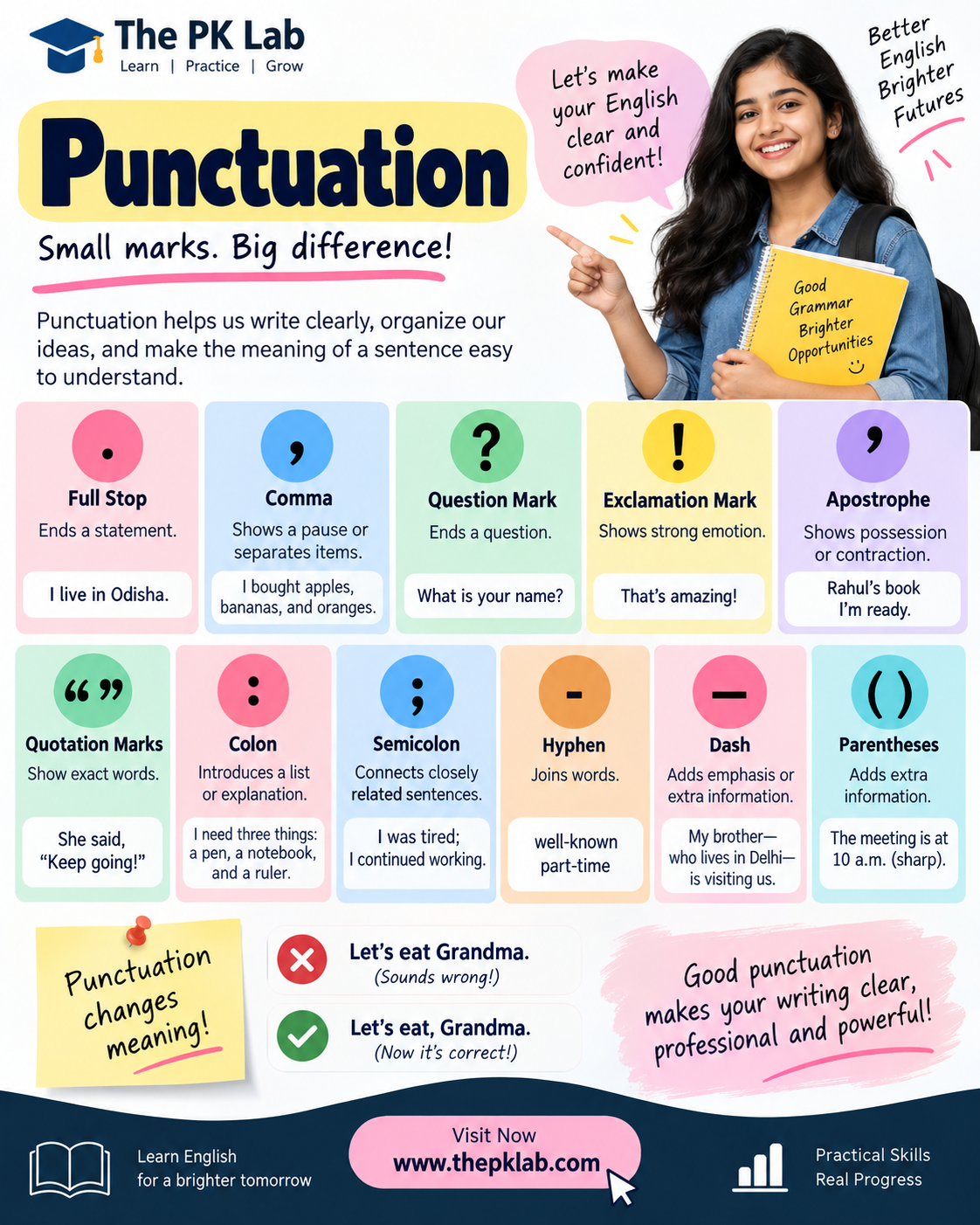
1. What Is Punctuation?
Punctuation is the use of special marks in written English to separate ideas, show pauses, ask questions, express emotions, and make the meaning of a sentence clear.
Common punctuation marks
| Mark | Name | Main Use |
|---|---|---|
| . | Full Stop / Period | Ends a statement |
| , | Comma | Shows a short pause or separates items |
| ? | Question Mark | Ends a question |
| ! | Exclamation Mark | Shows strong emotion |
| ‘ | Apostrophe | Possession and contractions |
| ” “ | Quotation Marks | Direct speech or quotations |
| : | Colon | Introduces a list or explanation |
| ; | Semicolon | Connects closely related sentences |
| – | Hyphen | Joins words |
| — | Dash | Adds emphasis or extra information |
| ( ) | Brackets / Parentheses | Adds additional information |
2. Why Is Punctuation Important?
Punctuation helps readers understand where one idea ends and another begins.
Compare:
Let’s go, Rahul.
You are asking Rahul to go.
Let’s go Rahul.
Without punctuation, the sentence can be confusing.
Good punctuation makes your writing:
- Clear
- Professional
- Easy to read
- More meaningful
- Grammatically correct
It is especially important in emails, applications, assignments, reports, messages, presentations, and professional communication.
3. Full Stop (.)
The full stop is used mainly at the end of a complete statement.
Examples
- I live in Odisha.
- She works in a bank.
- Rahul is studying English.
- We have a meeting today.
Correct vs Incorrect
❌ I live in Bhubaneswar
✅ I live in Bhubaneswar.
Remember
Statement → Full Stop (.)
4. Comma (,)
A comma creates a short pause or separates parts of a sentence.
Use 1: Separate items in a list
I bought apples, bananas, oranges, and grapes.
She needs a pen, notebook, ruler, and pencil.
Use 2: After an introductory word or phrase
However, I decided to go.
After lunch, we returned to work.
Use 3: To address someone directly
Rahul, please come here.
Thank you, sir.
Notice the difference:
Let’s eat, children.
We are speaking to the children.
Common mistake
❌ Dear Sir I am writing this email to request leave.
✅ Dear Sir, I am writing this email to request leave.
5. Question Mark (?)
Use a question mark at the end of a direct question.
Examples
- What is your name?
- Where do you live?
- Are you ready?
- Did you complete the assignment?
- Can you help me?
Don’t use it after an ordinary statement
❌ I want to know where he lives?
✅ I want to know where he lives.
6. Exclamation Mark (!)
An exclamation mark expresses strong emotion such as:
- Surprise
- Excitement
- Happiness
- Anger
- Warning
Examples
What a beautiful day!
Wow!
That’s amazing!
Be careful!
Tip
Don’t use too many exclamation marks in professional writing.
❌ Thank you!!!
❌ Great job!!!!!!!
✅ Thank you!
7. Apostrophe (‘)
The apostrophe has two major uses.
A. Contractions
An apostrophe shows that letters have been omitted.
| Full Form | Contraction |
|---|---|
| I am | I’m |
| You are | You’re |
| He is | He’s |
| She is | She’s |
| It is | It’s |
| Do not | Don’t |
| Cannot | Can’t |
| I will | I’ll |
| We have | We’ve |
Spoken English
Formal:
I do not know.
Natural everyday English:
I don’t know.
Both are grammatically correct, but the shorter form is common in conversation.
B. Possession
The apostrophe can show that something belongs to someone.
Rahul’s book
Anita’s phone
The teacher’s room
For plural nouns ending in s, generally add only an apostrophe:
students’ books
teachers’ room
players’ uniforms
Common mistake
❌ Rahuls book
✅ Rahul’s book
8. Quotation Marks (” “)
Quotation marks are commonly used to show someone’s exact words.
Example
Rahul said, “I am ready.”
The words inside quotation marks are the speaker’s exact words.
More examples
The teacher said, “Complete your homework.”
She asked, “Where are you going?”
Quotation marks can also be used around titles of shorter works or when directly quoting someone, depending on the style guide being followed.
9. Colon (:)
A colon is often used to introduce:
- A list
- An explanation
- An example
Examples
I need three things: a pen, a notebook, and a ruler.
Remember one thing: practice makes progress.
Bring the following documents: Aadhaar card, photographs, and certificates.
Memory Trick
Colon = “Here comes something.”
10. Semicolon (;)
A semicolon connects two closely related independent clauses.
Example
I wanted to go outside; it started raining.
Both parts can stand as sentences:
I wanted to go outside.
It started raining.
The semicolon shows that the two ideas are closely connected.
Another example
She studied hard; she passed the examination.
For beginners, don’t worry about using semicolons frequently. A full stop can often be used instead.
11. Hyphen (-)
A hyphen joins words or parts of words.
Examples
- well-known
- part-time
- English-speaking
- twenty-one
- self-confidence
Example in a sentence
She is a part-time employee.
Hyphen (-) and dash (—) are not the same punctuation mark.
12. Dash (—)
A dash can be used to add emphasis or extra information.
Examples
My brother—who lives in Delhi—is visiting us.
There is only one thing I need—your support.
A dash often creates a stronger break than a comma.
13. Parentheses / Brackets ( )
Parentheses add extra or additional information.
Examples
The meeting will begin at 10 a.m. (sharp).
Odisha’s capital (Bhubaneswar) is known as a smart city.
The information inside parentheses is useful but not essential to the main sentence.
14. Punctuation in Direct Speech
When writing someone’s exact words, punctuation becomes particularly important.
Example
Teacher said, “Please submit your assignment tomorrow.”
Question:
She asked, “Are you ready?”
Exclamation:
He shouted, “Watch out!”
Punctuation helps the reader understand who is speaking and how the words are being expressed.
15. Punctuation in Emails
Professional emails should use punctuation carefully.
Poor
Dear Sir
I am writing to inform you that I will not be able to attend the meeting tomorrow
Thank you
Better
Dear Sir,
I am writing to inform you that I will not be able to attend the meeting tomorrow.
Thank you.
Good punctuation makes professional communication look more polished.
16. Common Punctuation Mistakes
Mistake 1: Missing full stop
❌ She works in Cuttack
✅ She works in Cuttack.
Mistake 2: Missing comma in direct address
❌ Thank you Rahul.
✅ Thank you, Rahul.
Mistake 3: Confusing its and it’s
It’s = it is / it has
It’s raining.
Its = belonging to it
The company changed its policy.
Mistake 4: Using apostrophe for ordinary plurals
❌ Apple’s are expensive.
✅ Apples are expensive.
Mistake 5: Too many exclamation marks
❌ Welcome to our website!!!!!
✅ Welcome to our website!
Mistake 6: Confusing hyphen and dash
Hyphen: well-known
Dash: He came late—again.
17. Punctuation and Meaning
Sometimes punctuation can completely change the meaning of a sentence.
Example
Without comma:
Let’s eat children.
With comma:
Let’s eat, children.
The second sentence clearly means that you are talking to the children!
Another example
The teacher said, “Rahul is intelligent.”
versus
The teacher said Rahul is intelligent.
The first clearly presents the teacher’s exact words.
18. Punctuation for Spoken English Learners
When you speak English, you don’t actually say punctuation marks aloud. Instead, you use pauses, stress, and intonation.
For example:
Well, I don’t know.
The comma represents a small pause.
In conversation:
“Actually, I wanted to ask you something.”
That natural pause after Actually helps the sentence sound more natural.
So, understanding punctuation can also help learners understand how written English represents natural speech.
19. Quick Memory Guide
Remember these basic punctuation marks:
. → Stop
, → Short pause / separation
? → Question
! → Strong emotion
‘ → Possession / contraction
” ” → Exact words
: → Introduces something
; → Connects related ideas
– → Joins words
— → Strong break / emphasis
( ) → Extra information
20. Practice Exercise
A. Add the correct punctuation marks.
- What is your name
- I live in Odisha
- Rahul please open the door
- Wow that is amazing
- She bought a pen notebook and bag
- Where are you going
- I dont know the answer
- This is my brothers phone
- The teacher said Please sit down
- I need three things a pen a notebook and a ruler
B. Choose the correct sentence.
1.
A. Its a beautiful day.
B. It’s a beautiful day.
2.
A. Thank you, sir.
B. Thank you sir.
3.
A. Where are you going?
B. Where are you going.
4.
A. Rahul’s book is on the table.
B. Rahuls book is on the table.
Answers
A
- What is your name?
- I live in Odisha.
- Rahul, please open the door.
- Wow! That is amazing!
- She bought a pen, notebook, and bag.
- Where are you going?
- I don’t know the answer.
- This is my brother’s phone.
- The teacher said, “Please sit down.”
- I need three things: a pen, a notebook, and a ruler.
B
- B — It’s a beautiful day.
- A — Thank you, sir.
- A — Where are you going?
- A — Rahul’s book is on the table.
FAQs
What is punctuation in English?
Punctuation is the use of special marks such as ., ,, ?, !, and ‘ to make written sentences clear and meaningful.
How many punctuation marks are there?
English uses many punctuation marks. The most commonly used ones include the full stop, comma, question mark, exclamation mark, apostrophe, quotation marks, colon, semicolon, hyphen, dash, and parentheses.
What is the most commonly used punctuation mark?
The full stop and comma are among the most frequently used punctuation marks in everyday English writing.
Why is punctuation important?
Punctuation helps readers understand the meaning, structure, pauses, relationships, and emotions in written language.
What is the difference between a comma and a full stop?
A comma usually creates a short separation or pause within a sentence, while a full stop normally marks the end of a complete statement.
Is punctuation important in spoken English?
Punctuation itself belongs to writing, but understanding it can help learners recognize pauses, emphasis, and sentence structure when converting written English into natural speech.
Key Takeaways
- Punctuation makes writing clear.
- A full stop (.) ends a statement.
- A comma (,) separates ideas or creates a short pause.
- A question mark (?) ends a direct question.
- An exclamation mark (!) expresses strong emotion.
- An apostrophe (‘) shows possession or creates contractions.
- Quotation marks (” “) show exact words.
- A colon (:) introduces a list or explanation.
- A semicolon (;) connects closely related independent clauses.
- Good punctuation improves academic, professional, and everyday communication.
Good grammar tells us how to build a sentence. Good punctuation helps the reader understand it.