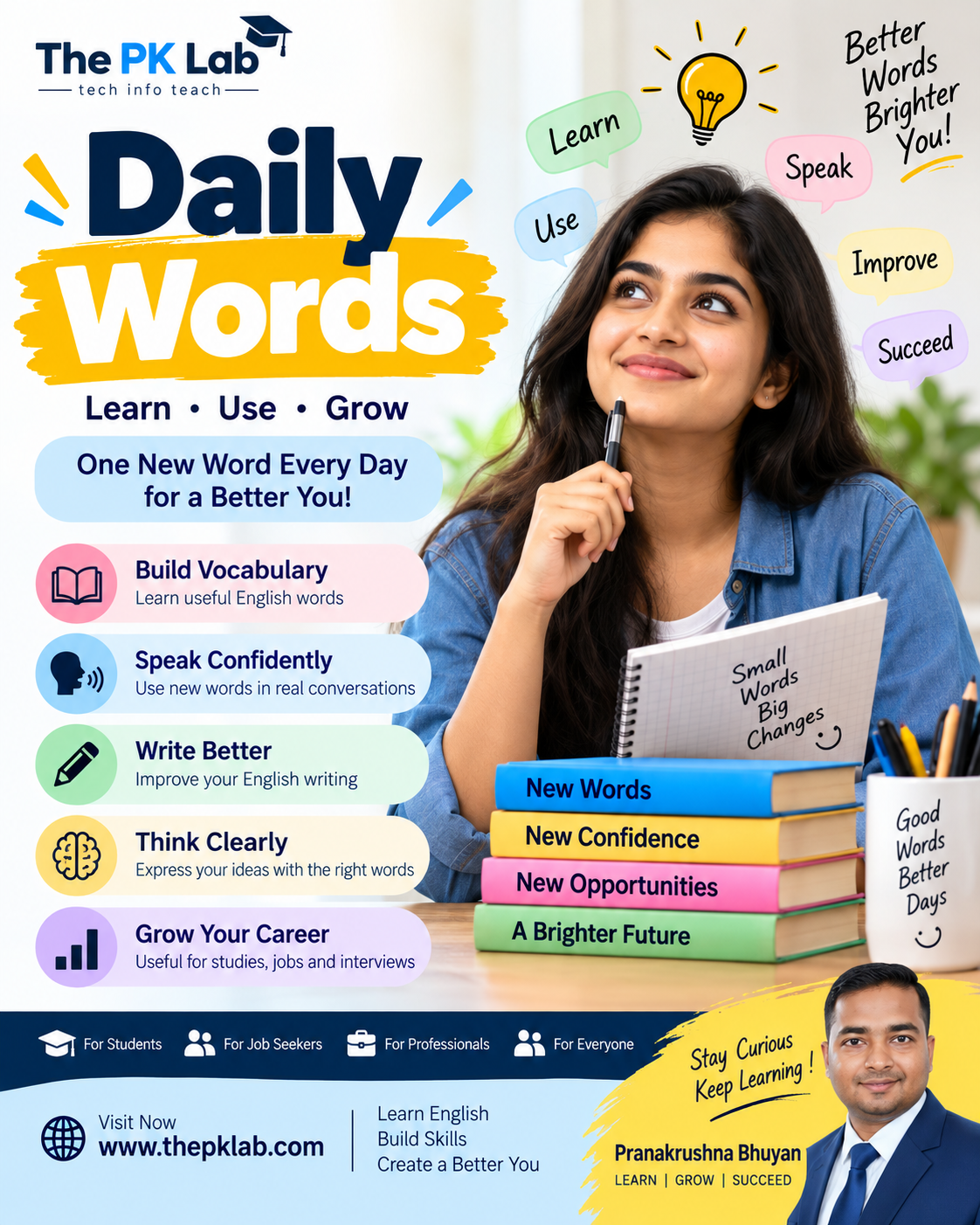
What Are Daily Words?
Daily Words means learning useful English words regularly and understanding how to use them in sentences.
For example:
Word: Confident
Meaning: Feeling sure about yourself or your ability
Sentence: She is confident about her interview.
Instead of simply memorising the meaning, learners should learn the word through meaning + pronunciation + examples + usage.
Why Should You Learn Daily Words?
A strong vocabulary helps you:
- Speak English more confidently
- Understand conversations more easily
- Write better sentences
- Improve reading and comprehension
- Perform better in interviews and examinations
- Communicate effectively at work
- Express your thoughts more clearly
- Learn new English words naturally
Remember: Knowing a word is not enough. You should know how and when to use it.
How to Learn a New Word
For every Daily Word, try to learn these important points:
| What to Learn | Example |
|---|---|
| Word | Confident |
| Part of Speech | Adjective |
| Meaning | Sure of yourself |
| Pronunciation | KON-fi-dent |
| Synonyms | Self-assured, assured |
| Antonyms | Nervous, unsure |
| Example | I feel confident today. |
| Real-life Use | I am confident about my interview. |
Daily Word Example
🌟 Word of the Day: Reliable
Meaning: Someone or something that can be trusted or depended on.
Part of Speech: Adjective
Easy Examples
- Rahul is a reliable friend.
- This is a reliable mobile phone.
- She is a reliable employee.
- We need a reliable internet connection.
Real-Life English
At home:
“My brother is very reliable. I can always depend on him.”
At college:
“She is a reliable member of our project team.”
At work:
“We need someone reliable to handle this responsibility.”
In an interview:
“I am a reliable person and always complete my responsibilities on time.”
Word Families
Learning related forms of a word can help you expand your vocabulary faster.
Example: Success
- Success – noun
- Successful – adjective
- Successfully – adverb
- Succeed – verb
Examples:
Hard work leads to success.
She is a successful entrepreneur.
He completed the task successfully.
I want to succeed in my career.
Synonyms and Antonyms
Learning synonyms and antonyms helps you express yourself in different ways.
Example: Happy
Synonyms:
- Glad
- Joyful
- Cheerful
- Delighted
Antonyms:
- Sad
- Unhappy
- Miserable
Instead of always saying:
“I am happy.”
You can say:
“I am delighted.”
“I am really glad.”
“I feel cheerful today.”
Common Mistakes
Do not learn vocabulary by translating every word directly from your mother tongue.
For example, learners may know the meaning of “discuss” but incorrectly say:
❌ We discussed about the problem.
Correct:
✅ We discussed the problem.
The goal of Daily Words is therefore not just to teach what a word means, but also how native and natural English uses it.
Spoken English Focus
Daily Words should also help learners sound more natural in conversations.
Instead of:
“I am very hungry.”
You may hear:
“I’m really hungry.”
Instead of:
“I am very tired.”
You may hear:
“I’m exhausted.”
The more useful words you learn, the more precisely you can express yourself.
Quick Memory Trick
Learn → Understand → Use → Repeat
1. Learn the word.
2. Understand its meaning and usage.
3. Use it in your own sentence.
4. Repeat it in conversation or writing.
One useful word used correctly is better than ten words quickly memorised and forgotten.
Daily Words Practice
Try creating your own sentences with these words:
- Improve
- Confident
- Reliable
- Opportunity
- Responsible
Challenge
Write one sentence for each word and try to use at least one word in a real conversation today.
Quick Revision
Before moving to the next word, ask yourself:
- What does the word mean?
- How do I pronounce it?
- What part of speech is it?
- Can I use it in a sentence?
- What are its synonyms?
- What is its opposite?
- Can I use it in a real conversation?
If you can answer these questions, you have learned the word—not just memorised it.
FAQs
1. How many English words should I learn every day?
Start with 3–5 useful words a day. Focus on using them rather than memorising a large number of words.
2. Should I learn difficult English words?
Not necessarily. Start with words that are useful in your daily life, studies, workplace, and conversations.
3. How can I remember new words?
Use the word in your own sentences, speak it aloud, write it down, and review it regularly.
4. Is vocabulary important for spoken English?
Yes. Grammar helps you form correct sentences, while vocabulary gives you the words needed to express your thoughts and ideas.
5. Should I learn synonyms for every word?
Learning a few useful synonyms is helpful, but first learn the meaning and normal usage of the main word.