1. What is Voice?
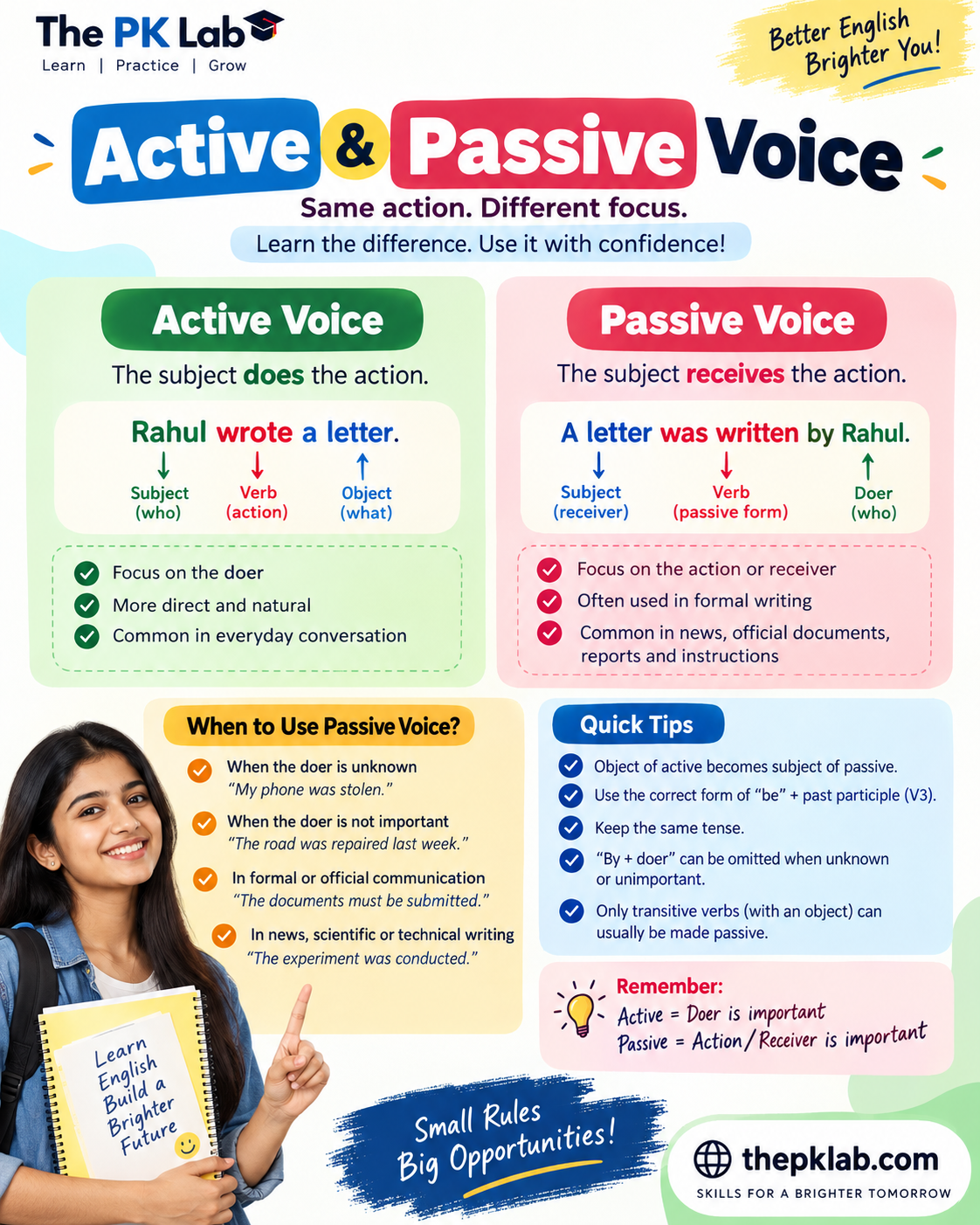
Voice tells us whether the subject does an action or receives an action.
There are two types of voice in English:
- Active Voice – The subject does the action.
- Passive Voice – The subject receives the action.
Simple Example
Active: Rahul wrote a letter.
→ Rahul did the action.
Passive: A letter was written by Rahul.
→ The letter received the action.
Easy memory trick:
Active = Doer is important
Passive = Action/Receiver is important
2. Why Do We Need Active and Passive Voice?
We use Active and Passive Voice to change the focus of a sentence.
Active Voice
We focus on who did the action.
The teacher explained the lesson.
Passive Voice
We focus on the action or the person/thing receiving it.
The lesson was explained by the teacher.
Passive Voice is especially common in:
- News reports
- Formal writing
- Official documents
- Scientific writing
- Instructions
- Reports
- Workplace communication
3. Basic Difference
| Active Voice | Passive Voice |
|---|---|
| Subject does the action. | Subject receives the action. |
| Focus is on the doer. | Focus is on the action/receiver. |
| Usually more direct. | Often more formal. |
| Rahul opened the door. | The door was opened by Rahul. |
Formula
Active:
Subject + Verb + Object
Passive:
Object + Helping Verb + Past Participle (V3) + by + Subject
Example
Active: The boy kicked the ball.
- Subject = The boy
- Verb = kicked
- Object = the ball
Passive: The ball was kicked by the boy.
- New subject = The ball
- Helping verb = was
- V3 = kicked
- Doer = the boy
4. How to Change Active into Passive
Follow these simple steps:
Step 1: Find the Subject, Verb and Object
The manager approved the request.
Subject: The manager
Verb: approved
Object: the request
Step 2: Move the Object to the Beginning
The request…
Step 3: Change the Verb into the Passive Form
The request was approved…
Step 4: Add “by + Subject”
The request was approved by the manager.
Final Answer
Active: The manager approved the request.
Passive: The request was approved by the manager.
5. Active and Passive Voice in Different Tenses
The tense does not disappear when we change the voice. The tense is maintained through the appropriate helping verb.
Present Simple
Active: She writes a letter.
Passive: A letter is written by her.
Structure:
Active: S + V1 + O
Passive: O + is/am/are + V3 + by + S
Present Continuous
Active: She is writing a letter.
Passive: A letter is being written by her.
Structure:
O + is/am/are + being + V3
Present Perfect
Active: She has written a letter.
Passive: A letter has been written by her.
Structure:
O + has/have + been + V3
Past Simple
Active: She wrote a letter.
Passive: A letter was written by her.
Structure:
O + was/were + V3
Past Continuous
Active: She was writing a letter.
Passive: A letter was being written by her.
Structure:
O + was/were + being + V3
Past Perfect
Active: She had written a letter.
Passive: A letter had been written by her.
Structure:
O + had + been + V3
Future Simple
Active: She will write a letter.
Passive: A letter will be written by her.
Structure:
O + will + be + V3
Modal Verbs
Active: You must complete the work.
Passive: The work must be completed by you.
Structure:
O + modal + be + V3
Examples:
- can → can be done
- should → should be completed
- must → must be followed
- may → may be changed
- will → will be completed
6. Quick Tense Table
| Tense | Active | Passive |
|---|---|---|
| Present Simple | writes | is written |
| Present Continuous | is writing | is being written |
| Present Perfect | has written | has been written |
| Past Simple | wrote | was written |
| Past Continuous | was writing | was being written |
| Past Perfect | had written | had been written |
| Future Simple | will write | will be written |
| Modal | can write | can be written |
Important: Not every tense is commonly or naturally used in the passive voice. For practical English, focus first on the forms you actually encounter in everyday and formal communication.
7. When Do We Use Passive Voice?
When the Doer Is Unknown
My phone was stolen.
We don’t know who stole it.
When the Doer Is Not Important
The road was repaired last week.
The important information is the repair, not who repaired it.
When the Action Is More Important
The application has been approved.
The approval is more important than the person who approved it.
In Formal or Official Communication
The documents must be submitted by Monday.
In Scientific or Technical Writing
The experiment was conducted under controlled conditions.
8. When Should We Prefer Active Voice?
Active Voice is generally better when you want your writing to be:
- Clear
- Direct
- Simple
- Natural
- Concise
Compare
Passive: The report was prepared by the team.
Active: The team prepared the report.
Both are grammatically correct, but the active sentence is more direct.
Another Example
Passive: The meeting was conducted by the manager.
Active: The manager conducted the meeting.
For everyday communication, Active Voice is often the more natural choice.
9. When “By” Is Not Necessary
We do not always need to mention the doer.
Active: Someone stole my bicycle.
Passive: My bicycle was stolen.
Not:
❌ My bicycle was stolen by someone.
The doer is unknown or unimportant, so we can leave it out.
Example
Active: People speak English all over the world.
Passive: English is spoken all over the world.
We don’t need to say:
❌ English is spoken by people all over the world.
10. Active vs Passive in Real Life
At Home
Active: Mother cooked dinner.
Passive: Dinner was cooked by Mother.
At College
Active: The teacher checked the assignments.
Passive: The assignments were checked by the teacher.
At Work
Active: The manager approved the leave request.
Passive: The leave request was approved by the manager.
Shopping
Active: The shopkeeper packed the items.
Passive: The items were packed by the shopkeeper.
News
A new bridge was inaugurated yesterday.
The focus is on the bridge and the inauguration.
Office Notice
All employees must submit the report by Friday.
Passive:
The report must be submitted by Friday.
11. Active and Passive with Modal Verbs
Modal verbs are very common in passive sentences.
Pattern
Active: Subject + Modal + V1 + Object
Passive: Object + Modal + be + V3
Examples
Active: You should follow the rules.
Passive: The rules should be followed.
Active: We must complete the project.
Passive: The project must be completed.
Active: They can solve the problem.
Passive: The problem can be solved.
Active: You should submit the form today.
Passive: The form should be submitted today.
12. Active and Passive Questions
Active
Did Rahul complete the assignment?
Passive
Was the assignment completed by Rahul?
Another example:
Active: Who prepared this report?
Passive: By whom was this report prepared?
In everyday spoken English, however, “Who was this report prepared by?” may be heard, while “By whom…” is more formal.
13. Imperative Sentences
Commands and instructions can also be expressed in the passive voice.
Active
Open the door.
Passive
Let the door be opened.
Active
Complete the form.
Passive
Let the form be completed.
However, in everyday English, the active form is usually much more natural:
Please complete the form.
So don’t use passive simply because you can. Choose the form that communicates naturally.
14. Correct vs Incorrect
Example 1
❌ The letter was wrote by Rahul.
✅ The letter was written by Rahul.
Why?
Passive Voice requires the past participle (V3).
Example 2
❌ The work is completed by him yesterday.
✅ The work was completed by him yesterday.
Why?
“Yesterday” indicates past time, so we need was, not is.
Example 3
❌ The project is being complete.
✅ The project is being completed.
Why?
After being, use V3 in the passive structure.
Example 4
❌ The work must completed today.
✅ The work must be completed today.
Why?
After a modal verb, passive voice requires be + V3.
15. Common Mistakes
Mistake 1: Forgetting V3
❌ The letter was write by me.
✅ The letter was written by me.
Mistake 2: Using the wrong helping verb
❌ The books is sold here.
✅ The books are sold here.
Mistake 3: Changing the tense
❌ He writes a letter → A letter was written by him.
✅ He writes a letter → A letter is written by him.
Mistake 4: Using “by” unnecessarily
❌ English is spoken by people everywhere.
✅ English is spoken everywhere.
Mistake 5: Making every sentence passive
Passive Voice is useful, but it should not replace Active Voice everywhere.
16. Important Rule: Only Transitive Verbs Usually Become Passive
A passive sentence normally requires an object in the active sentence.
Transitive Verb
Rahul opened the door.
There is an object: the door.
Passive:
The door was opened by Rahul.
Intransitive Verb
Rahul slept.
There is no object.
We cannot normally make this passive:
❌ A bed was slept by Rahul.
So remember:
No object → normally no passive voice.
17. Spoken English: Active vs Passive
In everyday conversation, Active Voice is often preferred because it is shorter and clearer.
Formal
The decision was taken by the management.
More direct
The management made the decision.
Formal
Your application has been received.
Everyday
We have received your application.
Both are correct. The choice depends on what you want to emphasize.
18. Quick Memory Trick
Remember:
ACTIVE
Doer → Action → Receiver
Rahul → opened → the door.
PASSIVE
Receiver → Action → Doer
The door → was opened → by Rahul.
The Golden Rule
Object of Active → Subject of Passive
And:
Passive Verb = appropriate form of BE + V3
19. Practice Exercise
A. Change into Passive Voice
- Rahul writes a letter.
- The teacher checked the answer sheets.
- She is preparing dinner.
- They have completed the project.
- The manager approved the request.
- We will organize the meeting.
- You must follow the rules.
- Someone stole my bag.
- The company launched a new product.
- The students are cleaning the classroom.
B. Change into Active Voice
- The letter was written by Rahul.
- The project has been completed by the team.
- The room is being cleaned by the students.
- The meeting will be organized by the manager.
- The rules must be followed by everyone.
20. Answers
A. Passive Voice
- A letter is written by Rahul.
- The answer sheets were checked by the teacher.
- Dinner is being prepared by her.
- The project has been completed by them.
- The request was approved by the manager.
- The meeting will be organized by us.
- The rules must be followed by you.
- My bag was stolen.
- A new product was launched by the company.
- The classroom is being cleaned by the students.
B. Active Voice
- Rahul wrote the letter.
- The team has completed the project.
- The students are cleaning the room.
- The manager will organize the meeting.
- Everyone must follow the rules.
21. Quick Revision
| Remember | Meaning |
|---|---|
| Active Voice | Subject does the action |
| Passive Voice | Subject receives the action |
| Active Formula | S + V + O |
| Passive Formula | O + BE + V3 + by + S |
| Main verb in Passive | V3 / Past Participle |
| Modal Passive | Modal + be + V3 |
| Unknown doer | “by” can be omitted |
| No object | Usually cannot form passive |
One Sentence to Remember
Active Voice tells us who does the action; Passive Voice tells us what happens to the receiver of the action.
FAQs
1. What is Active Voice?
Active Voice is a sentence structure in which the subject performs the action.
The boy opened the door.
2. What is Passive Voice?
Passive Voice is a sentence structure in which the subject receives the action.
The door was opened by the boy.
3. Is Passive Voice wrong?
No. Passive Voice is completely correct. It is useful when the action or receiver is more important than the doer.
4. Is Active Voice better than Passive Voice?
Not always. Active Voice is usually more direct and natural, while Passive Voice is useful for formal, official, scientific, and situations where the doer is unknown or unimportant.
5. What is the most important rule of Passive Voice?
Remember:
BE + V3
For example:
- is written
- was completed
- has been approved
- will be submitted
- must be followed
Key Takeaways
✅ Active Voice focuses on the doer.
✅ Passive Voice focuses on the receiver/action.
✅ The object of the active sentence generally becomes the subject of the passive sentence.
✅ Passive Voice normally uses BE + V3.
✅ Keep the original tense when changing voice.
✅ We can omit by + doer when the doer is unknown or unimportant.
✅ Use Active Voice for clear, direct communication.
✅ Use Passive Voice when the action or receiver deserves more attention.