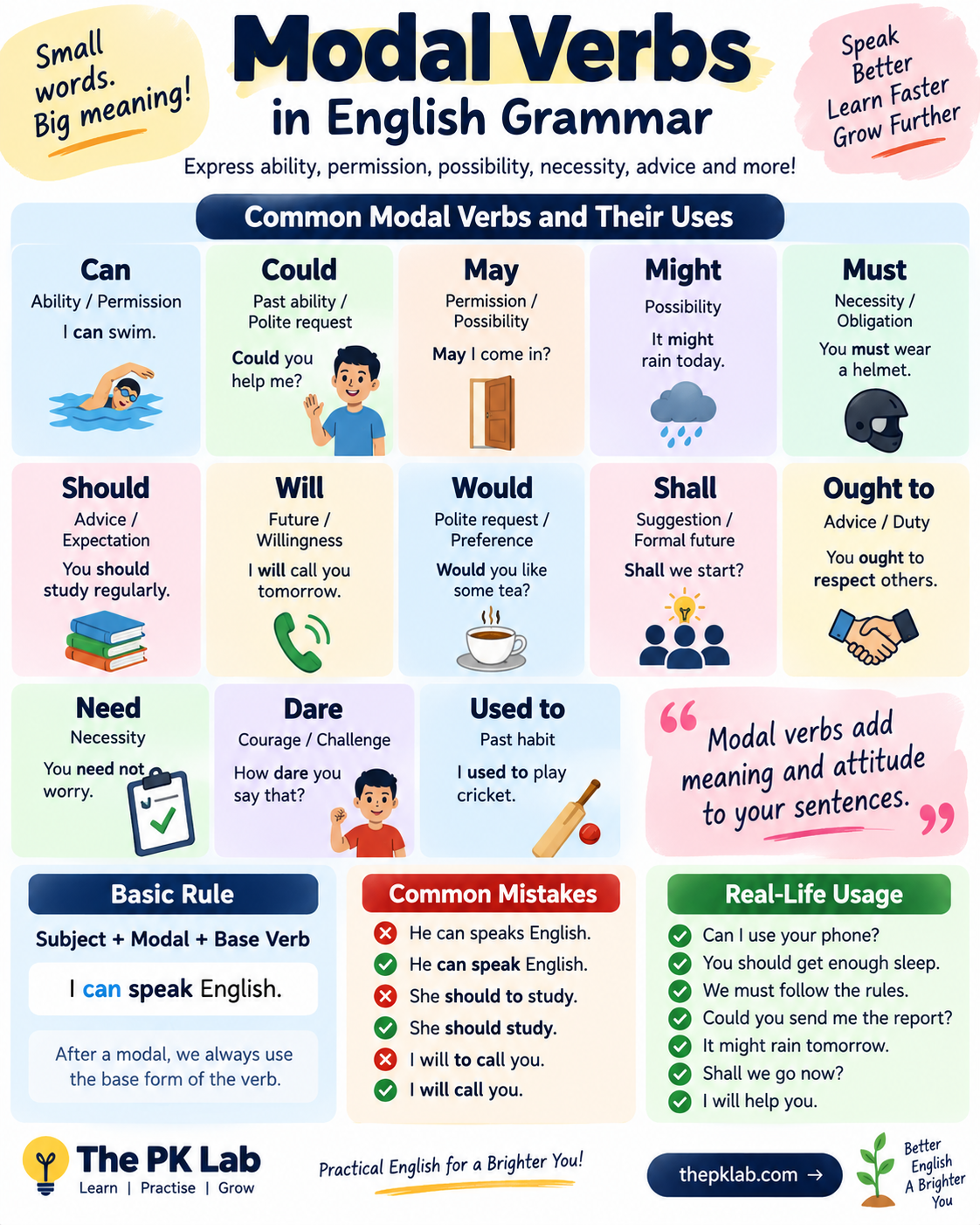
What are Modals?
Modal verbs are special helping verbs that show a person’s ability, possibility, permission, necessity, advice, intention, or obligation.
They help us express what someone can do, may do, should do, must do, or might do.
Common Modal Verbs
| Modal | Main Use | Example |
|---|---|---|
| Can | Ability / Permission | I can swim. |
| Could | Past ability / Polite request / Possibility | Could you help me? |
| May | Permission / Possibility | May I come in? |
| Might | Possibility | It might rain today. |
| Must | Strong necessity / Obligation | You must wear a helmet. |
| Shall | Suggestion / Formal future | Shall we start? |
| Should | Advice / Expectation | You should study regularly. |
| Will | Future / Willingness | I will call you. |
| Would | Polite request / Preference / Imaginary situation | Would you like some tea? |
| Ought to | Advice / Duty | You ought to respect your parents. |
| Need | Necessity | You need not worry. |
| Dare | Courage / Challenge | How dare you say that? |
| Used to | Past habit/state | I used to play cricket. |
Why Do We Need Modal Verbs?
Compare these sentences:
You submit the form.
This is simply a statement.
You must submit the form.
Now we understand that submitting the form is necessary.
You should submit the form.
Now it sounds like advice.
You can submit the form.
Now it expresses permission or possibility.
So, modal verbs add meaning and attitude to a sentence.
Basic Rule of Modal Verbs
The most important rule is:
Subject + Modal + Base Verb
Examples:
- I can speak English.
- She can speak English.
- They should study regularly.
- He must attend the meeting.
- We will meet tomorrow.
Remember:
After a modal, normally use the base form of the verb.
❌ He can speaks English.
✅ He can speak English.
❌ She should studies more.
✅ She should study more.
❌ You must to go now.
✅ You must go now.
1. CAN
Can mainly expresses ability, permission, or possibility.
Ability
- I can swim.
- She can speak English.
- Rahul can drive a car.
Permission
- Can I use your phone?
- Can I come in?
- Can we leave now?
Possibility
- It can be very hot in Odisha during summer.
Negative
cannot / can’t
- I cannot swim.
- You can’t park here.
- She can’t attend the meeting today.
2. COULD
Could is commonly used for past ability, polite requests, and possibility.
Past Ability
- I could swim when I was ten.
- She could speak English well even in school.
Polite Request
- Could you help me?
- Could you please open the door?
- Could you explain this again?
Possibility
- It could rain tonight.
- This could be a good opportunity.
Tip:
Could often sounds more polite than can when making a request.
3. MAY
May is used mainly for formal permission and possibility.
Permission
- May I come in, Sir?
- May I use your computer?
- May I leave early today?
Possibility
- It may rain tomorrow.
- The meeting may be cancelled.
Spoken English:
In everyday conversation, Can I…? is very common for permission.
Formal: May I come in?
Everyday: Can I come in?
4. MIGHT
Might expresses a possibility, usually when we are less certain.
- It might rain today.
- She might come tomorrow.
- We might go to Bhubaneswar this weekend.
- He might be busy.
Compare:
It will rain. → Strong expectation/certainty
It may rain. → Possible
It might rain. → Possible, but less certain
5. MUST
Must expresses strong necessity, obligation, or a strong conclusion.
Necessity / Obligation
- You must wear a helmet.
- Students must attend the examination.
- Employees must follow the company’s rules.
Strong conclusion
- He must be tired after such a long journey.
- You have been working all day; you must be hungry.
Negative: MUST NOT / MUSTN’T
Mustn’t means something is prohibited.
- You mustn’t smoke here.
- You mustn’t use your mobile during the examination.
Important Difference
You mustn’t go.
= You are not allowed to go.
You don’t have to go.
= It is not necessary to go.
These two meanings are very different.
6. SHOULD
Should is mainly used for advice, recommendation, duty, and expectation.
Advice
- You should practise English every day.
- You should get enough sleep.
- You should check your email.
Expectation
- The train should arrive soon.
- The results should be announced tomorrow.
Negative
should not / shouldn’t
- You shouldn’t waste your time.
- You shouldn’t speak rudely to others.
7. WILL
Will is commonly used for future actions, decisions, promises, and willingness.
- I will call you tomorrow.
- She will join the meeting.
- We will complete the work.
- I will help you.
Willingness
Don’t worry. I will help you.
Here, will shows willingness.
Negative
will not / won’t
- I won’t forget your help.
- He won’t attend the meeting.
8. WOULD
Would is commonly used for polite requests, offers, preferences, and hypothetical situations.
Polite Request
- Would you help me?
- Would you please wait here?
Offer
- Would you like some tea?
- Would you like to join us?
Preference
- I would like a cup of coffee.
- I would rather stay at home.
Hypothetical Situation
- I would travel more if I had enough time.
- She would buy a car if she had enough money.
9. SHALL
Shall is used mainly in formal English and for suggestions or offers, especially with I and we.
Suggestion
- Shall we start the class?
- Shall we go now?
- Shall we discuss this tomorrow?
Offer
- Shall I open the window?
- Shall I help you?
In modern everyday English, will is much more common for ordinary future statements.
10. OUGHT TO
Ought to expresses advice, duty, or what is morally right.
- You ought to respect your parents.
- We ought to help people in need.
- You ought to be more careful.
Important:
Unlike most modal verbs, ought is followed by to + base verb.
✅ You ought to study.
❌ You ought study.
11. NEED
Need can express necessity.
- You need to study.
- We need to leave now.
- She needs to complete the report.
As a modal in certain negative/question constructions:
- You needn’t worry.
- Need I explain it again?
In everyday English, need to is much more common:
You don’t need to worry.
12. DARE
Dare can express courage or a challenge.
- How dare you speak to me like that?
- I dare not ask him.
- Dare you question my decision?
In everyday English, dare is often used as an ordinary verb:
I don’t dare to ask him.
13. USED TO
Used to describes a past habit or past situation that is no longer true.
- I used to play cricket.
- She used to live in Cuttack.
- We used to go there every Sunday.
Compare:
I used to play cricket.
= I played cricket regularly in the past, but I don’t do it now.
Modal Verb Sentence Patterns
Affirmative
Subject + Modal + Base Verb
She can speak English.
Negative
Subject + Modal + not + Base Verb
She cannot speak English.
Question
Modal + Subject + Base Verb?
Can she speak English?
WH-Question
WH-word + Modal + Subject + Base Verb?
What can you do?
Where should I go?
When will they arrive?
Correct vs Incorrect
| ❌ Incorrect | ✅ Correct |
|---|---|
| He can speaks English. | He can speak English. |
| She should to study. | She should study. |
| I will to call you. | I will call you. |
| You must to go. | You must go. |
| He may comes tomorrow. | He may come tomorrow. |
| Could you to help me? | Could you help me? |
| She can sings well. | She can sing well. |
The Golden Rule
Modal + Base Verb
Not:
Modal + to + verb
Modal + -s + verb
Modal + -ed + verb
Modal Verbs in Real-Life English
At Home
Can you help me?
You should eat your breakfast.
You must lock the door.
At School/College
May I come in, Sir?
You must submit your assignment.
You should revise this chapter.
At Work
Could you send me the report?
We must complete this task today.
I will send the file shortly.
During an Interview
I can work under pressure.
I would like to learn new skills.
I will give my best to the organization.
While Travelling
Can I book a ticket?
Could you tell me the way?
It might take two hours.
Common Mistakes Made by Indian English Learners
1. Adding “to” after a modal
❌ I can to speak English.
✅ I can speak English.
2. Adding “s” to the verb
❌ He can drives a car.
✅ He can drive a car.
3. Using two modals together
❌ I will can attend the meeting.
✅ I will be able to attend the meeting.
❌ He may can come tomorrow.
✅ He may be able to come tomorrow.
4. Confusing mustn’t and don’t have to
❌ You mustn’t submit the form today. (if you mean it isn’t necessary)
✅ You don’t have to submit the form today.
Formal vs Natural Spoken English
Grammar is not only about correctness; it is also about natural usage.
| More Formal | Natural Everyday English |
|---|---|
| I cannot attend. | I can’t attend. |
| I would like some water. | I’d like some water. |
| Could you please help me? | Could you help me? |
| I will call you later. | I’ll call you later. |
| You should not worry. | You shouldn’t worry. |
Both forms can be correct. The best choice depends on the situation, audience, and level of formality.
Quick Memory Trick
Think of modal verbs as meaning makers:
CAN → Ability
COULD → Polite request / Past ability
MAY → Permission / Possibility
MIGHT → Possibility
MUST → Necessity
SHOULD → Advice
WILL → Future / Willingness
WOULD → Politeness / Preference
SHALL → Suggestion
OUGHT TO → Duty / Advice
Remember:
MODAL + BASE VERB
Can go.
Should study.
Must work.
Will come.
Could help.
Practice Exercise
Choose the correct modal verb.
- You ___ wear a seat belt.
a) must
b) can
c) might - ___ I come in, Sir?
a) Must
b) May
c) Should - You ___ practise speaking English every day.
a) should
b) might
c) would - ___ you please send me the document?
a) Could
b) Must
c) Shall - It ___ rain tonight.
a) might
b) mustn’t
c) ought - I ___ swim when I was eight.
a) could
b) may
c) shall - We ___ complete the work today.
a) must
b) might
c) could - ___ we start the meeting?
a) Shall
b) Must
c) Might - He ___ speak three languages.
a) can
b) should to
c) must to - You ___ worry about this.
a) needn’t
b) mustn’t
c) can’t
Answers
- must
- May
- should
- Could
- might
- could
- must
- Shall
- can
- needn’t
Quick Revision
Modal verbs are helping verbs that express ideas such as:
- Ability → can
- Past ability → could
- Permission → may / can
- Possibility → may / might / could
- Necessity → must
- Advice → should / ought to
- Future → will
- Polite request → could / would
- Suggestion → shall
The most important rule:
Subject + Modal + Base Verb
I can speak.
She should study.
They will come.
We must work.
FAQs
Can we use “to” after a modal?
Normally, no.
❌ I can to swim.
✅ I can swim.
However, ought to is an important exception.
Does a modal change according to the subject?
No.
We say:
- I can
- He can
- She can
- They can
Not he cans.
Can we use two modal verbs together?
Normally, no.
❌ I will can go.
✅ I will be able to go.
Which modal is best for polite requests?
Could and would are commonly used.
Could you help me?
Would you please wait?
Are modal verbs important for spoken English?
Yes. Modal verbs are extremely common in everyday communication because they help us express requests, advice, permission, possibility, ability, and necessity naturally.