Introduction
Learning English is not only about studying grammar rules, memorising vocabulary, or solving exercises.
The real goal is to use English confidently in everyday situations.
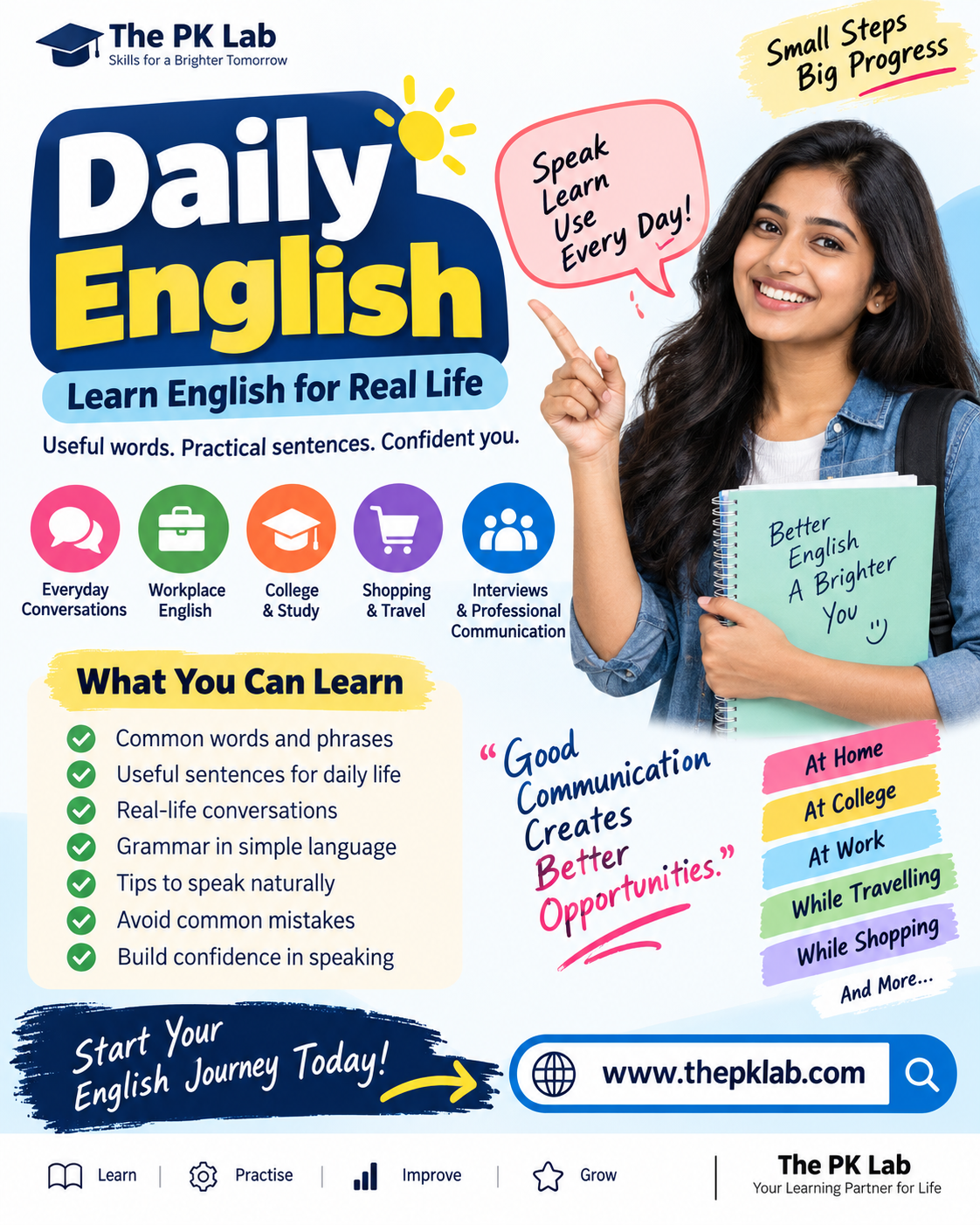
Daily English helps you learn the words, phrases, sentences, expressions, and communication patterns that people use in real life.
Whether you are talking to your family, attending college, going to work, shopping, travelling, speaking on the phone, or preparing for an interview, Daily English helps you communicate more naturally.
Learn a little English every day. Use it every day. Improve every day.
What is Daily English?
Daily English means the English we use in our everyday conversations and activities.
It includes:
- Common words
- Everyday sentences
- Useful expressions
- Questions and answers
- Greetings
- Requests
- Suggestions
- Apologies
- Opinions
- Conversations
- Workplace communication
- Telephone English
- Shopping English
- Travel English
- Interview English
For example:
Instead of only learning the word “thirsty,” learn how to use it:
I am thirsty.
Can I have some water?
I’m feeling thirsty.
Would you like something to drink?
This helps you move from knowing English to using English.
Why is Daily English Important?
Many learners understand English when they read it but hesitate when they have to speak.
Why?
Because knowing grammar and vocabulary is different from using them in real situations.
Daily English helps you:
1. Speak with Confidence
Practise common sentences until they become natural.
2. Improve Fluency
You learn ready-to-use sentence patterns instead of translating every sentence from your mother tongue.
3. Build Vocabulary
Learn useful words in context rather than memorising isolated word lists.
4. Improve Listening
Familiarity with everyday expressions makes conversations easier to understand.
5. Communicate Naturally
You learn how people actually communicate in everyday situations.
6. Reduce Common Mistakes
Regular exposure to correct English helps you recognise and avoid common errors.
Daily English vs Textbook English
There is a difference between grammatically correct English and the way people commonly speak in everyday situations.
| Formal / Textbook | Natural Everyday English |
|---|---|
| I do not know. | I don’t know. |
| I am going to the market. | I’m going to the market. |
| Would you like some tea? | Would you like some tea? |
| I cannot understand. | I can’t understand. |
| What are you doing? | What are you doing? |
| I will call you later. | I’ll call you later. |
Both forms can be correct. The important thing is understanding when and where to use them.
Formal English may be appropriate for official communication, academic writing, or professional situations.
Conversational English is often shorter and more natural in everyday speaking.
Common Daily English Sentences
Here are some simple sentences you can start using today.
At Home
- Good morning.
- Have you had breakfast?
- What are you doing?
- I’m getting ready.
- Please wait for me.
- Where is my phone?
- I’ll be back soon.
- I’m feeling tired.
- Let’s have dinner.
- See you tomorrow.
At College
- Which class do we have next?
- When is the exam?
- Did you complete the assignment?
- Can you explain this?
- I didn’t understand this topic.
- May I borrow your notes?
- Let’s study together.
- I’ll send you the notes.
At Work
- Good morning, everyone.
- Shall we start the meeting?
- I’ll check and let you know.
- Please give me a moment.
- Could you please explain this?
- I’ll send the report today.
- Let’s discuss this later.
- I agree with you.
- I’ll get back to you.
- Thank you for your support.
While Shopping
- How much does this cost?
- Do you have this in another size?
- Can I see another colour?
- Is there any discount?
- I’ll take this one.
- Do you accept digital payments?
- Can I get a bill, please?
While Travelling
- Where is the railway station?
- How can I get there?
- How far is it from here?
- What time does the bus leave?
- Where can I buy a ticket?
- Is this seat available?
- Could you please help me?
Useful Daily Expressions
Some expressions are more useful when learned as complete phrases.
Asking for Help
Could you please help me?
Can you help me with this?
Would you mind helping me?
Asking for Permission
May I come in?
Can I use your phone?
Is it okay if I leave early?
Making a Request
Please give me a minute.
Could you please send me the file?
Please let me know.
Giving an Opinion
I think this is a good idea.
In my opinion, we should wait.
I agree with you.
I’m not sure about that.
Apologising
I’m sorry.
I’m really sorry.
Sorry for the delay.
I apologise for the inconvenience.
Thanking Someone
Thank you.
Thanks a lot.
I really appreciate it.
Thank you for your help.
Correct vs Incorrect
Small mistakes can change the quality of your English.
| Incorrect | Correct |
|---|---|
| I am having two brothers. | I have two brothers. |
| He don’t know. | He doesn’t know. |
| I didn’t went there. | I didn’t go there. |
| Discuss about the problem. | Discuss the problem. |
| Return back tomorrow. | Return tomorrow. |
| Myself Pranakrushna. | My name is Pranakrushna. |
| He is senior than me. | He is senior to me. |
| I am going to home. | I am going home. |
Remember:
Don’t just ask:
“Is this sentence grammatically correct?”
Also ask:
“Would a person naturally say it this way?”
Daily English for Indian Learners
Many Indian learners first think in their regional language and then translate into English.
This can make speaking slow and sometimes produce unnatural sentences.
Instead of translating every sentence, start learning English sentence patterns.
For example:
Pattern: “I want to…”
I want to learn English.
I want to improve my communication.
I want to speak confidently.
I want to attend the meeting.
Pattern: “I need to…”
I need to study.
I need to complete this work.
I need to call my manager.
I need to leave now.
Pattern: “I’m going to…”
I’m going to college.
I’m going to the office.
I’m going to call him.
I’m going to start a new course.
Learning patterns like these helps learners create many sentences without memorising every sentence separately.
Daily English Conversations
Conversation 1: Meeting a Friend
A: Hi! How are you?
B: I’m good. How about you?
A: I’m doing well. Where are you going?
B: I’m going to college.
A: Are you free this evening?
B: Yes, I am.
A: Let’s meet in the evening.
B: Sure. See you then.
Conversation 2: At the Office
Manager: Have you completed the report?
Employee: Almost. I’m working on the final section.
Manager: When can you send it?
Employee: I’ll send it by this afternoon.
Manager: Okay. Please let me know once it’s ready.
Employee: Sure.
Daily English Practice Method
You don’t need to study English for several hours every day.
Try this simple method:
Step 1: Learn 5 New Words
Example:
- improve
- attend
- complete
- discuss
- explain
Step 2: Create Sentences
I want to improve my English.
I will attend the meeting.
I need to complete the assignment.
Let’s discuss the problem.
Could you explain this?
Step 3: Speak Them Aloud
Don’t only read the sentences.
Speak them.
Step 4: Use Them in Real Life
Try to use at least one or two new expressions during your day.
Step 5: Review at Night
Ask yourself:
What new English did I learn today?
This simple habit can gradually improve your vocabulary, grammar, fluency, and confidence.
Daily English Challenge
Try the 5-5-5 method:
5 new words
+
5 useful sentences
+
5 minutes of speaking
Do this every day.
Consistency is more important than studying a large amount of English once in a while.
Common Mistakes Learners Should Avoid
1. Translating Everything
Try to think in simple English instead of translating every sentence word-for-word.
2. Using Difficult Words Unnecessarily
Simple English is often better than complicated English.
Instead of:
I would like to utilise this opportunity…
You can often say:
I would like to use this opportunity.
3. Being Afraid of Mistakes
Mistakes are a natural part of language learning.
Speak, notice your mistakes, correct them, and try again.
4. Memorising Without Using
A word becomes useful when you use it in a sentence.
5. Focusing Only on Grammar
Grammar is important, but communication requires grammar + vocabulary + listening + speaking + practice.
Quick Tips
Tip 1: Learn Sentences, Not Just Words
Don’t learn:
“busy = having a lot of work”
Learn:
I’m busy right now.
Tip 2: Speak Every Day
Even five minutes of speaking practice can help build confidence.
Tip 3: Listen to English
Listen to conversations, interviews, presentations, podcasts, and educational videos.
Tip 4: Keep an English Notebook
Write down:
- New words
- Useful expressions
- Common mistakes
- Sentences you want to practise
Tip 5: Use English in Small Situations
Start with simple activities:
Good morning.
Please give me some water.
I’ll call you later.
What time is the meeting?
Small sentences build big confidence.
Practice Exercise
A. Fill in the blanks
- I ______ going to the office.
- Could you please ______ me?
- I ______ to improve my English.
- I’ll ______ you later.
- What ______ you doing?
Answers
- am
- help
- want
- call
- are
B. Correct the Sentences
- He don’t know me.
- I didn’t went there.
- Myself Rahul.
- I am going to home.
- She have a car.
Answers
- He doesn’t know me.
- I didn’t go there.
- My name is Rahul.
- I am going home.
- She has a car.
Quick Revision
Daily English is about using English in real-life situations.
Remember:
- Learn useful words.
- Learn complete sentences.
- Practise sentence patterns.
- Speak every day.
- Listen to natural English.
- Learn from your mistakes.
- Use English in real situations.
- Focus on communication, not perfection.
Don’t wait until your English is perfect to speak. Speak, practise, learn, and improve.
Frequently Asked Questions
What is Daily English?
Daily English is the practical English used in everyday conversations, activities, education, travel, work, and social situations.
How can I improve my Daily English?
Learn a few useful words and sentences every day, practise speaking aloud, listen to English, and use new expressions in real situations.
Is Daily English different from grammar?
Yes. Grammar explains how English works, while Daily English focuses more on how English is actually used in everyday communication. Both are important.
Can beginners learn Daily English?
Absolutely. Beginners can start with greetings, basic questions, common verbs, simple sentence patterns, and everyday expressions.
Should I learn grammar before speaking English?
You do not need to master all grammar before speaking. Learn basic grammar while practising real communication.
How many sentences should I practise every day?
Start with 5–10 useful sentences. The quality and regular use of practice matter more than memorising a large number of sentences.
Key Takeaways
Daily English = Learn + Practise + Use
You don’t have to learn thousands of words before you start speaking.
Start with the English you need today.
Learn one word.
Make one sentence.
Speak it.
Use it.
Then repeat tomorrow.
That is how everyday English becomes natural English.