Learn How to Build English Sentences Correctly
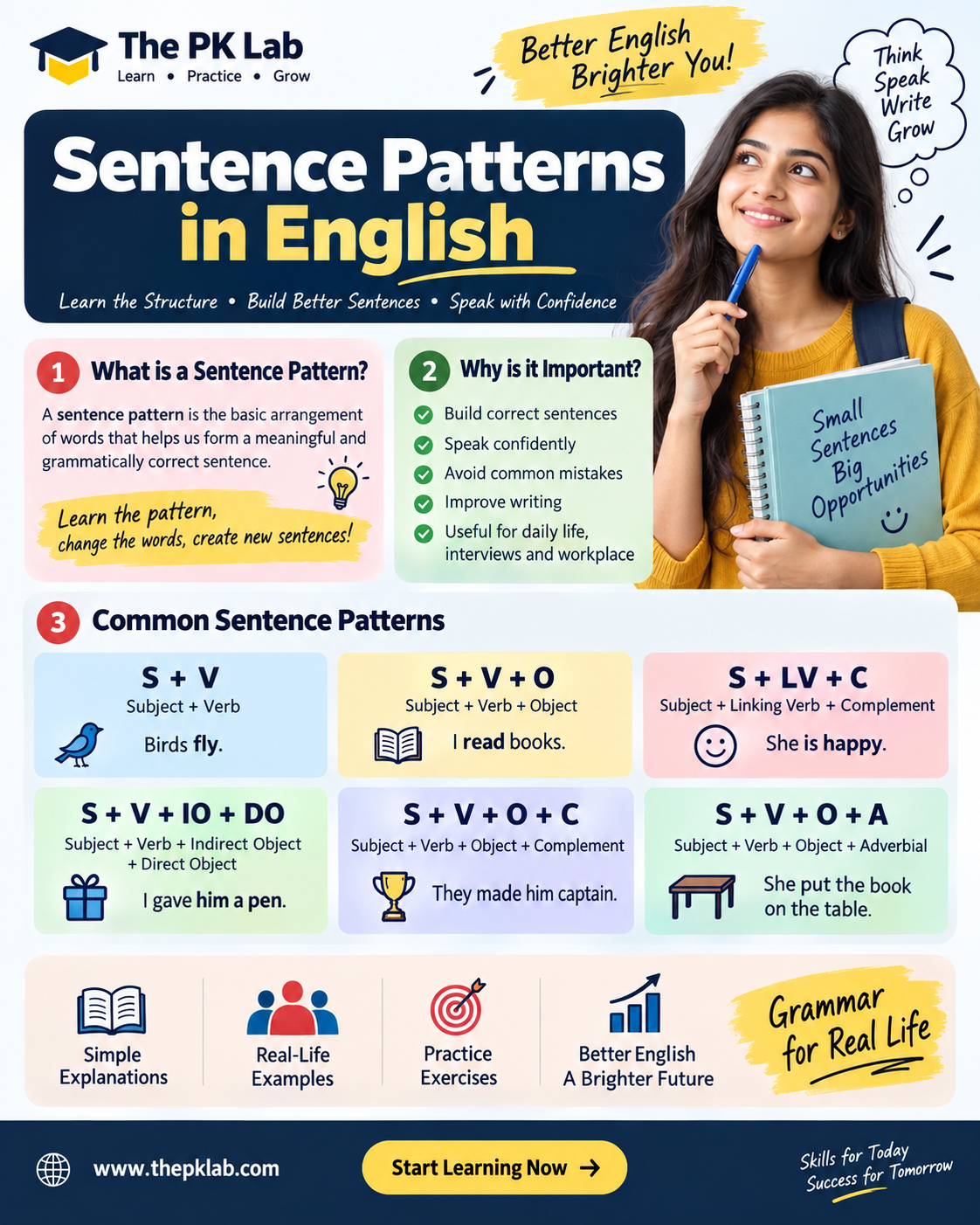
A sentence pattern is a basic arrangement of words that helps us form a meaningful and grammatically correct sentence.
Think of a sentence pattern as a framework. Once you understand the framework, you can create hundreds of sentences by changing the words.
For example:
I eat rice.
I read books.
I play cricket.
I watch movies.
The words are different, but the basic pattern is the same:
Subject + Verb + Object
Sentence patterns are especially useful for beginners because they teach you how to put words together, rather than asking you to memorize individual sentences.
1. What Is a Sentence Pattern?
A sentence pattern is the usual order in which the main parts of a sentence are arranged.
For example:
Rahul plays cricket.
- Rahul → Subject
- plays → Verb
- cricket → Object
So the pattern is:
Subject + Verb + Object
S + V + O
Once you know this pattern, you can make many sentences:
| Subject | Verb | Object |
|---|---|---|
| I | read | books. |
| She | drinks | tea. |
| They | play | football. |
| We | watch | movies. |
| He | drives | a car. |
2. Why Are Sentence Patterns Important?
Knowing vocabulary is not enough.
You may know:
I
market
yesterday
go
But you need to arrange these words correctly:
I went to the market yesterday.
Sentence patterns help you:
- Build sentences correctly
- Speak English more confidently
- Avoid word-order mistakes
- Understand English conversations
- Improve writing
- Speak naturally
- Form longer and more complex sentences
- Improve interview and workplace communication
Remember:
Words give you vocabulary. Sentence patterns help you use that vocabulary.
3. The Basic Parts of a Sentence
Before learning sentence patterns, understand these important parts.
Subject
The subject tells us who or what the sentence is about.
Ravi plays cricket.
She is studying.
The students are working.
Verb
The verb tells us about an action, state, or condition.
Ravi plays cricket.
She is happy.
They work hard.
Object
The object receives the action.
Ravi plays cricket.
She reads a book.
I bought a laptop.
Complement
A complement gives additional information about the subject or object.
She is a teacher.
He became angry.
The food is delicious.
4. The Most Common English Sentence Patterns
Let’s learn the major sentence patterns step by step.
Pattern 1: Subject + Verb
S + V
This is one of the simplest sentence patterns.
The sentence has a subject and a verb. The verb does not need an object.
Examples
Birds fly.
Children laugh.
Dogs bark.
Babies cry.
The sun rises.
Students study.
Real-Life Examples
I work.
She sings.
He runs.
They arrived.
We laughed.
Remember:
Some verbs can make a complete sentence without an object.
Pattern 2: Subject + Verb + Object
S + V + O
This is one of the most important English sentence patterns.
I read books.
I = Subject
read = Verb
books = Object
Examples
I drink tea.
She reads newspapers.
Rahul plays cricket.
We watch television.
They bought a car.
He opened the door.
Daily Conversation
I need help.
I want water.
She likes music.
We need information.
He uses a laptop.
Memory Trick
Ask:
Who + does what + to what/who?
I + eat + rice.
Pattern 3: Subject + Linking Verb + Complement
S + LV + C
A linking verb connects the subject with information that describes or identifies it.
Common linking verbs include:
am, is, are, was, were, become, seem, look, feel
Examples
I am happy.
She is a teacher.
He is tired.
They are students.
The food looks delicious.
Ravi became angry.
Here:
She is a teacher.
- She → Subject
- is → Linking Verb
- a teacher → Complement
The complement tells us more about the subject.
Pattern 4: Subject + Verb + Indirect Object + Direct Object
S + V + IO + DO
This pattern is common when someone gives, sends, tells, shows, or offers something to another person.
Example
I gave Rahul a book.
- I → Subject
- gave → Verb
- Rahul → Indirect Object
- a book → Direct Object
More Examples
She gave me a pen.
He sent his friend a message.
Mother bought me a shirt.
The teacher taught us English.
I told him the truth.
Easy Question Trick
Ask:
To whom? / For whom?
I gave Rahul a book.
Who received the book?
Rahul → Indirect Object
What did I give?
a book → Direct Object
Pattern 5: Subject + Verb + Object + Complement
S + V + O + C
Here, the complement gives more information about the object.
Examples
They elected him president.
We found the movie interesting.
The news made her happy.
They painted the wall blue.
Look at:
They painted the wall blue.
- They → Subject
- painted → Verb
- the wall → Object
- blue → Complement
Blue tells us the resulting condition of the wall.
Pattern 6: Subject + Verb + Object + Adverbial
S + V + O + A
An adverbial gives additional information such as place, time, manner, or direction.
Examples
I kept the book on the table.
She put her phone in the bag.
He parked the car outside.
They completed the work yesterday.
For example:
She put her phone on the table.
- She → Subject
- put → Verb
- her phone → Object
- on the table → Adverbial
5. Sentence Patterns for Everyday English
Sentence patterns become particularly useful in spoken English.
Talking About Yourself
I + Verb + Object
I work in Bhubaneswar.
I teach English.
I like reading.
I watch documentaries.
Talking About Another Person
He/She + Verb + Object
She works in a bank.
He plays cricket.
She speaks English.
He likes music.
Talking About the Present
Subject + am/is/are + Complement
I am busy.
She is ready.
He is tired.
They are happy.
Talking About Possession
Subject + have/has + Object
I have a laptop.
She has a car.
He has two brothers.
They have a meeting.
6. Sentence Patterns for Questions
English questions also follow patterns.
Yes/No Questions
Helping Verb + Subject + Main Verb…?
Do you work here?
Does she speak English?
Did he call you?
Are you ready?
Is he coming?
Examples
Statement:
You speak English.
Question:
Do you speak English?
7. WH-Question Pattern
Common WH-words include:
What, Where, When, Why, Who, Which, Whose, How
Pattern
WH-word + Helping Verb + Subject + Main Verb…?
Examples:
Where do you live?
What do you want?
Why are you late?
When did he arrive?
How do you know?
In Daily Conversation
What are you doing?
Where are you going?
When will you come?
Why did you call me?
How can I help you?
8. Negative Sentence Patterns
To make many English sentences negative, we use helping verbs such as:
do, does, did, am, is, are, was, were, have, has, will, etc.
Present Simple
Subject + do/does + not + Verb
I do not smoke.
They do not agree.
She does not work here.
He does not like coffee.
Spoken English
I don’t know.
We don’t need it.
She doesn’t agree.
He doesn’t understand.
Formal vs Spoken English
| Formal | Natural Spoken English |
|---|---|
| I do not know. | I don’t know. |
| I cannot come. | I can’t come. |
| She is not ready. | She isn’t ready. |
| We will not go. | We won’t go. |
Both forms can be grammatically correct; the appropriate choice depends on the situation.
9. Sentence Patterns with Adjectives
Adjectives describe nouns or provide information about them.
Pattern
Subject + be + Adjective
I am happy.
She is beautiful.
He is honest.
The room is clean.
The weather is pleasant.
Before a Noun
Adjective + Noun
a good student
a beautiful city
an expensive phone
a difficult question
In a Sentence
She is a good teacher.
He bought an expensive phone.
10. Sentence Patterns with Adverbs
Adverbs can tell us how, when, where, or how often something happens.
He runs quickly.
She speaks clearly.
I usually wake up early.
They arrived yesterday.
Compare:
He speaks English.
with:
He speaks English fluently.
The second sentence gives us additional information about how he speaks.
11. Correct vs Incorrect
Sentence patterns can help identify common word-order mistakes.
| ❌ Incorrect | ✅ Correct |
|---|---|
| I to school go. | I go to school. |
| He cricket plays. | He plays cricket. |
| Where you are going? | Where are you going? |
| She English speaks. | She speaks English. |
| I yesterday went there. | I went there yesterday. |
| What you want? | What do you want? |
Important:
English generally follows a predictable word order.
Subject → Verb → Object
Not:
Subject → Object → Verb
This is particularly important for learners whose first language follows a different word order.
12. Common Sentence Pattern Mistakes
Mistake 1: Incorrect Word Order
❌ I English speak.
✅ I speak English.
Mistake 2: Missing Helping Verb
❌ You going to college?
✅ Are you going to college?
Mistake 3: Wrong Question Structure
❌ Where you live?
✅ Where do you live?
Mistake 4: Incorrect Third-Person Verb
❌ She go to work every day.
✅ She goes to work every day.
Mistake 5: Translating Word-for-Word
Learners sometimes translate directly from their first language.
Instead of translating every word, learn English sentence patterns.
For example:
I am going to the market.
Learn the pattern:
Subject + am/is/are + verb-ing + place
Then create:
I am going to college.
She is going to work.
They are going to the station.
13. Sentence Pattern Expansion
One of the best ways to improve English is to start with a short sentence and gradually expand it.
Step 1
I work.
S + V
Step 2
I work in an office.
Add place.
Step 3
I work in an office in Bhubaneswar.
Add more information.
Step 4
I work in an office in Bhubaneswar every day.
Add time.
Step 5
I work in an office in Bhubaneswar every day with my team.
Add additional information.
This is how simple sentences become richer and more natural.
14. A Simple Sentence-Building Formula
When you don’t know what to say, start with:
WHO + DOES WHAT + WHAT/WHOM + WHERE + WHEN
For example:
I + attend + English classes + online + every evening.
Another example:
She + completed + her assignment + at home + yesterday.
This simple framework can help beginners start speaking English.
15. Sentence Patterns for Spoken English
Don’t try to create every sentence from scratch.
Learn useful sentence frames.
Giving an Opinion
I think + sentence.
I think this is useful.
I think we should wait.
Expressing a Preference
I prefer + noun/verb-ing.
I prefer tea.
I prefer working in the morning.
Making a Request
Could you + verb…?
Could you help me?
Could you explain this?
Asking for Information
Could you tell me + question?
Could you tell me where the office is?
Could you tell me when the meeting starts?
Offering Help
Can I + verb…?
Can I help you?
Can I carry this?
These patterns make spoken English easier because learners can reuse the structure in different situations.
16. Quick Memory Trick
Remember these core patterns:
| Pattern | Structure | Example |
|---|---|---|
| 1 | S + V | Birds fly. |
| 2 | S + V + O | I read books. |
| 3 | S + LV + C | She is happy. |
| 4 | S + V + IO + DO | I gave him a pen. |
| 5 | S + V + O + C | They made him captain. |
| 6 | S + V + O + A | She put the book on the table. |
The most important one for beginners:
Subject + Verb + Object
I + eat + rice.
She + reads + books.
They + play + cricket.
Master this first. Then gradually learn the other patterns.
17. Practice Exercise
A. Identify the Pattern
Identify the sentence pattern.
- Birds fly.
- I drink tea.
- She is happy.
- He gave me a pen.
- They made him captain.
B. Arrange the Words
Put the words in the correct order.
- English / speak / I
- cricket / plays / Rahul
- you / where / live / do?
- is / she / happy
- bought / a / I / laptop
C. Build Your Own Sentences
Use these patterns:
S + V
S + V + O
S + LV + C
S + V + IO + DO
18. Answers
A
- Birds fly. → S + V
- I drink tea. → S + V + O
- She is happy. → S + LV + C
- He gave me a pen. → S + V + IO + DO
- They made him captain. → S + V + O + C
B
- I speak English.
- Rahul plays cricket.
- Where do you live?
- She is happy.
- I bought a laptop.
19. FAQs
What is a sentence pattern?
A sentence pattern is the basic arrangement of words and grammatical elements used to form a meaningful sentence.
What is the most common English sentence pattern?
One of the most common patterns is:
Subject + Verb + Object
Example:
I read books.
Why should beginners learn sentence patterns?
Sentence patterns help learners understand English word order and create their own sentences instead of memorizing individual sentences.
Are sentence patterns useful for spoken English?
Yes. Learning common sentence patterns makes it easier to form sentences quickly during conversations.
Is English word order important?
Yes. Changing the position of words can make a sentence incorrect or change its meaning.
20. Key Takeaways
Remember these points:
- A sentence needs a meaningful structure.
- Subject tells us who or what we are talking about.
- Verb tells us about an action or state.
- Object receives the action.
- English usually follows a predictable word order.
- S + V + O is one of the most useful patterns for beginners.
- Question and negative sentences often require helping verbs.
- Learning sentence patterns can improve both grammar and spoken English.
- Start with short sentences and gradually add information.
- Don’t translate every word from your mother tongue—learn useful English patterns.
Learn the pattern → Change the words → Create new sentences → Practise speaking.