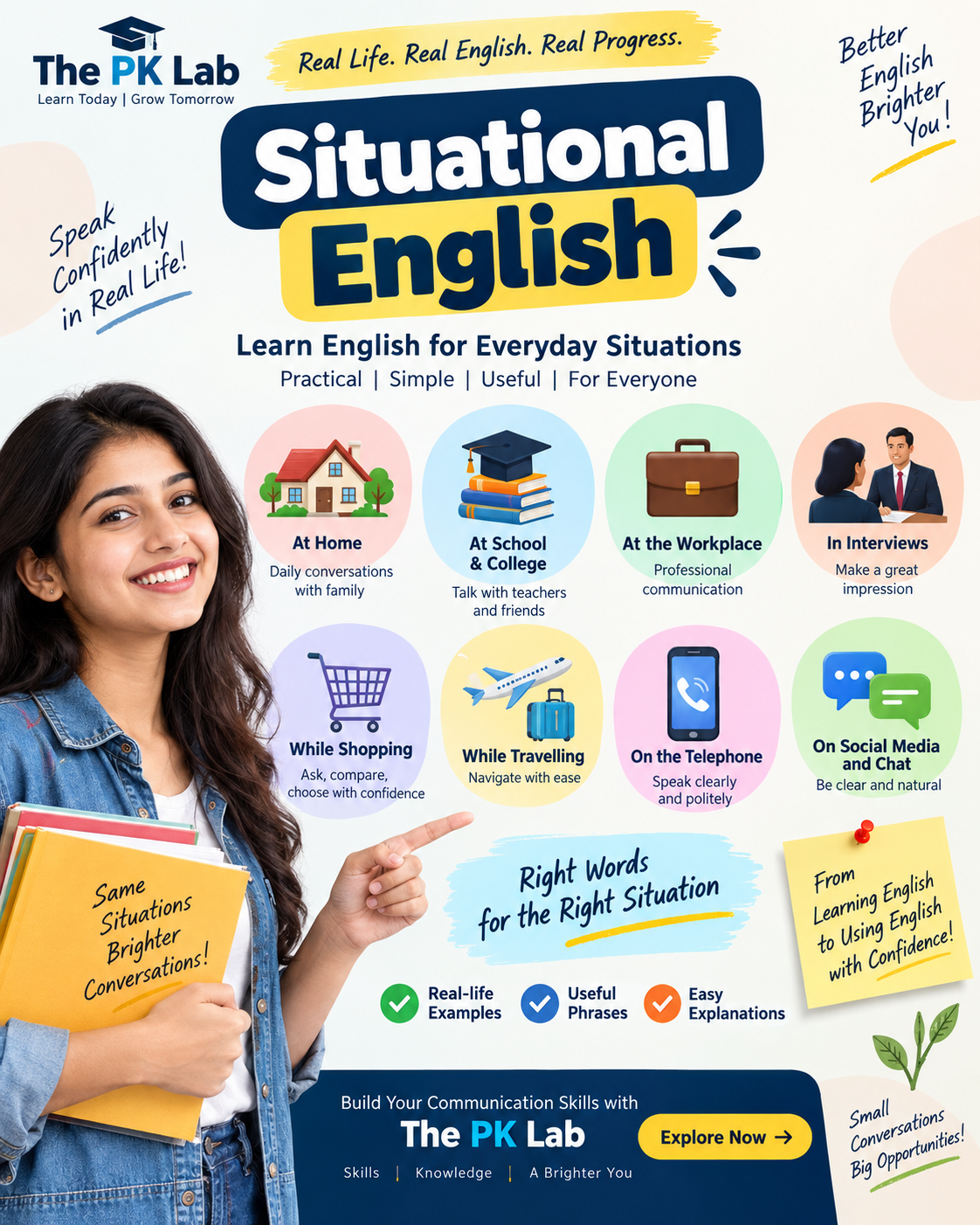
1. What Is Situational English?
Situational English is English used for specific real-life situations.
The English you use with your friend may be different from the English you use with your manager, teacher, interviewer, or a customer.
Example
Imagine you want someone to close the door.
With a friend:
Close the door, please.
More polite:
Could you please close the door?
At work:
Could you please close the door? There is a lot of noise outside.
All three sentences communicate a similar idea, but the situation and relationship influence how we speak.
2. Why Is Situational English Important?
Knowing grammar rules is important, but communication requires more than grammar.
Situational English helps you:
- Speak confidently in everyday situations
- Choose appropriate words
- Sound more natural
- Communicate politely
- Handle conversations effectively
- Participate in meetings
- Attend interviews
- Speak with teachers and colleagues
- Travel comfortably
- Communicate with customers
- Deal with unfamiliar situations
Remember:
Grammar tells you how a sentence works. Situational English helps you know when and how to use it.
3. The Basic Idea
Before speaking, think about three things:
WHO?
Who are you talking to?
WHERE?
Where are you?
WHY?
Why are you speaking?
For example, asking for information:
| Situation | Natural English |
|---|---|
| Friend | Where are you going? |
| Teacher | May I ask where you are going? |
| Workplace | Could you please let me know where you are going? |
| Stranger | Excuse me, could you tell me where this place is? |
The message is similar, but the language changes according to the situation.
4. Situational English at Home
English is not only for classrooms and offices. You can practise it at home every day.
Common sentences
| Situation | Useful Sentence |
|---|---|
| Asking someone to wait | Please wait for a minute. |
| Asking for help | Can you help me? |
| Asking about food | Is lunch ready? |
| Asking someone to come | Please come here. |
| Looking for something | Where is my phone? |
| Offering something | Would you like some tea? |
| Saying you are busy | I’m busy right now. |
| Asking someone to repeat | What did you say? |
Natural conversation
Mother: Are you ready?
Son: Almost. Give me five minutes.
Mother: Don’t be late.
Son: Don’t worry. I’ll be there on time.
5. Situational English at School or College
Students regularly need English for communicating with teachers and classmates.
Asking a teacher for permission
Less natural:
Teacher, I want leave.
Better:
May I leave early today?
Asking a question
Could you please explain this again?
Asking for clarification
I didn’t understand this part. Could you explain it once more?
Talking to a classmate
Have you completed the assignment?
Can you share your notes with me?
When is the submission deadline?
6. Situational English at the Workplace
Professional situations require clear, polite, and appropriate English.
Asking for help
Could you please help me with this task?
Asking for clarification
Could you please clarify this point?
Giving an update
I’ve completed the first part of the work.
Requesting more time
Could I have some additional time to complete this?
Disagreeing politely
Instead of:
You are wrong.
Say:
I understand your point, but I have a slightly different view.
This keeps the conversation professional.
7. Situational English for Interviews
An interview is a situation where your English should be clear, confident, and professional.
Introducing yourself
Good morning. Thank you for giving me this opportunity. My name is Pranakrushna Bhuyan.
Talking about your experience
I have experience in project coordination, team management, training, and stakeholder engagement.
Answering when you don’t know something
Avoid:
I don’t know.
You can say:
I’m not completely sure about that, but I would be happy to learn more about it.
Asking a question
Could you please tell me more about the responsibilities of this role?
8. Situational English While Shopping
Asking the price
How much does this cost?
Asking for another size
Do you have this in a larger size?
Asking for another colour
Do you have this in blue?
Asking for a discount
Is there any discount available?
Returning an item
I’d like to return this item. Could you please help me with the process?
9. Situational English While Travelling
Travelling requires practical English.
At a railway station
Which platform is the train on?
What time does the train arrive?
Is this train going to Bhubaneswar?
At an airport
Where is the check-in counter?
Where can I collect my baggage?
Could you please help me find Gate 12?
At a hotel
I have a reservation.
Could I check in, please?
What time is breakfast?
10. Situational English on the Telephone
Telephone conversations can feel difficult because you cannot see the other person’s facial expressions.
Answering a call
Hello, this is Pranakrushna speaking.
Asking who is calling
May I know who is speaking?
Asking someone to wait
Could you please hold for a moment?
When you cannot hear clearly
I’m sorry, I can’t hear you clearly.
When the call gets disconnected
Sorry, the call got disconnected.
Ending the call
Thank you for calling. Have a great day.
11. Situational English on Social Media and Chat
Digital communication is usually more informal.
Formal
Thank you for sharing the information.
Casual
Thanks for sharing!
Asking for an update
Any update on this?
Asking someone to respond
Please let me know when you get a chance.
Important
The language you use in a WhatsApp message to a friend may not be appropriate for an official email.
12. Formal vs Informal Situational English
One important skill is knowing how formal your English should be.
| Informal | More Formal |
|---|---|
| Can you help me? | Could you please help me? |
| Give me a minute. | Could you give me a moment? |
| I want to know… | I’d like to know… |
| Send me the file. | Could you please send me the file? |
| Tell me the reason. | Could you please explain the reason? |
| I don’t understand. | I’m afraid I don’t quite understand. |
Remember
Formal English → workplace, interviews, official communication
Informal English → friends, family, casual conversations
Neither is automatically “better.” The situation determines the appropriate choice.
13. Correct vs Incorrect
Situation: Asking your manager for leave
❌ Incorrect / too direct:
I need leave tomorrow.
✅ Better:
I’d like to request leave for tomorrow.
Situation: Asking a stranger for directions
❌
Where is the railway station?
✅
Excuse me, could you please tell me how to get to the railway station?
Situation: Asking someone to repeat
❌
What?
✅
Sorry, could you please repeat that?
14. Common Mistakes Made by Indian English Learners
Mistake 1
❌ What is your good name?
More natural:
✅ What’s your name?
In formal situations:
✅ May I know your name?
Mistake 2
❌ I am having two brothers.
Usually:
✅ I have two brothers.
Mistake 3
❌ Please revert back to me.
Better:
✅ Please get back to me.
Mistake 4
❌ Discuss about the issue.
Correct:
✅ Discuss the issue.
Mistake 5
❌ Myself Pranakrushna.
Correct:
✅ I’m Pranakrushna.
or
✅ My name is Pranakrushna.
15. Situational English and Spoken English
Situational English teaches you ready-to-use communication patterns.
For example:
Asking for something
Could you please + verb…?
Could you please send me the document?
Could you please explain this?
Could you please wait for a moment?
Asking permission
May I + verb…?
May I come in?
May I ask a question?
May I leave early today?
Making a request
I’d like to + verb…
I’d like to make a request.
I’d like to speak with the manager.
I’d like to change my appointment.
Learning these patterns makes speaking easier because you don’t have to construct every sentence from scratch.
16. Useful Situational English Expressions
Asking for help
- Could you help me, please?
- Can you give me a hand?
- Could you please guide me?
Asking for clarification
- Could you explain that?
- What do you mean?
- Could you please clarify that?
Apologising
- I’m sorry.
- Sorry about that.
- I apologise for the inconvenience.
Thanking
- Thank you.
- Thanks a lot.
- I really appreciate your help.
Agreeing
- I agree.
- That’s a good point.
- I completely agree with you.
Disagreeing politely
- I see your point, but…
- I understand what you mean, but…
- I have a slightly different opinion.
17. Quick Memory Trick
Remember:
SITUATION → PERSON → PURPOSE → LANGUAGE
Before speaking, ask:
1. What is the situation?
2. Who am I talking to?
3. What do I want to communicate?
4. How formal or informal should I be?
This simple process can dramatically improve your everyday communication.
18. Practice Exercise
Choose the most appropriate sentence for each situation.
1. You want to ask your teacher for permission to leave.
A. I am going now.
B. May I leave early today, please?
C. I want to go.
2. You cannot hear your colleague clearly.
A. What?
B. Speak loudly.
C. Sorry, I can’t hear you clearly. Could you please repeat that?
3. You want to ask a shopkeeper about the price.
A. Give price.
B. How much does this cost?
C. Tell price.
4. You want to ask your manager for help.
A. Help me.
B. You have to help me.
C. Could you please help me with this?
5. You are meeting someone for the first time.
A. What’s your name?
B. May I know your name?
C. Who are you?
Answers
1. B
2. C
3. B
4. C
5. B
19. Quick Revision
Situational English = English for real-life situations.
Remember these key points:
- Use English according to the situation.
- Consider who you are speaking to.
- Choose formal or informal language appropriately.
- Learn useful sentence patterns.
- Practise complete conversations, not isolated words.
- Be polite when making requests.
- Use simple and clear language.
- Don’t translate every sentence directly from your mother tongue.
- Focus on communication + context + natural usage.
Good English is not just about knowing the rules. It is about knowing what to say, when to say it, and how to say it.
20. Frequently Asked Questions
What is Situational English?
Situational English is the practical use of English according to different real-life situations, such as conversations at home, college, workplace, interviews, shopping, travel, and telephone calls.
Is Situational English the same as Spoken English?
Not exactly. Spoken English focuses on speaking English, while Situational English focuses on choosing appropriate English for a particular situation.
Can beginners learn Situational English?
Yes. In fact, situational learning can be particularly useful for beginners because they learn complete sentences that they can immediately use.
How can I improve my Situational English?
Start with common situations from your daily life. Learn useful sentence patterns, practise conversations aloud, listen to natural English, and gradually expand your vocabulary.
Should I always use formal English?
No. Use language appropriate to the person and situation. Formal English is useful in professional and official contexts, while informal English is common with friends and family.
21. What to Learn Next?
After learning Situational English, explore:
- Daily Words
- Phrasal Verbs
- English Idioms
- Confusing Words
- Workplace English
- Interview English
- Email Writing
- Presentation Skills
- Telephone English
- Professional English
- Common Grammar Mistakes
Final Takeaway
Situational English turns grammar knowledge into practical communication.