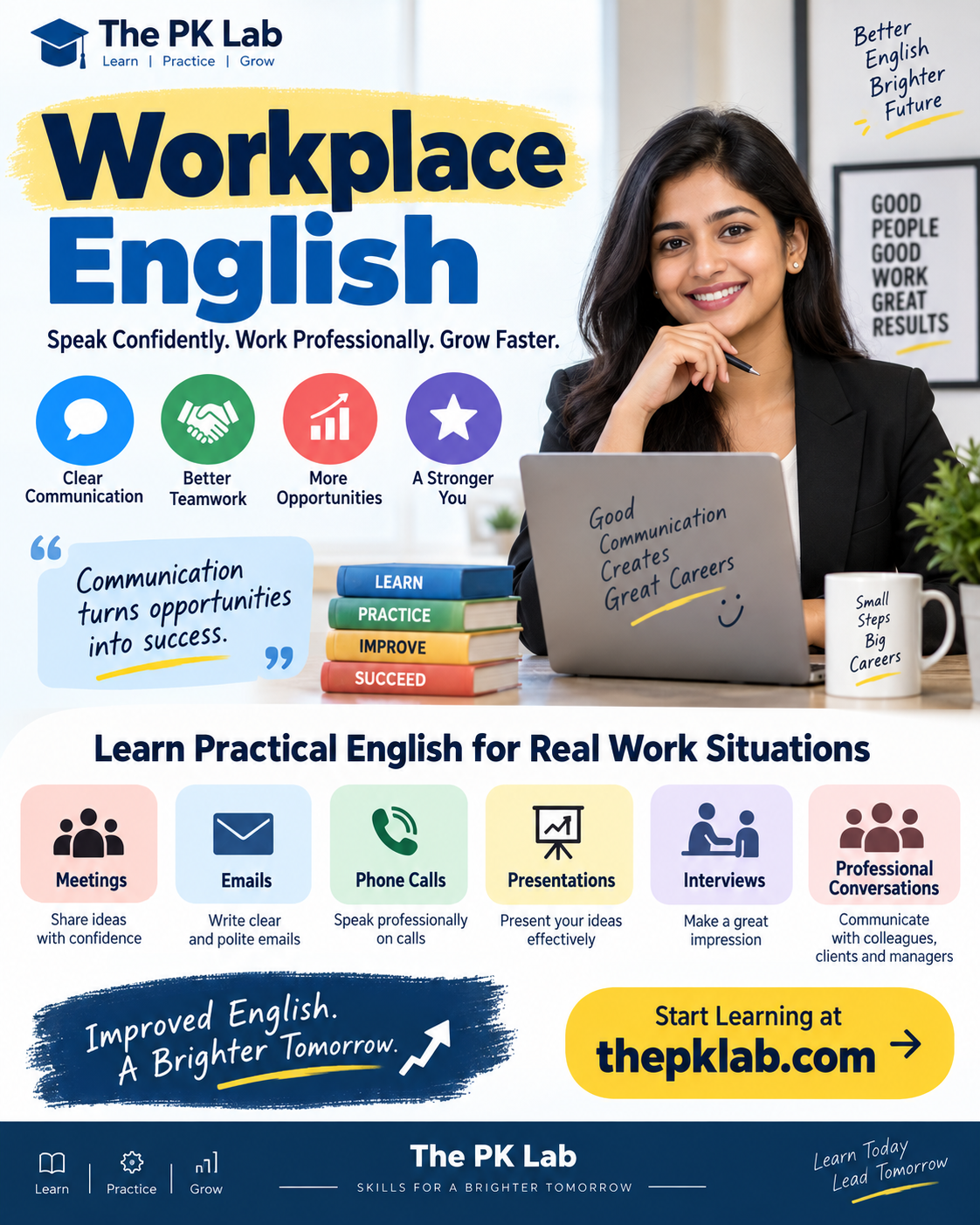
Workplace English is the English we use to communicate clearly and professionally at work. It helps you speak with colleagues, managers, clients, customers, and other professionals in a confident and respectful way.
For students and job seekers, Workplace English is especially useful because good communication can improve interviews, teamwork, presentations, emails, meetings, and career growth.
1. What Is Workplace English?
Workplace English means using English appropriately in professional situations.
It includes:
- Speaking with colleagues
- Talking to managers and supervisors
- Attending meetings
- Writing emails
- Making phone calls
- Giving presentations
- Asking for information
- Giving updates
- Making requests
- Handling customers and clients
- Discussing problems
- Participating in interviews
Simple Example
Casual English:
“Hey, send me that file.”
Professional English:
“Could you please send me the file?”
Both sentences communicate the same basic idea, but the second sounds more professional and polite.
2. Why Is Workplace English Important?
Good workplace communication helps you:
- Express your ideas clearly
- Avoid misunderstandings
- Build professional relationships
- Participate confidently in meetings
- Communicate with senior colleagues
- Handle customers professionally
- Write effective emails
- Perform better in interviews
- Give presentations confidently
- Create a positive professional image
Remember: Workplace English is not about using difficult English. It is about using clear, polite, appropriate, and effective English.
3. Formal vs Casual vs Professional English
Different situations require different styles of communication.
| Situation | Casual | Professional |
|---|---|---|
| Asking for help | Help me with this. | Could you please help me with this? |
| Asking for information | What’s the update? | Could you please share the latest update? |
| Asking someone to wait | Wait. | Please give me a moment. |
| Disagreeing | You’re wrong. | I see your point, but I have a different view. |
| Asking about a meeting | When is the meeting? | Could you please confirm the meeting time? |
| Requesting a document | Send the report. | Could you please send me the report? |
Important
Professional English does not mean making every sentence complicated.
Instead of:
“I would be highly obliged if you could kindly provide me with the requested document at your earliest possible convenience.”
A simple and natural sentence is better:
“Could you please share the document when you have a chance?”
4. Useful Workplace Sentence Patterns
Learning sentence patterns can help beginners speak faster and more confidently.
Asking for Help
- Could you please help me with this?
- Could you guide me through this process?
- Can you please explain this?
- Would you mind helping me?
Asking for Information
- Could you please share the details?
- Do you have any updates?
- Could you clarify this point?
- May I know the status of the project?
Giving an Update
- I have completed the task.
- I am currently working on it.
- The work is in progress.
- I will complete it by tomorrow.
- I have shared the report.
Talking About Problems
- We are facing an issue with the system.
- There seems to be a problem with the report.
- I am unable to access the file.
- We need some additional information.
- I will check and get back to you.
5. Workplace English for Meetings
Meetings require clear and respectful communication.
Starting a Meeting
“Good morning, everyone. Let’s get started.”
“Shall we begin the meeting?”
Sharing an Opinion
“I think we should consider this option.”
“In my opinion, this approach would be more effective.”
Agreeing
“I completely agree.”
“That’s a good point.”
“I agree with your suggestion.”
Disagreeing Politely
Avoid:
“You’re wrong.”
Better:
“I understand your point, but I have a different view.”
Or:
“I see it slightly differently.”
Asking a Question
“Could you please clarify that point?”
“May I ask a question?”
Ending a Meeting
“Thank you, everyone.”
“Let’s summarize the key action points before we close.”
6. Workplace English for Emails
Professional emails should generally be clear, concise, polite, and purposeful.
Common Email Expressions
Opening:
Dear Sir/Madam,
Dear Mr. Sharma,
Hello Team,
Purpose:
I am writing to inform you that…
I am writing regarding…
I would like to request…
Request:
Could you please share the required details?
Kindly review the attached document.
Closing:
Thank you for your support.
I look forward to hearing from you.
Regards,
Your Name
7. Workplace English for Telephone Conversations
Phone conversations often require short and clear sentences.
Answering a Call
“Good morning. This is Rahul speaking. How may I help you?”
Asking Someone to Wait
“Could you please hold for a moment?”
If You Didn’t Hear Clearly
Instead of:
“What?”
Say:
“I’m sorry, could you please repeat that?”
If You Don’t Know the Answer
“I’m not sure about that. Let me check and get back to you.”
Ending the Call
“Thank you for calling. Have a great day.”
8. Workplace English for Presentations
Useful presentation phrases include:
Opening
“Good morning, everyone. Today I am going to talk about…”
Moving to the Next Point
“Let’s move on to the next point.”
“Now, let’s look at…”
Highlighting Important Information
“I’d like to highlight an important point.”
“Please note that…”
Conclusion
“To conclude…”
“Let me summarize the key points.”
“Thank you for your time.”
9. Workplace English for Asking Questions
Good professionals ask questions when they need clarification.
Instead of:
❌ “I don’t understand.”
Try:
✅ “Could you please explain that again?”
Instead of:
❌ “What should I do?”
Try:
✅ “Could you please advise me on the next step?”
Instead of:
❌ “What does this mean?”
Try:
✅ “Could you please clarify what this means?”
10. Workplace English for Giving Opinions
Useful expressions:
- I think…
- In my opinion…
- From my perspective…
- I believe…
- I would suggest…
- One possible solution is…
- I would recommend…
Example
“I would suggest completing the first phase before starting the next one.”
This sounds more professional than:
“Do this first.”
11. Workplace English for Apologizing
Mistakes can happen at work. A professional apology should acknowledge the issue and, where appropriate, explain the corrective action.
Useful Expressions
“I’m sorry for the delay.”
“I apologize for the inconvenience.”
“I apologize for the misunderstanding.”
“Thank you for your patience.”
Better Professional Communication
Instead of:
“It wasn’t my fault.”
Try:
“I understand the issue. Let me check what happened and see how we can resolve it.”
12. Workplace English for Deadlines
Useful sentences:
- I will complete it by Friday.
- I am working on it.
- We are on track to meet the deadline.
- We may need some additional time.
- Could we extend the deadline?
- I will share the completed report by 5 PM.
- The task has been completed.
Be Specific
Instead of:
“I’ll do it soon.”
Say:
“I’ll complete it by tomorrow afternoon.”
Specific communication reduces confusion.
13. Common Workplace Mistakes
Indian English learners sometimes translate directly from their regional language.
Mistake 1
❌ “Please do the needful.”
This expression is understood in Indian professional communication but can sound dated or vague in international workplace English.
Better:
✅ “Could you please take the necessary action?”
Or, more specifically:
✅ “Could you please review the document and confirm?”
Mistake 2
❌ “I am having a doubt.”
Better:
✅ “I have a question.”
Mistake 3
❌ “I will revert back to you.”
Better:
✅ “I will get back to you.”
Mistake 4
❌ “Discuss about the issue.”
Better:
✅ “Discuss the issue.”
Mistake 5
❌ “Kindly revert.”
Better:
✅ “Please let me know.”
14. Correct vs Incorrect
| Incorrect | Better |
|---|---|
| I am having a doubt. | I have a question. |
| Discuss about this issue. | Discuss this issue. |
| Revert back to me. | Get back to me. |
| I will inform you once I will know. | I will inform you once I know. |
| Please explain me this. | Please explain this to me. |
| I didn’t understood. | I didn’t understand. |
| He don’t know. | He doesn’t know. |
| Send me the mail. | Please send me the email. |
15. Spoken English at the Workplace
Written English can be more formal, while spoken workplace English is often shorter and more natural.
Formal/Written
“I would like to inform you that the meeting has been rescheduled.”
Natural Spoken English
“The meeting has been rescheduled.”
Formal/Written
“I am writing to request your approval.”
Natural Spoken English
“Could you please approve this?”
The goal is not to sound overly formal. The goal is to sound natural, respectful, and professional.
16. Quick Tips to Improve Workplace English
1. Keep sentences short
Instead of trying to use complicated vocabulary, focus on clarity.
2. Learn phrases, not only words
Learn:
“Could you please clarify…?”
rather than only memorizing the word clarify.
3. Listen to professional conversations
Observe how people communicate during meetings, presentations, and interviews.
4. Practise speaking every day
Speak for 5–10 minutes about your work, studies, or daily activities.
5. Replace direct language with polite language
“Send this.” → “Could you please send this?”
6. Be specific
“I’ll do it soon.” → “I’ll complete it by 3 PM.”
17. Practice Exercise
Choose the more professional sentence.
1.
A. Give me the report.
B. Could you please share the report?
2.
A. What?
B. I’m sorry, could you please repeat that?
3.
A. You’re wrong.
B. I understand your point, but I have a different view.
4.
A. I am having a doubt.
B. I have a question.
5.
A. I’ll do it soon.
B. I’ll complete it by tomorrow.
Answers
- B
- B
- B
- B
- B
18. Quick Revision
Workplace English = Clear + Polite + Professional + Natural
Remember these five useful expressions:
- Could you please…?
- May I…?
- I would suggest…
- Could you clarify…?
- I’ll get back to you.
You don’t need perfect English to communicate professionally. You need clear sentences, appropriate vocabulary, good listening, and confidence.
FAQs
What is Workplace English?
Workplace English is English used in professional situations such as meetings, emails, interviews, presentations, phone calls, and conversations with colleagues.
Is Workplace English different from normal English?
The basic grammar is the same. The main difference is context, tone, vocabulary, and level of formality.
Do I need advanced English for the workplace?
No. Clear and correct basic English is more useful than complicated vocabulary.
How can I improve my Workplace English?
Practise common workplace phrases, listen to professional conversations, read emails, speak regularly, and learn from your common mistakes.
Is Workplace English useful for job interviews?
Yes. It can help you communicate more confidently during interviews, introduce yourself, answer questions, discuss your experience, and ask professional questions.
Key Takeaways
Good Workplace English is not about speaking difficult English. It is about communicating your ideas clearly, politely, confidently, and professionally.
Start with simple sentences. Learn useful expressions. Practise them in real situations. Gradually, your vocabulary, fluency, and confidence will improve.