1. What is a Tense?
Tense tells us when an action happens.
It helps us understand whether something happens:
- Now → Present
- Before now → Past
- After now → Future
For example:
- I play cricket. → Present
- I played cricket. → Past
- I will play cricket. → Future
Simply remember:
Tense = Time of an action
2. Why Are Tenses Important?
Tenses help us communicate clearly.
Compare:
I eat dinner.
I ate dinner.
I will eat dinner.
The verb changes because the time of the action changes.
Tenses are especially important for:
- Everyday conversations
- Writing
- Interviews
- Workplace communication
- Presentations
- Emails
- Storytelling
- Exams and competitive tests
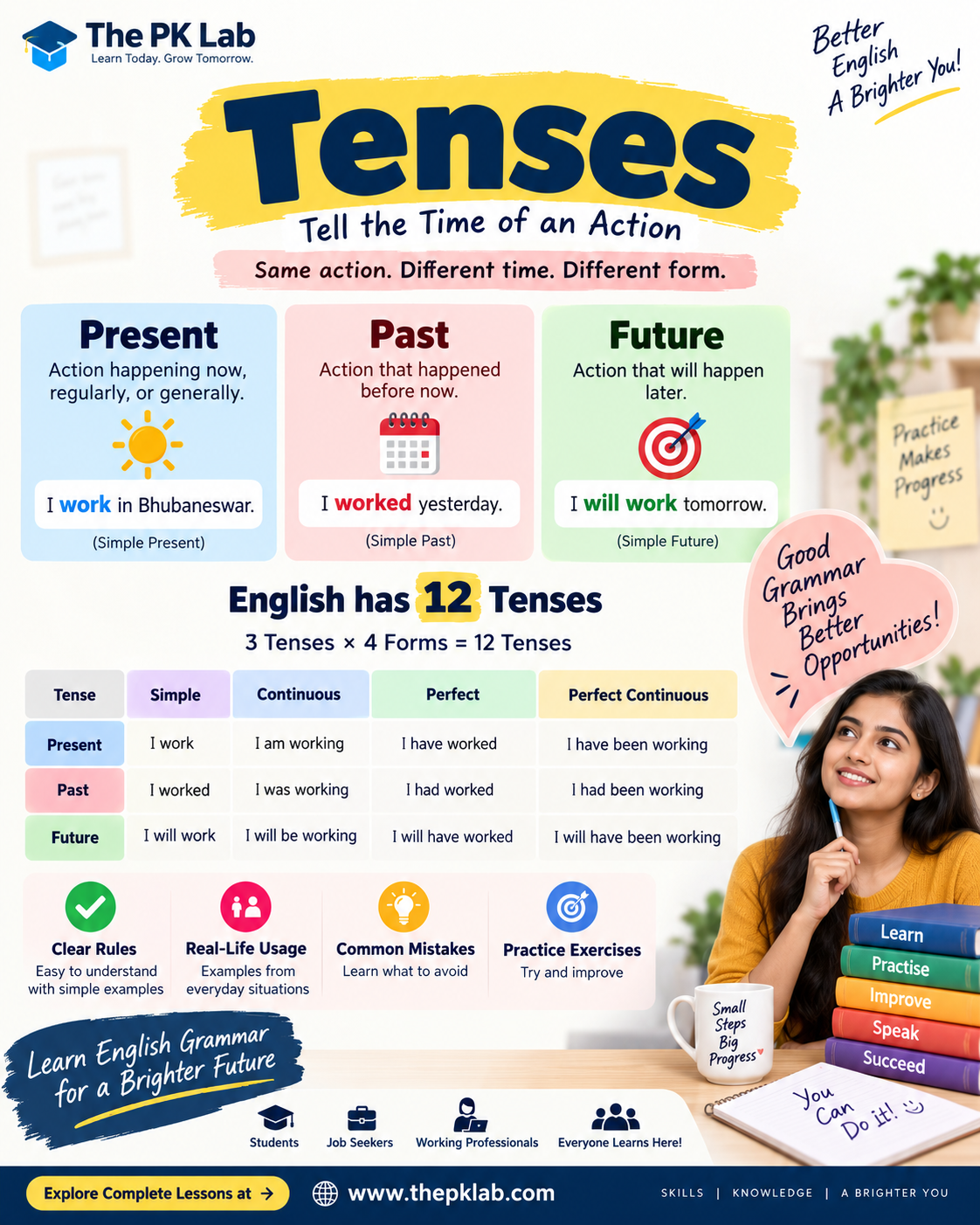
3. The 3 Main Tenses
English has three main tenses:
| Tense | Basic Meaning | Example |
|---|---|---|
| Present | Action happening now, regularly, or generally | I work in Bhubaneswar. |
| Past | Action that happened before now | I worked yesterday. |
| Future | Action that will happen later | I will work tomorrow. |
Each main tense has four forms.
Therefore:
3 Tenses × 4 Forms = 12 Tenses
4. The 12 Tenses
| Main Tense | Form | Example |
|---|---|---|
| Present | Simple Present | I work. |
| Present | Present Continuous | I am working. |
| Present | Present Perfect | I have worked. |
| Present | Present Perfect Continuous | I have been working. |
| Past | Simple Past | I worked. |
| Past | Past Continuous | I was working. |
| Past | Past Perfect | I had worked. |
| Past | Past Perfect Continuous | I had been working. |
| Future | Simple Future | I will work. |
| Future | Future Continuous | I will be working. |
| Future | Future Perfect | I will have worked. |
| Future | Future Perfect Continuous | I will have been working. |
5. Present Tense
Present tense is generally used for actions, situations, or states connected with the present.
It has four forms.
A. Simple Present Tense
What is it?
We use the Simple Present for:
- Regular actions
- Habits
- Facts
- General truths
- Routines
- Permanent situations
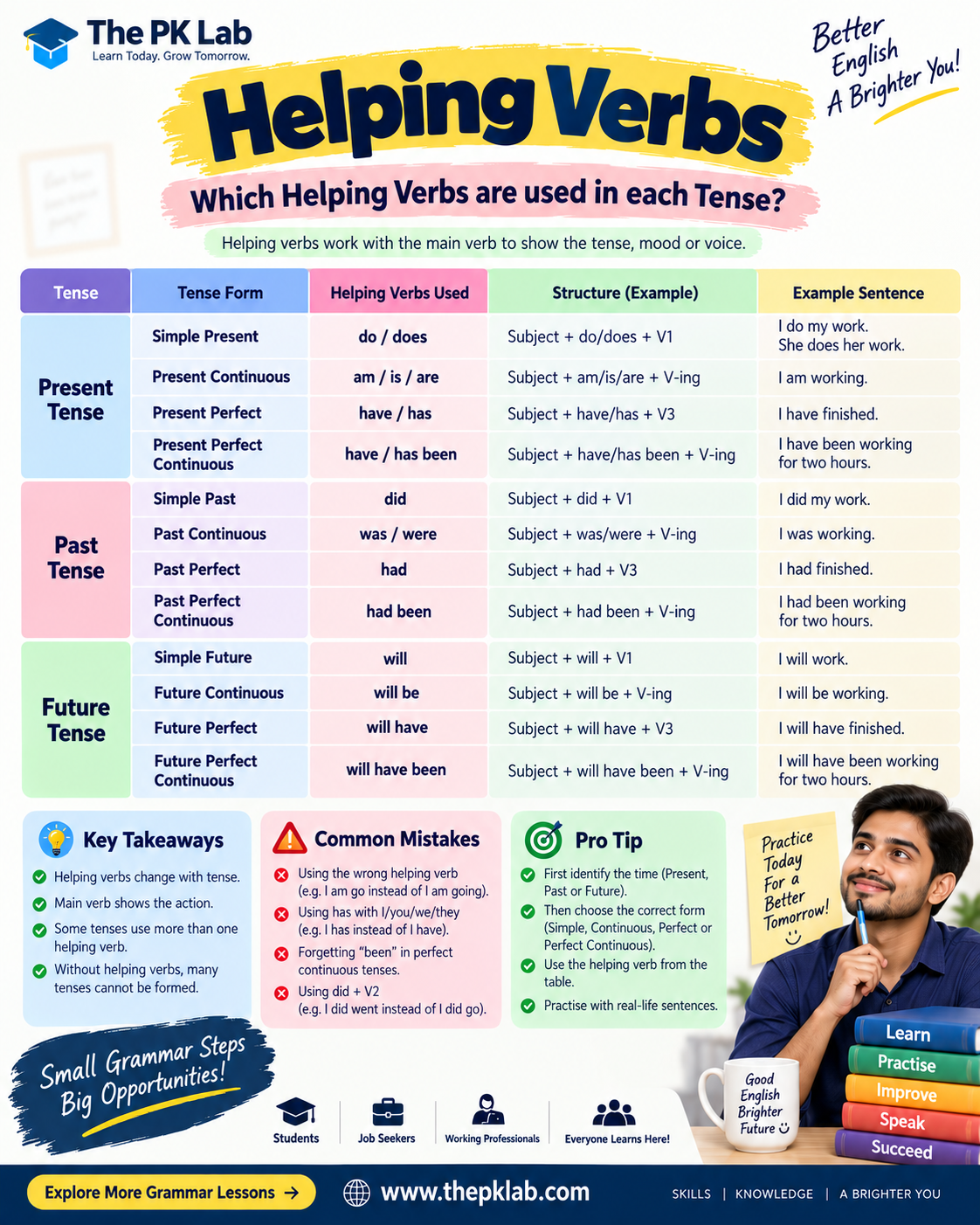
Structure
Subject + V1 + Object
For he/she/it, generally add -s/-es to the main verb.
Examples
- I go to work every day.
- She works in a bank.
- We play football.
- The sun rises in the east.
- He drinks tea every morning.
Real-Life Examples
At home:
“I wake up at 6 a.m. every day.”
At college:
“I attend college regularly.”
At work:
“I check my email every morning.”
Common mistake
❌ He go to office every day.
✅ He goes to the office every day.
6. Present Continuous Tense
What is it?
We use the Present Continuous for an action that is happening now or around the present time.
Structure
Subject + am/is/are + V-ing + Object
Examples
- I am studying English.
- She is cooking dinner.
- They are playing cricket.
- We are learning grammar.
Real-Life Conversation
A: What are you doing?
B: I am watching a movie.
A: Where is Rahul?
B: He is attending a meeting.
Common mistake
❌ I am go to college.
✅ I am going to college.
7. Present Perfect Tense
What is it?
The Present Perfect is commonly used for:
- A completed action with a present connection
- Life experiences
- Recent events
- Actions where the exact past time is not important
Structure
Subject + has/have + V3 + Object
Examples
- I have finished my work.
- She has completed the assignment.
- They have visited Delhi.
- He has lost his phone.
Real-Life Example
“I have completed my report, so I can send it now.”
The action is complete, but it has a connection with the present.
Common mistake
❌ I have went there.
✅ I have gone there.
8. Present Perfect Continuous Tense
What is it?
This tense describes an action that started in the past and is continuing up to now, or has recently stopped with a noticeable present result.
Structure
Subject + has/have been + V-ing + Object
Examples
- I have been studying for two hours.
- She has been working since morning.
- They have been waiting for an hour.
Since vs For
Since → starting point
- since Monday
- since 9 a.m.
- since 2020
For → duration
- for two hours
- for three days
- for five years
Example
“I have been working here for five years.”
9. Past Tense
Past tense talks about actions, events, or situations that happened before now.
It has four forms.
A. Simple Past Tense
What is it?
Used for a completed action in the past.
Structure
Subject + V2 + Object
Examples
- I visited Delhi yesterday.
- She called me last night.
- We watched a movie.
- He went to college.
Common time expressions
- yesterday
- last week
- last year
- two days ago
- in 2020
Common mistake
❌ I did not went there.
✅ I did not go there.
After did/did not, use the base form (V1).
10. Past Continuous Tense
What is it?
Used for an action that was in progress at a particular time in the past.
Structure
Subject + was/were + V-ing + Object
Examples
- I was studying at 8 p.m.
- She was cooking when I called.
- They were playing cricket.
- We were watching television.
Real-Life Example
“I was travelling to Bhubaneswar when you called me.”
11. Past Perfect Tense
What is it?
Used when we want to show that one past action happened before another past action.
Structure
Subject + had + V3 + Object
Example
“I had finished my work before the manager arrived.”
Two actions happened:
- I finished my work.
- The manager arrived.
The first action → Past Perfect
The second action → Simple Past
More examples
- She had left before I arrived.
- They had completed the work before the deadline.
12. Past Perfect Continuous Tense
What is it?
Used to show that an action continued for a period of time before another event in the past.
Structure
Subject + had been + V-ing + Object
Example
“I had been waiting for an hour before the bus arrived.”
Another example:
“She had been working there for five years before she changed jobs.”
13. Future Tense
Future tense talks about actions or situations that will happen later.
It has four forms.
A. Simple Future Tense
What is it?
Used for:
- Future actions
- Predictions
- Promises
- Decisions made at the moment of speaking
- Offers
Structure
Subject + will + V1 + Object
Examples
- I will call you tomorrow.
- She will join the meeting.
- We will help you.
- I will send the document.
Spoken English
Formal: I will contact you tomorrow.
Natural conversation: I’ll contact you tomorrow.
14. Future Continuous Tense
What is it?
Used for an action that will be in progress at a particular time in the future.
Structure
Subject + will be + V-ing + Object
Examples
- I will be working at 10 a.m. tomorrow.
- She will be travelling next week.
- They will be attending the meeting.
Example
“Don’t call me at 8 p.m. I will be attending a class.”
15. Future Perfect Tense
What is it?
Used for an action that will be completed before a specific time or event in the future.
Structure
Subject + will have + V3 + Object
Examples
- I will have completed the project by Friday.
- She will have reached home by 8 p.m.
- They will have finished the work before the meeting.
Key expression
by + future time
I will have completed the course by December.
16. Future Perfect Continuous Tense
What is it?
Used to show how long an action will have continued up to a particular point in the future.
Structure
Subject + will have been + V-ing + Object
Example
“By next month, I will have been working here for three years.”
Another example:
“By 8 p.m., she will have been studying for five hours.”
17. The 12 Tenses at a Glance
Take the verb “work”:
| Tense | Structure | Example |
|---|---|---|
| Simple Present | V1 | I work. |
| Present Continuous | am/is/are + V-ing | I am working. |
| Present Perfect | has/have + V3 | I have worked. |
| Present Perfect Continuous | has/have been + V-ing | I have been working. |
| Simple Past | V2 | I worked. |
| Past Continuous | was/were + V-ing | I was working. |
| Past Perfect | had + V3 | I had worked. |
| Past Perfect Continuous | had been + V-ing | I had been working. |
| Simple Future | will + V1 | I will work. |
| Future Continuous | will be + V-ing | I will be working. |
| Future Perfect | will have + V3 | I will have worked. |
| Future Perfect Continuous | will have been + V-ing | I will have been working. |
18. A Simple Way to Understand the 12 Tenses
Think about one action: “study English.”
Present
I study English.
→ My habit/routine.
I am studying English.
→ I am doing it now.
I have studied English.
→ The action is completed/has present relevance.
I have been studying English for two hours.
→ It started earlier and continues up to now.
Past
I studied English yesterday.
→ Completed past action.
I was studying English at 8 p.m.
→ Action was in progress.
I had studied English before the test.
→ One past action happened before another.
I had been studying English for two hours before the test.
→ Duration before another past event.
Future
I will study English tomorrow.
→ Future action.
I will be studying English at 8 p.m.
→ Action will be in progress.
I will have studied English by Friday.
→ Action will be completed by a future point.
I will have been studying English for two hours by 8 p.m.
→ Duration continuing up to a future point.
19. Correct vs Incorrect
| ❌ Incorrect | ✅ Correct |
|---|---|
| He go to school. | He goes to school. |
| I am go there. | I am going there. |
| She have finished. | She has finished. |
| I have went there. | I have gone there. |
| I did not went. | I did not go. |
| He was work yesterday. | He was working yesterday. |
| They was playing. | They were playing. |
| I will going tomorrow. | I will go tomorrow. |
| She will be go there. | She will be going there. |
20. Common Mistakes by Indian English Learners
1. Using “is/am/are” incorrectly
❌ I am know him.
✅ I know him.
Why?
“Know” is normally not used in the continuous form in this meaning.
2. Using V2 after “did”
❌ Did you went there?
✅ Did you go there?
3. Using “has” with I/You/We/They
❌ I has completed the work.
✅ I have completed the work.
4. Confusing Simple Present and Present Continuous
❌ I am going to office every day.
✅ I go to the office every day.
But:
✅ I am going to the office now.
5. Confusing “since” and “for”
❌ I have been working since five years.
✅ I have been working for five years.
❌ I have been working for 2020.
✅ I have been working since 2020.
21. Tenses in Spoken English
In everyday conversation, English speakers frequently use contractions.
| Formal | Natural Spoken English |
|---|---|
| I am | I’m |
| You are | You’re |
| He is | He’s |
| She is | She’s |
| I have | I’ve |
| I will | I’ll |
| I would | I’d |
| Do not | Don’t |
| Does not | Doesn’t |
| Did not | Didn’t |
| Cannot | Can’t |
| Will not | Won’t |
Example
Formal: I do not know.
Natural conversation: I don’t know.
Both are grammatically correct. The shorter form is very common in everyday speech.
22. Quick Memory Trick
Remember the four forms using four questions:
Simple
Does it happen?
I work.
Continuous
Is it happening?
I am working.
Perfect
Has it happened/completed?
I have worked.
Perfect Continuous
How long has it been happening?
I have been working for two hours.
This pattern helps you understand all three time periods.
23. Practice Exercise
Choose the correct form of the verb.
A. Fill in the blanks
- She ______ to college every day. (go)
- I ______ dinner right now. (eat)
- They ______ the project already. (complete)
- He ______ to Delhi yesterday. (go)
- We ______ television when you called. (watch)
- She ______ before I arrived. (leave)
- I ______ you tomorrow. (call)
- They ______ the work by Friday. (finish)
- He ______ here for five years. (work)
- By next year, I ______ here for three years. (work)
B. Identify the Tense
- I play cricket every Sunday.
- She is reading a book.
- They have completed the work.
- He visited Cuttack yesterday.
- We were having dinner.
- I will call you later.
24. Answers
- goes
- am eating
- have completed
- went
- were watching
- had left
- will call
- will have finished
- has been working
- will have been working
- Simple Present
- Present Continuous
- Present Perfect
- Simple Past
- Past Continuous
- Simple Future
25. Quick Revision
Remember:
3 Main Tenses → Present, Past, Future
Each has:
4 Forms → Simple, Continuous, Perfect, Perfect Continuous
Therefore:
3 × 4 = 12 Tenses
The most important question is not simply “Which tense is this?”
Ask:
1. When did the action happen?
2. Is the action complete or ongoing?
3. Is duration important?
4. Is there another action/event to compare it with?
Once you understand these four questions, tenses become much easier.
26. FAQs
How many tenses are there in English?
English grammar is commonly taught using 12 tense forms: four present, four past, and four future forms.
Which tense is most commonly used in spoken English?
Simple Present, Simple Past, Present Continuous, Present Perfect, and future forms such as will and be going to are especially common in everyday communication.
What is V1, V2 and V3?
They refer to common verb forms:
- V1: go
- V2: went
- V3: gone
Another example:
- V1: eat
- V2: ate
- V3: eaten
What is the easiest way to learn tenses?
Don’t memorize all 12 structures at once. First understand Present, Past and Future, then learn Simple, Continuous, Perfect and Perfect Continuous within each.
Do I need all 12 tenses for spoken English?
You should understand all 12, but you do not need to use every form equally often in everyday conversation. Focus first on the forms you encounter frequently in real communication.
Key Takeaways
- Tense tells us about time and the way an action relates to that time.
- English is commonly taught using 12 tense forms.
- The three main time references are Present, Past and Future.
- Each has Simple, Continuous, Perfect and Perfect Continuous forms.
- Focus on meaning and usage, not just formulas.
- Practise tenses through real conversations, not only grammar exercises.
- Pay special attention to V1, V2, V3, helping verbs, since/for, and did + V1.