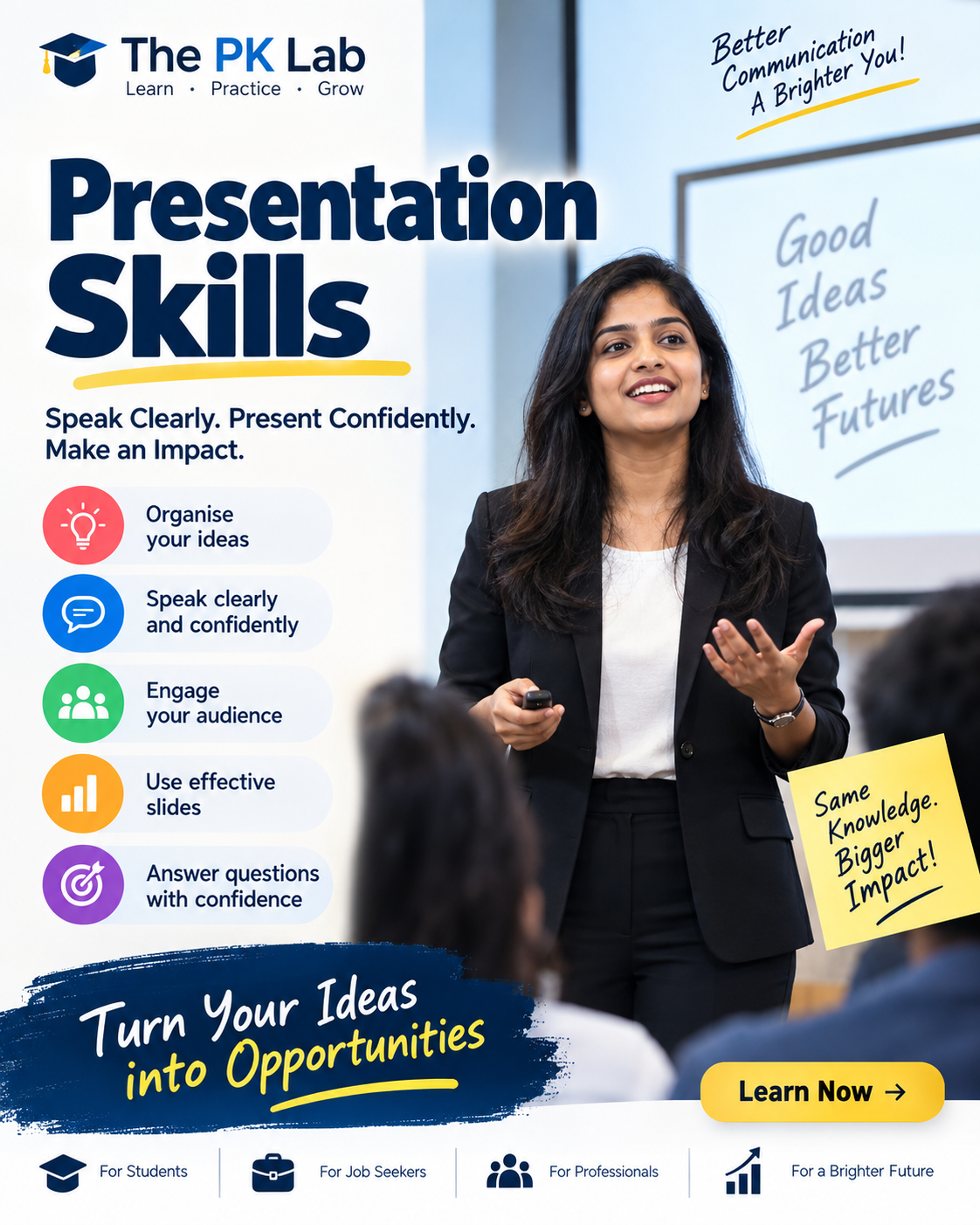
What Are Presentation Skills?
Presentation skills are the skills you use to communicate your ideas, information, or message clearly and confidently to an audience.
A presentation is not just about standing in front of people and speaking. It involves:
- Planning what you want to say
- Organising your ideas
- Speaking clearly
- Using the right words
- Using appropriate body language
- Making effective slides
- Engaging your audience
- Answering questions confidently
Simply put:
Good presentation skills help you explain your ideas so that people can understand, remember, and respond to them.
Why Are Presentation Skills Important?
Presentation skills are useful in school, college, interviews, workplaces, meetings, seminars, and everyday communication.
For example, you may need to:
- Give a classroom presentation
- Present a college project
- Explain an idea to your manager
- Present a business proposal
- Introduce a project to a team
- Give a seminar
- Deliver a training session
- Present your research
- Speak at a meeting
- Explain a product to a customer
Example
Imagine two students have the same project.
Student A: Has excellent knowledge but speaks very quietly and reads every sentence from the slides.
Student B: Has similar knowledge but explains the topic clearly, maintains eye contact, and answers questions confidently.
Who is more likely to make a strong impression?
Student B.
This shows why presentation skills are important.
The 7 Essential Presentation Skills
A successful presentation usually requires seven important skills:
| Skill | What it means |
|---|---|
| 1. Preparation | Knowing your topic and audience |
| 2. Organisation | Arranging ideas in a logical order |
| 3. Clear Speaking | Speaking clearly and at an appropriate speed |
| 4. Body Language | Using eye contact, gestures and posture effectively |
| 5. Visual Communication | Using slides, images and charts effectively |
| 6. Audience Engagement | Keeping listeners interested |
| 7. Question Handling | Responding to questions calmly and confidently |
1. Prepare Before You Present
Good presentations begin before you enter the room.
Before preparing your presentation, ask yourself:
- What is my topic?
- Who is my audience?
- What do they already know?
- What do I want them to learn?
- How much time do I have?
- What are the three or four most important points?
Example
If you are presenting “Artificial Intelligence in Education” to school students, your explanation should be different from a presentation on the same topic to IT professionals.
Remember:
Know your topic. Know your audience. Know your purpose.
2. Organise Your Presentation
A good presentation should have a clear structure.
The easiest structure to remember is:
Beginning → Middle → End
Beginning
Introduce:
- Yourself
- Your topic
- The purpose of the presentation
Middle
Explain:
- Main points
- Examples
- Facts
- Evidence
- Solutions or recommendations
End
Summarise:
- Main ideas
- Key message
- Final conclusion
Simple Presentation Structure
1. Greeting
Good morning everyone.
2. Introduction
My name is Rahul, and today I am going to talk about the importance of communication skills.
3. Main Topic
There are three important aspects of communication…
4. Examples
Let me give you a simple example…
5. Conclusion
To conclude, effective communication can help us perform better academically and professionally.
6. Closing
Thank you for listening. I’d be happy to answer your questions.
3. Speak Clearly
You do not need a foreign accent to give a good presentation.
Your priority should be:
Clarity > Accent
Speak:
- Clearly
- At a comfortable speed
- Loudly enough for everyone to hear
- With appropriate pauses
Avoid speaking too fast.
Instead of:
TodayIwilltalkaboutcommunicationanditsimportance…
Say:
Today, / I am going to talk about / communication / and its importance.
Pauses make your speech easier to understand.
4. Use Appropriate Body Language
Your body communicates even when you are not speaking.
Important elements include:
Eye Contact
Look at your audience instead of constantly looking at your laptop or screen.
Posture
Stand comfortably and confidently.
Facial Expressions
Use natural expressions that match your message.
Hand Gestures
Use simple, natural gestures to emphasise important points.
Movement
Move purposefully. Avoid walking continuously without reason.
Avoid These Habits
❌ Looking at the floor constantly
❌ Reading every word from the slide
❌ Keeping your hands in your pockets
❌ Standing completely stiff
❌ Turning your back to the audience unnecessarily
❌ Repeatedly saying “umm”, “aaa”, or “actually”
5. Use Slides Effectively
Your slides should support your presentation, not replace you.
A good slide should be:
- Simple
- Clear
- Easy to read
- Visually attractive
- Relevant to the topic
Avoid:
- Too much text
- Very small fonts
- Too many animations
- Unnecessary images
- Complicated charts
- Reading the slide word-for-word
Weak Slide
Communication is a process through which information is exchanged between individuals and it involves various components such as sender, receiver, message, channel, feedback…
Better Slide
Communication
- Sender
- Message
- Channel
- Receiver
- Feedback
Then explain the points verbally.
6. Engage Your Audience
A presentation should feel like communication, not a speech being read from a textbook.
You can engage your audience by asking questions.
Examples
Have you ever felt nervous before speaking in public?
How many of you use AI tools every day?
What do you think is the biggest challenge facing students today?
You can also use:
- Real-life examples
- Short stories
- Interesting facts
- Questions
- Demonstrations
- Audience participation
Example
Instead of saying:
Communication skills are important.
Say:
Imagine you have excellent technical knowledge but cannot explain your ideas during an interview. Do you think the interviewer will fully understand your abilities?
This immediately makes the audience think.
7. Handle Questions Confidently
Questions are a normal part of presentations.
You do not need to know the answer to every question.
If you know the answer:
That’s a good question. The answer is…
If you need clarification:
Could you please clarify your question?
If you don’t know:
That’s an interesting question. I don’t have the exact information at the moment, so I don’t want to give you an incorrect answer.
If you need time:
Let me think about that for a moment.
Never panic because you do not know an answer.
Confidence does not mean knowing everything. It means responding calmly and honestly.
Useful English for Presentations
Presentation English becomes easier when you learn common sentence patterns.
Starting a Presentation
- Good morning everyone.
- Good afternoon everyone.
- Thank you for joining me today.
- I’m pleased to be here today.
- Today, I’m going to talk about…
- My presentation is about…
- The topic of today’s presentation is…
Introducing the Topic
Let me begin by explaining…
First, let’s look at…
I’d like to start with…
Let me give you some background information.
Moving to the Next Point
- Let’s move on to the next point.
- Now, let’s look at…
- The next point I’d like to discuss is…
- Moving on…
- This brings us to our next point.
Giving Examples
- For example…
- For instance…
- Let me give you an example.
- Consider this example…
- To illustrate this…
Emphasising an Important Point
- The key point is…
- It’s important to remember that…
- I’d like to emphasise…
- The most important thing to understand is…
Showing a Chart or Image
- As you can see here…
- This graph shows…
- This chart illustrates…
- If you look at this image…
- The data shows that…
Concluding
- To conclude…
- In conclusion…
- To summarise…
- Let me briefly summarise the main points.
- The key takeaway is…
Ending a Presentation
Thank you for your time and attention.
Thank you for listening.
I’d be happy to answer any questions.
Formal vs Natural Spoken English
Good presentation English should be professional but natural.
| More Formal | Natural Professional English |
|---|---|
| I would like to begin my presentation. | I’d like to begin my presentation. |
| I am going to explain… | I’m going to explain… |
| Let us move to the next point. | Let’s move to the next point. |
| I would like to thank you. | I’d like to thank you. |
| Do you have any questions? | Any questions? |
Important
Contractions such as I’m, I’d, we’re, let’s, don’t are common in natural spoken English.
However, choose your language according to the situation and audience.
Correct vs Incorrect Presentation Language
1. Starting
❌ Today I will discuss about communication skills.
✅ Today I will discuss communication skills.
Or:
✅ Today I will talk about communication skills.
2. Moving to a Topic
❌ Now I am coming to the next point.
✅ Now, let’s move on to the next point.
3. Giving an Example
❌ I want to give one example regarding this.
✅ Let me give you an example.
4. Conclusion
❌ At last, I want to conclude my presentation.
✅ To conclude, I’d like to highlight three key points.
Common Presentation Mistakes
Mistake 1: Reading Everything
Your audience can read the slide. They need your explanation.
Better approach:
Slide:
Three Benefits of Teamwork
- Collaboration
- Problem-solving
- Productivity
Speaker:
There are three major benefits of teamwork. First, teamwork improves collaboration…
Mistake 2: Memorising Every Word
You don’t need to memorise the entire presentation.
Instead:
Understand → Practise → Present
Remember the key points, not every sentence.
Mistake 3: Speaking Too Fast
Nervous speakers often increase their speaking speed.
Solution:
Use pauses.
There is one important lesson here. [Pause]
Good communication is not only about speaking. [Pause]
It is also about listening.
Mistake 4: Too Much Text
A presentation is not a document.
Use short points and explain them verbally.
Mistake 5: Ignoring the Audience
Don’t spend the entire presentation looking at your screen.
Remember:
Slides are for the audience. Your attention should be on the audience.
Presentation Skills for Students
Students can use presentation skills for:
- Classroom presentations
- Project presentations
- Seminars
- Viva examinations
- Group discussions
- Competitions
- College events
- Internship interviews
Student Presentation Example
Topic: Importance of Time Management
Good morning everyone.
Today, I am going to talk about the importance of time management.
Time is one of our most valuable resources. As students, we have classes, assignments, examinations, personal responsibilities and many other activities.
Effective time management helps us organise these activities and reduce unnecessary stress.
To conclude, managing our time effectively can help us become more organised, productive and confident.
Thank you.
Presentation Skills for Job Seekers
Presentation skills are especially useful during:
- Job interviews
- Campus placements
- Group discussions
- Case studies
- Project presentations
- Assessment centres
An interviewer may evaluate:
- Confidence
- Communication
- Clarity
- Professionalism
- Logical thinking
- Listening
- Ability to explain ideas
Useful Interview Presentation Language
Let me explain my approach.
There are three main reasons for this.
Based on my experience…
Let me give you a practical example.
The key result was…
My recommendation would be…
Presentation Skills at the Workplace
Professionals frequently present:
- Project updates
- Business proposals
- Sales reports
- Monthly performance
- Training sessions
- Client presentations
- Team plans
- Business strategies
Workplace Example
Instead of saying:
Our project is going well.
Say:
The project is progressing as planned. We have completed 80% of the planned activities, and we expect to complete the remaining activities by the end of this month.
This sounds more specific, professional, and informative.
A Simple Formula for a Great Presentation
Remember:
P + S + V + E + C
P – Prepare
Know your topic and audience.
S – Structure
Organise your ideas.
V – Voice & Visuals
Speak clearly and use effective slides.
E – Engage
Connect with your audience.
C – Conclude
Finish with a clear takeaway.
Quick Tips for Better Presentations
Before the Presentation
✔ Know your audience
✔ Understand your topic
✔ Prepare your structure
✔ Create simple slides
✔ Practise aloud
✔ Check your timing
✔ Test your equipment
During the Presentation
✔ Stand confidently
✔ Maintain eye contact
✔ Speak clearly
✔ Use natural gestures
✔ Pause between important ideas
✔ Engage your audience
✔ Watch your time
After the Presentation
✔ Listen carefully to questions
✔ Respond calmly
✔ Ask for feedback
✔ Note what you can improve
Practice Exercise
Exercise 1: Complete the Sentences
Choose the most appropriate phrase.
- ________, today I am going to talk about digital education.
- ________ the next point.
- ________, let me give you an example.
- ________, there are three key lessons.
- Thank you for listening. ________?
Options:
- To conclude
- Let’s move on to
- Good morning everyone
- For example
- Do you have any questions?
Answers
- Good morning everyone
- Let’s move on to
- For example
- To conclude
- Do you have any questions?
Exercise 2: Correct the Sentences
Correct these common presentation mistakes:
- Today I will discuss about teamwork.
- Now I am coming to my next point.
- I want to give one example.
- At last I want to conclude.
- Please see the slide.
Suggested Answers
- Today I will discuss teamwork.
- Now, let’s move on to the next point.
- Let me give you an example.
- To conclude, I’d like to summarise the main points.
- As you can see on the slide…
Mini Presentation Practice
Choose any one topic and speak for 2–3 minutes.
Topics
- My College
- My Career Goal
- Importance of Communication Skills
- Artificial Intelligence
- Social Media
- My Favourite Book
- Skill Development
- Digital Education
- Environmental Protection
- My Future Career
Use this structure:
Opening → Introduction → 3 Main Points → Example → Conclusion
Record yourself and check:
- Am I speaking clearly?
- Am I speaking too fast?
- Am I looking at the audience?
- Am I using too many filler words?
- Is my presentation logically organised?
- Did I finish within the time limit?
Frequently Asked Questions
1. What are presentation skills?
Presentation skills are the abilities required to communicate ideas clearly, confidently, and effectively to an audience.
2. How can I improve my presentation skills?
Prepare your topic, organise your ideas, practise speaking aloud, improve your body language, use simple slides, and ask for feedback.
3. Do I need fluent English to give a good presentation?
No. Clear communication is more important than using complicated English.
4. How can I stop being nervous during presentations?
Prepare well, practise several times, take slow breaths, speak slowly, and focus on communicating your message rather than trying to be perfect.
5. Should I memorise my presentation?
It is better to understand and practise your key points rather than memorise every sentence.
6. How many slides should a presentation have?
There is no fixed number. Use enough slides to communicate your message clearly without overcrowding them with information.
7. What should I say at the end of a presentation?
You can say:
“To conclude, these are the key points I’d like you to remember. Thank you for your time. I’d be happy to answer any questions.”
Quick Revision
Remember these 5 principles:
1. Prepare
Know what you want to say.
2. Structure
Give your presentation a clear beginning, middle, and end.
3. Speak Clearly
Use simple language, appropriate speed, and pauses.
4. Connect
Use eye contact, body language, questions, and examples.
5. Finish Strong
Summarise your message and invite questions.
A great presentation is not about speaking perfect English. It is about communicating your ideas clearly, confidently, and effectively.