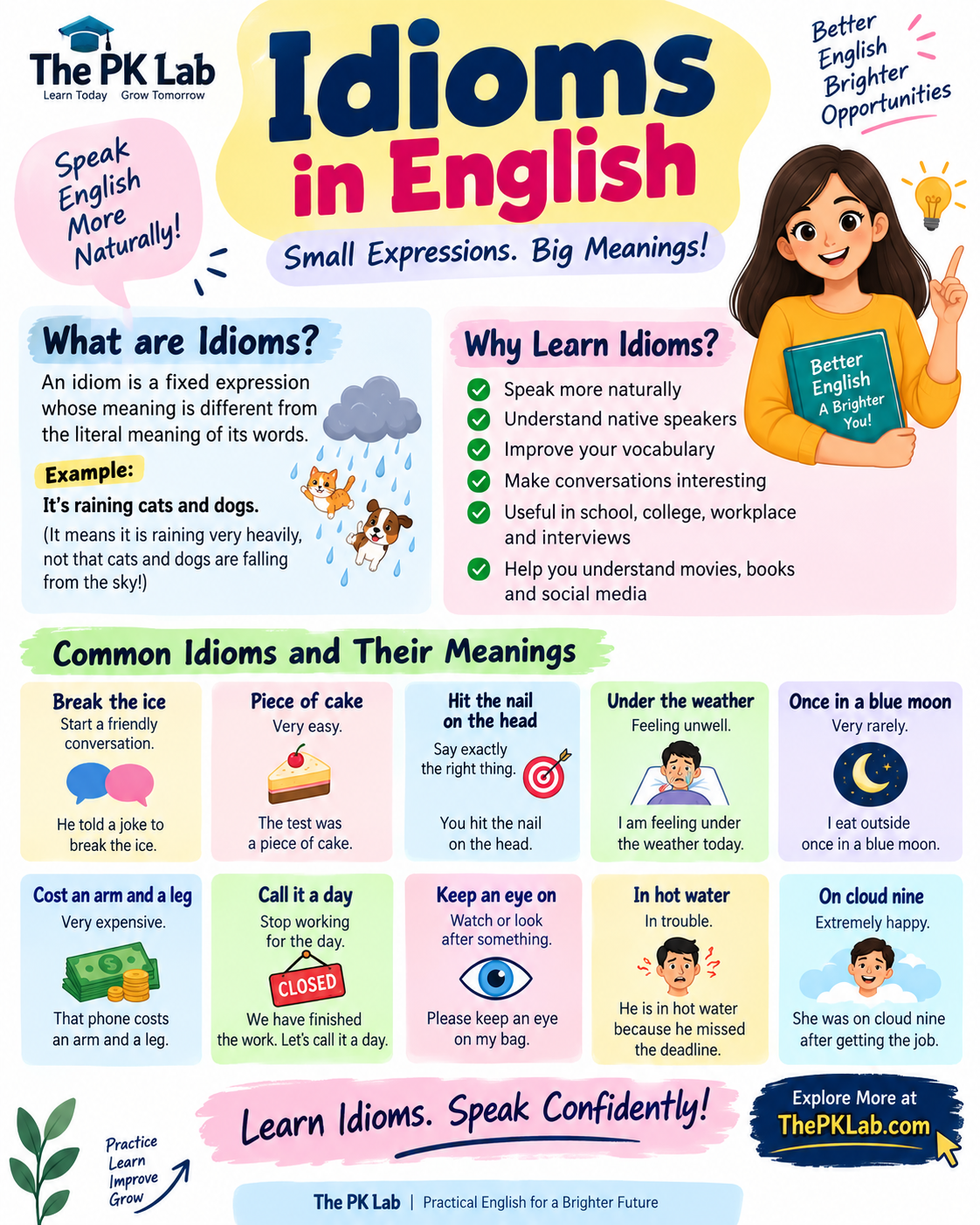
English is full of expressions whose meanings are different from the literal meanings of the individual words. These expressions are called idioms.
For example:
“It’s raining cats and dogs.”
This does not mean that cats and dogs are falling from the sky! 😄
It simply means:
It is raining very heavily.
Learning idioms can make your English sound more natural, expressive, and fluent, especially in conversations, movies, interviews, and workplace communication.
1. What is an Idiom?
An idiom is a fixed expression or group of words that has a special meaning different from its literal meaning.
Simple Definition
An idiom is an expression whose overall meaning cannot always be understood by translating each word separately.
Example
Break the ice
Literal meaning: Break something made of ice ❌
Idiomatic meaning: Start a conversation and make people feel comfortable ✅
Example:
Rahul told a joke to break the ice at the meeting.
2. Why Are Idioms Important?
Idioms are useful because they help you:
- Speak more naturally
- Understand native and fluent English speakers
- Understand movies, books, and social media
- Express ideas creatively
- Improve your vocabulary
- Make conversations more interesting
- Communicate feelings and situations effectively
However, you do not need to use idioms in every sentence. Use them when they fit the situation naturally.
3. Common Idioms You Should Know
| Idiom | Meaning | Example |
|---|---|---|
| Break the ice | Start a friendly conversation | He told a joke to break the ice. |
| Piece of cake | Very easy | The test was a piece of cake. |
| Hit the nail on the head | Say exactly the right thing | You hit the nail on the head. |
| Once in a blue moon | Very rarely | I eat outside once in a blue moon. |
| Under the weather | Feeling unwell | I am feeling under the weather today. |
| A blessing in disguise | Something that seems bad but turns out good | Missing that bus was a blessing in disguise. |
| Cost an arm and a leg | Very expensive | That phone costs an arm and a leg. |
| Call it a day | Stop working for the day | We have finished the work. Let’s call it a day. |
| Keep an eye on | Watch or look after something | Please keep an eye on my bag. |
| In hot water | In trouble | He is in hot water because he missed the deadline. |
| On cloud nine | Extremely happy | She was on cloud nine after getting the job. |
| Spill the beans | Reveal a secret | Who spilled the beans about the surprise? |
| Beat around the bush | Avoid talking directly about something | Don’t beat around the bush. Tell me what happened. |
| Get cold feet | Become nervous or afraid before doing something | He got cold feet before the interview. |
| Go the extra mile | Make an additional effort | She always goes the extra mile for her students. |
4. Idioms in Real-Life Situations
🏠 At Home
Idiom: Keep an eye on
Meaning: Look after something or someone.
Please keep an eye on the baby while I cook.
🎓 At College
Idiom: Hit the books
Meaning: Start studying seriously.
I have an exam tomorrow, so I need to hit the books.
💼 At the Workplace
Idiom: Go the extra mile
Meaning: Make more effort than expected.
A good employee is willing to go the extra mile to complete an important project.
💰 Shopping
Idiom: Cost an arm and a leg
Meaning: Be extremely expensive.
That laptop looks great, but it costs an arm and a leg.
🗣️ Conversation
Idiom: Break the ice
Meaning: Make people feel comfortable at the beginning of a conversation.
The trainer asked everyone to introduce themselves to break the ice.
5. Literal Meaning vs Idiomatic Meaning
Understanding this difference is very important.
| Expression | Literal Meaning | Idiomatic Meaning |
|---|---|---|
| Break the ice | Break ice | Start a conversation |
| Piece of cake | A piece of a cake | Something very easy |
| Hit the books | Hit books | Study seriously |
| Spill the beans | Drop beans | Reveal a secret |
| Under the weather | Below the weather | Feeling unwell |
| Cold feet | Cold feet | Feeling nervous or afraid |
6. Correct vs Incorrect Usage
Example 1
❌ The exam was a piece of cake, so I ate the cake.
The idiom is not talking about actual cake.
✅ The exam was a piece of cake.
Meaning: The exam was very easy.
Example 2
❌ I am under the weather, so I stood under the weather.
Here, the expression is not literal.
✅ I am feeling under the weather today.
Meaning: I am feeling unwell.
Example 3
❌ Don’t break the ice between your friends.
If you mean “start a friendly conversation,” this is inappropriate.
✅ The teacher told a joke to break the ice.
7. Common Mistakes with Idioms
1. Taking the idiom literally
“It’s a piece of cake.”
It usually means something is easy, not that someone is offering you cake.
2. Changing the words unnecessarily
Idioms generally have a fixed or relatively fixed form.
For example:
Break the ice ✅
Break an ice ❌
3. Using an idiom in the wrong situation
Some idioms are informal and are better suited to casual conversation.
4. Using too many idioms
Using an idiom in every sentence can make your English sound unnatural.
Natural English is more important than using complicated expressions.
8. Idioms and Spoken English
Idioms are common in everyday English.
Formal
We should stop working for today.
Natural / Conversational
Let’s call it a day.
Both are correct, but the second uses an idiom and sounds more conversational.
Another Example
Formal:
I rarely visit restaurants.
Conversational:
I eat out once in a blue moon.
9. Indian Learners: A Useful Tip
Many English learners in India translate expressions directly from their mother tongue.
This can sometimes create unnatural English.
Instead of translating an idiom word-for-word, learn it as a complete expression with its meaning and example.
Learn:
Once in a blue moon = very rarely
rather than trying to translate each word individually.
10. Memory Trick
Learn an idiom using this 3-step method:
IDIOM → MEANING → SENTENCE
For example:
Break the ice
↓
Start a friendly conversation
↓
I told a joke to break the ice.
This makes the idiom easier to remember and use.
11. Practice Exercise
Choose the correct idiom.
1. The mathematics test was very easy. It was a ______.
a) cold feet
b) piece of cake
c) hot water
2. I rarely watch movies in theatres. I go ______.
a) once in a blue moon
b) on cloud nine
c) under the weather
3. Please ______ my bag while I go to the counter.
a) spill the beans
b) keep an eye on
c) hit the books
4. She was extremely happy after getting the job.
She was ______.
a) on cloud nine
b) in hot water
c) under the weather
5. We have completed today’s work. Let’s ______.
a) break the ice
b) call it a day
c) get cold feet
Answers
- b) piece of cake
- a) once in a blue moon
- b) keep an eye on
- a) on cloud nine
- b) call it a day
12. FAQs
What is an idiom in English?
An idiom is a fixed expression whose overall meaning is different from the literal meaning of its words.
Are idioms important for spoken English?
Yes. Understanding common idioms can help learners understand and participate in natural conversations.
Should beginners learn idioms?
Yes, but beginners should start with common, frequently used idioms rather than memorizing long lists.
Are idioms formal or informal?
It depends on the idiom. Many are common in conversational English, while some can also be used in professional or written contexts.
Should I use idioms in an interview?
Use them carefully. Clear and professional English is more important than trying to sound complicated.
13. Key Takeaways
Remember:
- An idiom has a special meaning.
- Its meaning may be different from its literal meaning.
- Learn idioms as complete expressions.
- Learn the meaning and an example sentence.
- Use idioms naturally, not excessively.
- Understanding idioms improves listening and spoken English.
- Context is important when using an idiom.
Quick Revision
Idiom = Expression + Special Meaning
Example:
Piece of cake → Something very easy