1. What Are Phrasal Verbs?
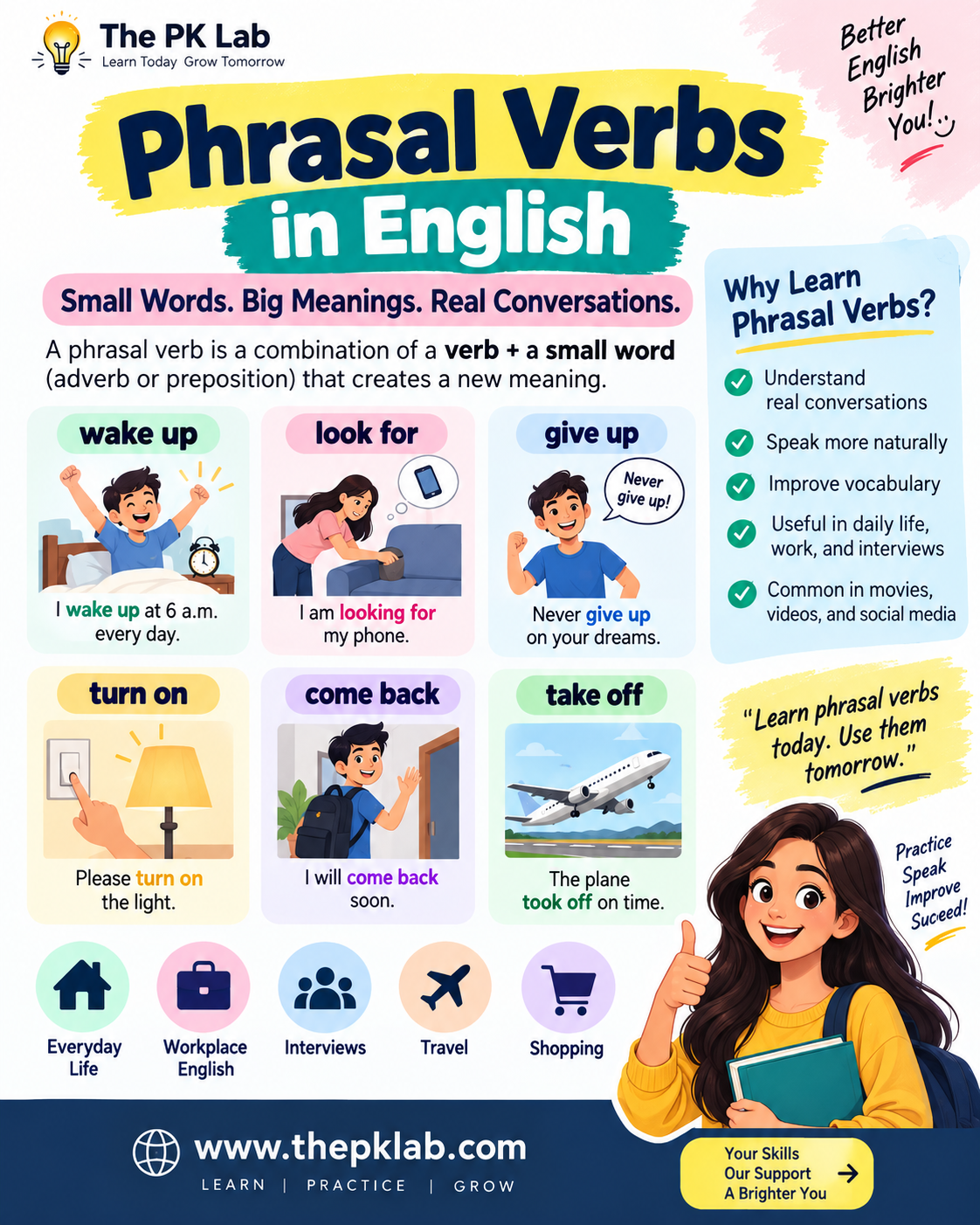
A phrasal verb is a combination of a verb + one or more small words such as an adverb or preposition. Together, they often create a new meaning.
For example:
- give = to hand something to someone
- give up = to stop trying
So, when a small word is added to a verb, the meaning can change completely.
Phrasal Verb = Verb + Particle
Examples:
| Phrasal Verb | Meaning |
|---|---|
| wake up | stop sleeping |
| sit down | take a seat |
| get up | leave your bed / stand |
| turn on | start a machine |
| turn off | stop a machine |
| look for | try to find |
| give up | stop trying |
| find out | discover information |
| pick up | lift or collect something |
| put off | postpone |
2. Why Are Phrasal Verbs Important?
Phrasal verbs are extremely common in everyday spoken English.
You may know the verb continue, but in a normal conversation, someone may say:
“Please carry on.”
Both mean “continue,” but carry on is a common phrasal verb.
Learning phrasal verbs will help you:
- Understand native and fluent English speakers
- Speak more naturally
- Improve your vocabulary
- Understand movies, videos, and conversations
- Communicate better at work
- Perform better in interviews
- Express everyday actions more easily
3. How Does a Phrasal Verb Work?
A phrasal verb usually contains:
Verb + Particle
wake + up → wake up
sit + down → sit down
turn + off → turn off
The particle can change the meaning of the original verb.
For example:
look = use your eyes
look for = try to find
look after = take care of
look at = direct your eyes toward something
look up = search for information
The verb look remains the same, but the particle changes the meaning.
4. Common Phrasal Verbs for Beginners
1. Wake up
Meaning: Stop sleeping.
I wake up at 6 a.m. every day.
2. Get up
Meaning: Leave your bed or stand.
I get up at 6:30.
3. Sit down
Meaning: Take a seat.
Please sit down.
4. Stand up
Meaning: Rise to your feet.
Please stand up.
5. Come in
Meaning: Enter a place.
Please come in.
6. Go out
Meaning: Leave a place or go somewhere outside.
I am going to go out with my friends.
7. Turn on
Meaning: Start a device or machine.
Please turn on the fan.
8. Turn off
Meaning: Stop a device or machine.
Please turn off the light.
9. Put on
Meaning: Wear something.
Put on your shoes.
10. Take off
Meaning: Remove clothing or leave the ground.
Take off your jacket.
5. Phrasal Verbs You Can Use Every Day
| Phrasal Verb | Meaning | Example |
|---|---|---|
| wake up | stop sleeping | I wake up early. |
| get up | leave the bed | I get up at 6 a.m. |
| hurry up | do something quickly | Hurry up! We are late. |
| slow down | become slower | Please slow down. |
| come back | return | I will come back soon. |
| go back | return to a place | I need to go back home. |
| find out | discover | I will find out the answer. |
| look for | search | I am looking for my phone. |
| pick up | collect/lift | Please pick up the bag. |
| put down | place something somewhere | Put down your phone. |
| carry on | continue | Please carry on with your work. |
| give up | stop trying | Never give up. |
| calm down | become relaxed | Please calm down. |
| grow up | become an adult | I grew up in Odisha. |
| hang up | end a phone call | She hung up the phone. |
6. Phrasal Verbs in Real-Life Situations
🏠 At Home
Wake up early.
Get up from the bed.
Turn on the light.
Put on your clothes.
Turn off the fan before leaving.
Example Conversation
Mother: Why are you still in bed?
Son: I just woke up.
Mother: Then get up quickly. You are getting late!
🎓 At College
Please hand in your assignment.
I need to look up this word.
Let’s go over the lesson again.
Don’t give up if the topic is difficult.
Go over means review or examine something carefully.
💼 At the Workplace
Please fill out this form.
I will get back to you tomorrow.
Let’s carry on with the meeting.
We need to work out a solution.
Work out can mean find a solution.
We need to work out this problem.
🛍️ While Shopping
I am looking for a black shirt.
Can I try on this jacket?
The shop will close down at 9 p.m.
✈️ While Travelling
We set off early in the morning.
The plane took off at 8 a.m.
We checked in at the hotel.
We checked out the next morning.
7. Phrasal Verbs Can Have More Than One Meaning
This is one reason learners sometimes find phrasal verbs difficult.
For example:
“Take off”
Meaning 1: Remove clothing
Take off your shoes.
Meaning 2: A plane leaves the ground
The plane took off on time.
Meaning 3: Become successful or popular
Her new business really took off.
The meaning depends on the context.
8. Separable and Inseparable Phrasal Verbs
Some phrasal verbs allow the object to come between the verb and particle.
Separable
Turn off the light.
Turn the light off.
Both are correct.
With a pronoun, however:
Turn it off. ✅
Turn off it. ❌
Inseparable
Some phrasal verbs cannot normally be separated.
I am looking for my keys. ✅
Not:
I am looking my keys for. ❌
Common inseparable examples:
- look after
- look for
- deal with
- depend on
- listen to
- wait for
9. Phrasal Verbs with Pronouns
This is an important rule.
For many separable phrasal verbs, when the object is a pronoun such as it, him, her, them, the pronoun comes between the verb and particle.
Example:
Turn it off. ✅
Pick it up. ✅
Put it down. ✅
Take it off. ✅
Incorrect:
Turn off it. ❌
Pick up it. ❌
Put down it. ❌
10. Common Mistakes by English Learners
Mistake 1
❌ I will return back tomorrow.
✅ I will return tomorrow.
Or:
✅ I will come back tomorrow.
“Return back” is generally redundant.
Mistake 2
❌ Please discuss about this issue.
✅ Please discuss this issue.
“Discuss” does not normally need about.
Mistake 3
❌ I will call back to you.
✅ I will call you back.
Mistake 4
❌ Please switch off it.
✅ Please switch it off.
11. Formal English vs Spoken English
Phrasal verbs are particularly useful in conversational English.
| More Formal | Common Spoken English |
|---|---|
| continue | carry on |
| investigate | look into |
| postpone | put off |
| discover | find out |
| tolerate | put up with |
| return | come back |
| cancel | call off |
| contact | get in touch with |
| increase | go up |
| decrease | go down |
Example
Formal:
The meeting was postponed.
Everyday English:
The meeting was put off.
Both are grammatically correct. The choice depends on the situation and level of formality.
12. Phrasal Verbs for Interviews
Phrasal verbs can also be useful in professional conversations.
Useful examples:
take on — accept responsibility/work
I am ready to take on new responsibilities.
deal with — handle
I can deal with challenging situations.
work on — spend time improving or developing something
I am currently working on my communication skills.
follow up — contact again to get an update
I will follow up with the candidate tomorrow.
get back to — respond later
I will get back to you after discussing it with my team.
13. Correct vs Incorrect
| ❌ Incorrect | ✅ Correct |
|---|---|
| Turn off it. | Turn it off. |
| Pick up it. | Pick it up. |
| Return back home. | Return home. / Go back home. |
| Discuss about the issue. | Discuss the issue. |
| Explain me the problem. | Explain the problem to me. |
| I will call back you. | I will call you back. |
14. Quick Memory Trick
Don’t try to memorize hundreds of phrasal verbs at once.
Learn them in groups.
With “LOOK”
- look at → direct your eyes toward
- look for → search
- look after → take care of
- look up → search for information
- look into → investigate
With “GET”
- get up → rise
- get in → enter
- get out → leave
- get back → return
- get on → board / have a good relationship
- get over → recover from something
With “TAKE”
- take off → remove / plane leaves ground
- take on → accept responsibility
- take up → begin an activity
- take back → return something / withdraw a statement
- take over → assume control
Learning phrasal verbs by verb families and situations makes them much easier to remember.
15. Practice Exercise
A. Choose the correct phrasal verb.
- Please ______ the lights before leaving.
a) turn off
b) look for
c) give up - I am ______ my mobile phone.
a) giving up
b) looking for
c) taking off - Never ______ your dreams.
a) give up
b) turn on
c) put down - Please ______. The teacher is coming.
a) hurry up
b) look after
c) take off - I will ______ to you tomorrow.
a) get back
b) put on
c) take over
Answers
- turn off
- looking for
- give up
- hurry up
- get back
16. Quick Revision
Remember:
Phrasal Verb = Verb + Particle
Examples:
- wake up → stop sleeping
- get up → rise from bed
- look for → search
- find out → discover
- give up → stop trying
- turn on → start a device
- turn off → stop a device
- put on → wear
- take off → remove
- come back → return
The most important point:
Don’t learn only the words. Learn the phrasal verb together with its meaning and a complete sentence.
Instead of memorizing:
give up = stop
Learn:
Never give up when you face difficulties.
This helps you remember both the meaning and the usage.
17. FAQs
What is a phrasal verb?
A phrasal verb is a combination of a verb and a particle that together create a particular meaning, such as give up, look for, or turn off.
Are phrasal verbs important for spoken English?
Yes. They are very common in everyday conversations and are an important part of natural English usage.
Are phrasal verbs formal or informal?
Many are common in conversational English, but some are also perfectly appropriate in professional communication. The right choice depends on context.
How can I learn phrasal verbs easily?
Learn them in small groups based on situations, common verbs, and example sentences rather than memorizing a long list.
Can one phrasal verb have multiple meanings?
Yes. For example, take off can mean removing clothing, an aircraft leaving the ground, or something becoming successful.
18. Key Takeaways
✅ A phrasal verb usually combines a verb + particle.
✅ The combination may have a different meaning from the original verb.
✅ Phrasal verbs are extremely common in spoken English.
✅ Learn them through real-life sentences and situations.
✅ Pay attention to separable and inseparable phrasal verbs.
✅ With many separable phrasal verbs, pronouns come between the verb and particle: Turn it off.
✅ Context is important because some phrasal verbs have multiple meanings.