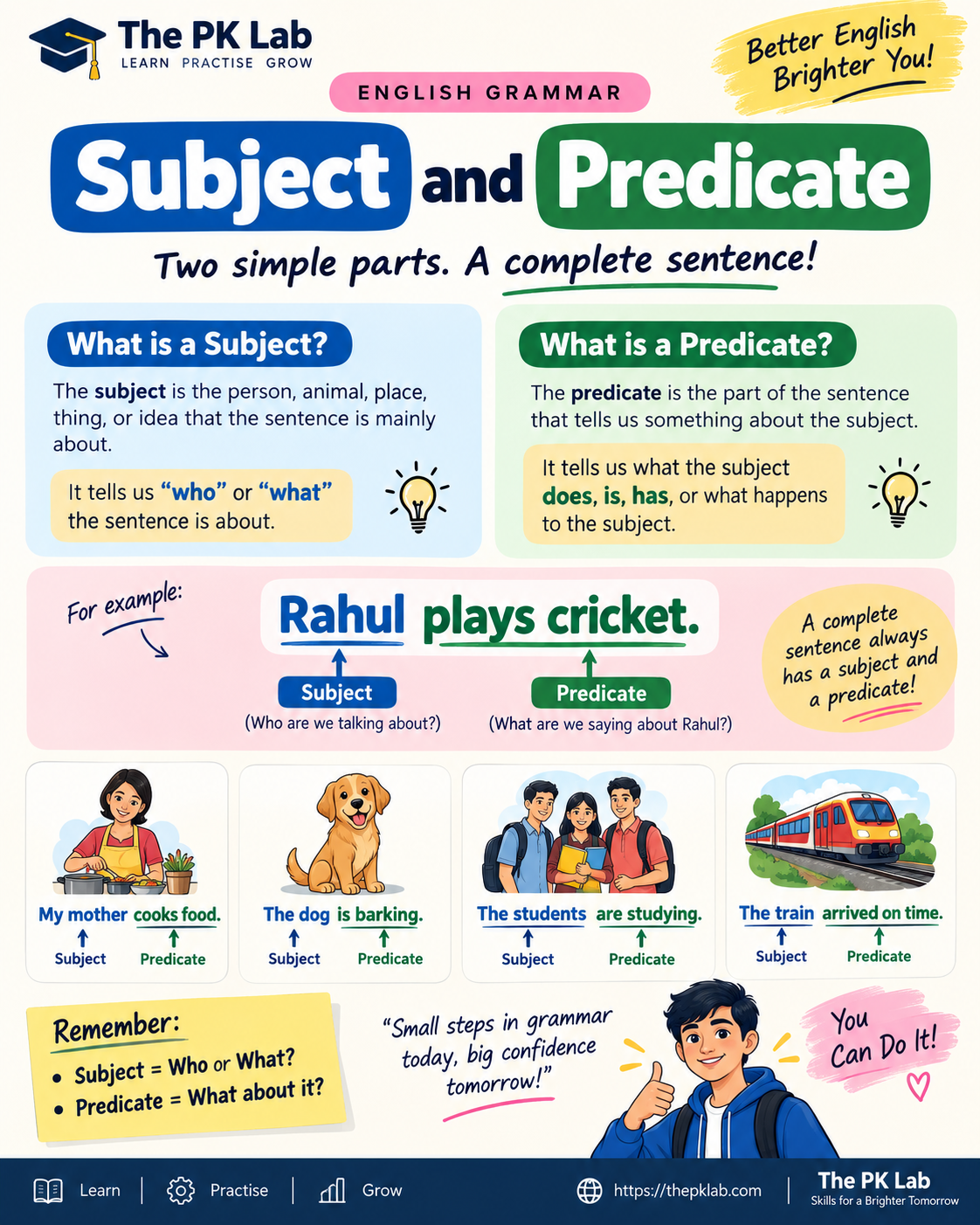
Subject and Predicate
Learn the two basic parts of an English sentence
Every complete sentence tells us something about someone or something.
To understand a sentence easily, we can divide it into two main parts:
Subject + Predicate
For example:
Rahul plays cricket.
- Subject: Rahul → Who are we talking about?
- Predicate: plays cricket → What are we saying about Rahul?
Once you understand Subject and Predicate, forming and understanding English sentences becomes much easier.
1. What is a Subject?
Simple Definition
The Subject is the person, animal, place, thing, or idea that the sentence is mainly about.
In simple words:
The Subject tells us “who” or “what” the sentence is about.
Examples
| Sentence | Subject |
|---|---|
| Rahul plays cricket. | Rahul |
| My mother cooks food. | My mother |
| The dog is barking. | The dog |
| Bhubaneswar is a beautiful city. | Bhubaneswar |
| The students are studying. | The students |
| Honesty is important. | Honesty |
Easy Trick
Ask:
Who? or What?
For example:
The boy is running.
Who is running?
👉 The boy
Therefore, “The boy” is the Subject.
2. What is a Predicate?
Simple Definition
The Predicate is the part of the sentence that tells us something about the Subject.
In simple words:
The Predicate tells us what the Subject does, is, has, or what happens to the Subject.
Examples
Rahul plays cricket.
- Subject → Rahul
- Predicate → plays cricket
The baby is sleeping.
- Subject → The baby
- Predicate → is sleeping
My father works in a bank.
- Subject → My father
- Predicate → works in a bank
The students are preparing for their examination.
- Subject → The students
- Predicate → are preparing for their examination
3. The Basic Structure
A simple sentence can often be divided like this:
Subject + Predicate
| Subject | Predicate |
|---|---|
| Rahul | plays cricket. |
| My sister | is reading a book. |
| The dog | is barking. |
| Our teacher | teaches English. |
| The children | are playing outside. |
Think of it this way:
Subject = Who/What?
Predicate = What about them/it?
4. Let’s Understand with a Story
Imagine your friend says:
“Ravi is going to college.”
You can immediately ask:
Who are we talking about?
👉 Ravi
That’s the Subject.
Then ask:
What is Ravi doing?
👉 is going to college
That’s the Predicate.
So:
Ravi + is going to college.
Subject + Predicate
5. Subject and Predicate in Everyday English
You use Subject and Predicate every time you speak English—even if you don’t realize it.
At Home
Mother is preparing dinner.
- Subject → Mother
- Predicate → is preparing dinner.
My brother is watching TV.
- Subject → My brother
- Predicate → is watching TV.
At School
The teacher is explaining the lesson.
- Subject → The teacher
- Predicate → is explaining the lesson.
The students are writing.
- Subject → The students
- Predicate → are writing.
At Work
The manager called a meeting.
- Subject → The manager
- Predicate → called a meeting.
Our team completed the project.
- Subject → Our team
- Predicate → completed the project.
While Travelling
The train arrived on time.
- Subject → The train
- Predicate → arrived on time.
6. Subject Can Be More Than One Word
The Subject is not always a single word.
Example:
The little boy is playing football.
The Subject is:
👉 The little boy
The Predicate is:
👉 is playing football.
Another example:
My best friend from college lives in Cuttack.
- Subject → My best friend from college
- Predicate → lives in Cuttack.
So, don’t assume that the first word is always the Subject.
7. Predicate Can Also Be Long
The Predicate can contain several words.
Example:
The students are preparing for their final examination in the classroom.
- Subject → The students
- Predicate → are preparing for their final examination in the classroom.
The Predicate can include:
- Verb
- Object
- Adverb
- Prepositional phrases
- Other information about the Subject
8. Finding the Subject and Predicate
Use this simple three-step method.
Step 1: Find the Verb
Look for the action or state.
Step 2: Ask “Who?” or “What?”
Who or what is performing the action or being described?
That’s usually the Subject.
Step 3: Everything that tells us something about the Subject forms the Predicate.
Example
The children are playing in the park.
Step 1: Verb → are playing
Step 2: Who are playing?
👉 The children
Subject → The children
Predicate → are playing in the park.
9. More Examples
Example 1
The sun is shining brightly.
- Subject → The sun
- Predicate → is shining brightly.
Example 2
My mother cooks delicious food.
- Subject → My mother
- Predicate → cooks delicious food.
Example 3
The students completed their homework.
- Subject → The students
- Predicate → completed their homework.
Example 4
Our English teacher speaks clearly.
- Subject → Our English teacher
- Predicate → speaks clearly.
Example 5
The new laptop is very fast.
- Subject → The new laptop
- Predicate → is very fast.
10. What About Commands?
Some sentences don’t openly show the Subject.
For example:
Open the door.
Who should open the door?
👉 You
The Subject “you” is understood, but it isn’t written.
So:
Open the door.
- Subject → You (understood)
- Predicate → open the door
Similarly:
Please sit down.
- Subject → You (understood)
- Predicate → please sit down
This is especially useful when learning Imperative Sentences.
11. Subject and Predicate in Questions
Questions can have a different word order.
Example:
Are you ready?
Here:
- Subject → you
- Predicate → are ready
Another example:
Is Rahul coming today?
- Subject → Rahul
- Predicate → is coming today
So, don’t always assume that the Subject comes first.
12. Compound Subjects
Sometimes two or more subjects share the same Predicate.
Example:
Rahul and Amit play cricket.
- Compound Subject → Rahul and Amit
- Predicate → play cricket
Another example:
My mother and father work together.
- Compound Subject → My mother and father
- Predicate → work together
13. Compound Predicate
Sometimes one Subject performs two or more actions.
Example:
Rahul opened the door and entered the room.
- Subject → Rahul
- Compound Predicate → opened the door and entered the room
Another example:
She cooked dinner and washed the dishes.
- Subject → She
- Predicate → cooked dinner and washed the dishes
14. Subject vs Predicate
| Subject | Predicate |
|---|---|
| Tells us who/what the sentence is about | Tells us something about the Subject |
| Usually contains the main person/thing | Contains the verb and remaining information |
| Answers “Who?” or “What?” | Answers “What about the Subject?” |
| Example: Rahul | Example: plays cricket. |
Remember:
Subject = The main character
Predicate = What the main character does/is/has
15. Correct vs Incorrect Understanding
Example 1
❌ Subject: plays cricket
✅ Subject: Rahul
Rahul plays cricket.
Example 2
❌ Predicate: The students
✅ Predicate: are studying in the classroom.
The students are studying in the classroom.
Example 3
Sentence:
My younger brother watches cartoons every evening.
❌ Subject → brother
✅ Subject → My younger brother
❌ Predicate → watches
✅ Predicate → watches cartoons every evening
Remember: the Subject and Predicate can contain multiple words.
16. Common Mistakes
Mistake 1: Thinking the Subject is always one word
The tall boy from my class won the competition.
The Subject is not just boy.
✅ Subject → The tall boy from my class
Mistake 2: Thinking the first word is always the Subject
In the morning, my father goes for a walk.
The first phrase is In the morning, but the Subject is:
✅ my father
Mistake 3: Looking only for the action
The flowers are beautiful.
There isn’t an obvious action.
But:
- Subject → The flowers
- Predicate → are beautiful
The Predicate doesn’t always describe an action. It can describe a state or quality.
17. Subject & Predicate for Spoken English
Understanding Subject and Predicate helps you build sentences naturally.
Instead of memorizing hundreds of complete sentences, learn useful patterns.
Pattern 1
I + verb + object
- I like coffee.
- I need help.
- I speak English.
- I understand the question.
Pattern 2
My + noun + verb
- My brother works here.
- My mother cooks well.
- My friend lives nearby.
Pattern 3
The + noun + is/are + information
- The class is interesting.
- The students are ready.
- The food is delicious.
Once you understand this structure, you can create your own sentences.
18. A Simple Memory Trick
Remember:
S = Subject = Someone/Something
P = Predicate = Provides information
Or simply remember:
Subject = Who or What?
Predicate = What about it?
For example:
The dog is barking.
🐶 Who?
👉 The dog = Subject
What about the dog?
👉 is barking = Predicate
19. Practice Exercise
A. Identify the Subject and Predicate
- Rahul plays football.
- My mother is cooking dinner.
- The children are playing in the park.
- Our teacher teaches English.
- The sun rises in the east.
- My best friend lives in Bhubaneswar.
- The train arrived late.
- The little girl is singing a song.
- My brother and sister study together.
- The manager called a meeting.
Challenge
- The boy in the blue shirt won the race.
- My parents are watching television.
- Rina opened the door and entered the room.
- The students completed their project successfully.
- Please close the window.
20. Answers
| No. | Subject | Predicate |
|---|---|---|
| 1 | Rahul | plays football. |
| 2 | My mother | is cooking dinner. |
| 3 | The children | are playing in the park. |
| 4 | Our teacher | teaches English. |
| 5 | The sun | rises in the east. |
| 6 | My best friend | lives in Bhubaneswar. |
| 7 | The train | arrived late. |
| 8 | The little girl | is singing a song. |
| 9 | My brother and sister | study together. |
| 10 | The manager | called a meeting. |
| 11 | The boy in the blue shirt | won the race. |
| 12 | My parents | are watching television. |
| 13 | Rina | opened the door and entered the room. |
| 14 | The students | completed their project successfully. |
| 15 | You (understood) | please close the window. |
Quick Revision
Before moving ahead, remember these five points:
- Every complete sentence communicates an idea.
- A sentence can usually be divided into Subject + Predicate.
- Subject tells us who or what the sentence is about.
- Predicate tells us something about the Subject.
- The Subject and Predicate can contain one word or many words.
The Golden Formula
WHO / WHAT? → SUBJECT
WHAT ABOUT IT? → PREDICATE
Example
The students are learning English.
The students → Who?
✅ Subject
are learning English → What are they doing?
✅ Predicate
Frequently Asked Questions
1. What is a Subject?
A Subject is the person, animal, place, thing, or idea that a sentence is mainly about.
2. What is a Predicate?
A Predicate tells us something about the Subject and normally contains the verb.
3. Can a Subject contain more than one word?
Yes. For example, “The little boy” is a Subject.
4. Can a Predicate contain more than one word?
Yes. For example, “is playing football in the park” is a Predicate.
5. Does every sentence have a Subject?
Most complete sentences have a Subject, but in imperative sentences such as “Open the door,” the Subject “you” is understood rather than stated.
6. Why should I learn Subject and Predicate?
Because they help you understand how English sentences are constructed. Once you understand this basic structure, learning tenses, sentence formation, and spoken English becomes easier.
Key Takeaway
A sentence needs a clear idea. The Subject tells us who or what we are talking about, and the Predicate tells us what we are saying about that Subject.
Subject + Predicate = The basic building blocks of an English sentence.