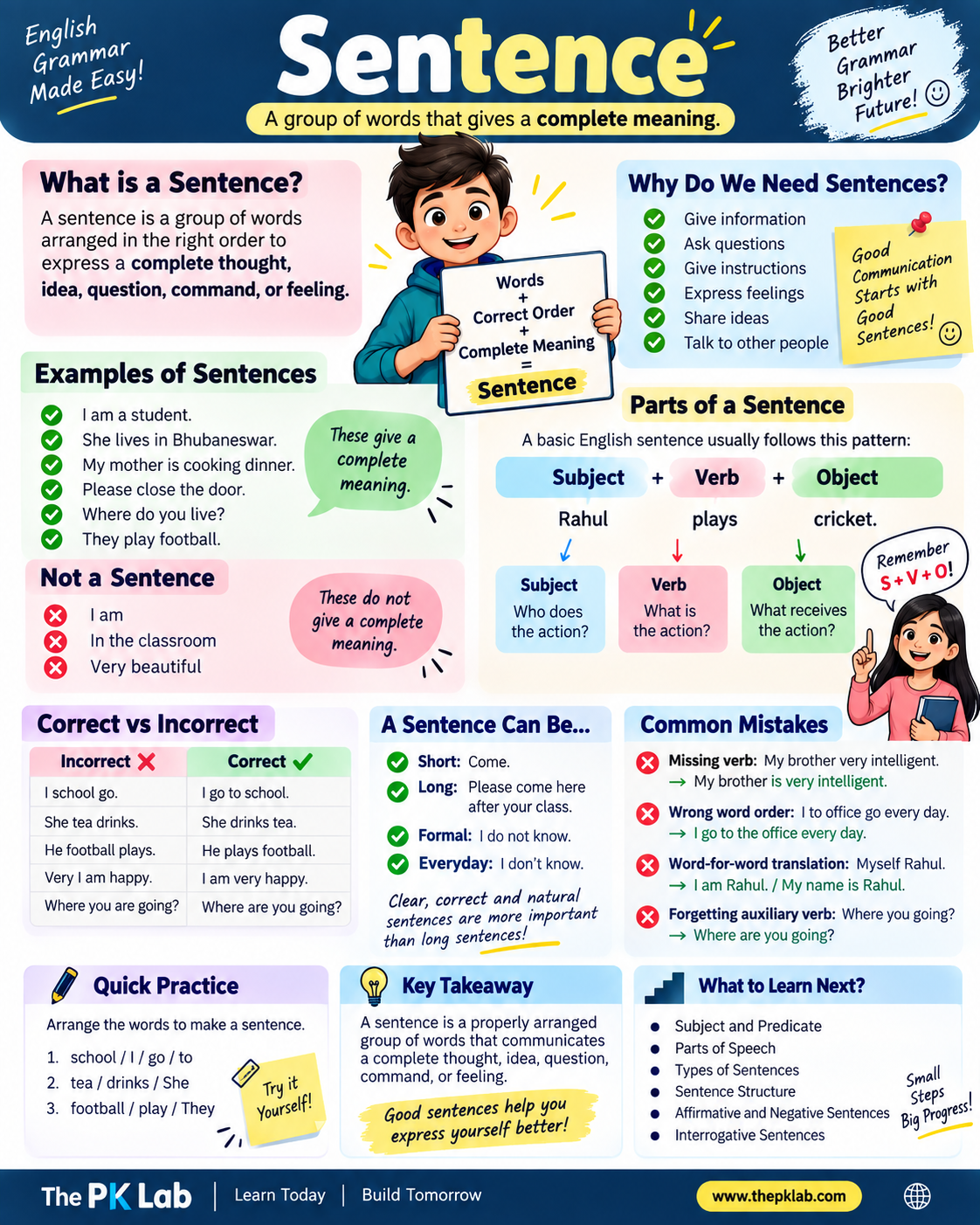
What Is a Sentence?
A sentence is a group of words that gives us a complete meaning.
In simple words:
A sentence is a group of words arranged in the right order to express a complete thought, idea, question, command, or feeling.
Look at these examples:
✅ I am a student.
This gives us a complete meaning.
✅ She lives in Bhubaneswar.
This tells us something complete.
❌ I am
We expect more information.
❌ In Bhubaneswar
This does not express a complete thought by itself.
So, remember:
Words + Correct Order + Complete Meaning = Sentence
Why Do We Need Sentences?
We use sentences every day to:
- Give information
- Ask questions
- Give instructions
- Express feelings
- Share ideas
- Talk to other people
For example:
At home:
Please close the door.
At college:
I have a class at 10 a.m.
At work:
Please send me the report.
At a shop:
How much does this shirt cost?
In an interview:
I have five years of experience in this field.
Without sentences, it would be difficult to communicate our thoughts clearly.
How Is a Sentence Made?
A basic English sentence usually follows a particular order.
Subject + Verb + Object
Rahul + plays + cricket.
| Part | Word | What does it tell us? |
|---|---|---|
| Subject | Rahul | Who does the action? |
| Verb | plays | What is the action? |
| Object | cricket | What receives the action? |
More examples:
I read books.
She drinks tea.
They play football.
We watch movies.
This basic pattern is extremely useful when you are learning to speak English.
The Subject
The subject tells us who or what the sentence is about.
Examples:
Riya is studying.
Who is studying?
➡️ Riya
The dog is barking.
What is barking?
➡️ The dog
My friends are coming.
Who is coming?
➡️ My friends
So:
Subject = Who or what the sentence is about.
The Verb
A verb usually tells us what someone or something does, or what someone or something is.
Examples:
Rahul runs every morning.
She works in a bank.
They play cricket.
I am happy.
Here, runs, works, play, am are verbs.
Remember:
A sentence normally needs a verb to express a complete thought.
The Object
The object receives the action of the verb.
Example:
I read a book.
I → Subject
read → Verb
a book → Object
Another example:
She bought a new phone.
She → Subject
bought → Verb
a new phone → Object
However, not every sentence needs an object.
For example:
The baby is sleeping.
Here, there is a subject and a verb, but no object.
Examples of Sentences
Let’s see how sentences work in real life.
At Home
My mother is cooking dinner.
Please turn off the fan.
Where is my mobile phone?
At School or College
I have an English class today.
The teacher explained the topic.
Can I come inside, sir?
At the Workplace
I will send the report today.
Please join the meeting.
Could you explain this point?
While Shopping
How much is this shirt?
I want to buy these shoes.
Do you accept UPI?
While Travelling
Where is the railway station?
When does the bus leave?
I have booked a ticket to Cuttack.
Correct vs Incorrect
The order of words is very important in English.
| Incorrect ❌ | Correct ✅ |
|---|---|
| I school go. | I go to school. |
| She tea drinks. | She drinks tea. |
| He football plays. | He plays football. |
| Very I am happy. | I am very happy. |
| Where you are going? | Where are you going? |
Why?
English generally follows a particular word order.
For a basic statement:
Subject + Verb + Object
For example:
I + eat + rice.
Not:
❌ I rice eat.
This is one reason why understanding sentence structure is important for spoken English.
A Sentence Can Be Short or Long
A sentence does not have to be long to be correct.
Short sentence:
Come.
Slightly longer:
Please come here.
Longer:
Please come here after your class.
All three can communicate a complete thought depending on the context.
So don’t think:
Long sentence = Good English
Good English means clear, correct, and appropriate communication.
Four Basic Things a Sentence Can Do
A sentence can be used to:
1. Tell Something
I live in Odisha.
2. Ask Something
Where do you live?
3. Give a Command or Request
Please sit down.
4. Express Strong Feeling
What a beautiful place!
These are commonly discussed as different types of sentences, which we will learn in detail separately.
Sentence vs Group of Words
Not every group of words is a sentence.
Compare:
Group of words:
in the classroom
It does not give a complete thought.
Sentence:
The students are in the classroom.
It gives complete information.
Therefore:
A sentence expresses a complete meaning, while a group of words may not.
Common Mistakes
Mistake 1: Wrong Word Order
❌ I to office go every day.
✅ I go to the office every day.
Mistake 2: Missing Verb
❌ My brother very intelligent.
✅ My brother is very intelligent.
Mistake 3: Translating Word-for-Word
Regional-language speakers sometimes translate directly from their mother tongue.
For example:
❌ Myself Rahul.
Better:
✅ I am Rahul.
Or:
✅ My name is Rahul.
The goal is not to translate every word. The goal is to learn natural English sentence patterns.
Mistake 4: Forgetting the Auxiliary Verb
❌ Where you going?
✅ Where are you going?
❌ What you doing?
✅ What are you doing?
Spoken English: Natural Sentence Patterns
In everyday conversation, we often use short and natural sentences.
Formal:
I do not know.
Everyday:
I don’t know.
Both are grammatically correct. The second is a common contraction in everyday conversation.
More examples:
Formal: I cannot come today.
Natural: I can’t come today.
Formal: I will not do it.
Natural: I won’t do it.
Formal: Do you want to go?
Natural: Do you want to go?
The important thing is to understand when to use formal and informal language.
Quick Memory Trick
Remember:
S + V + O
S = Subject
V = Verb
O = Object
Example:
I eat rice.
I → Subject
eat → Verb
rice → Object
Try creating your own sentences using:
I + verb + something
For example:
- I read books.
- I watch movies.
- I play cricket.
- I drink tea.
- I learn English.
This simple pattern can help beginners start forming English sentences confidently.
Practice Exercise
Exercise 1: Identify the Sentence
Which of the following are complete sentences?
- I am happy.
- In the classroom.
- She is reading a book.
- Very beautiful.
- They play football.
Answers:
- ✅ Sentence
- ❌ Not a complete sentence
- ✅ Sentence
- ❌ Not a complete sentence
- ✅ Sentence
Exercise 2: Arrange the Words
Arrange the words to make correct sentences.
- school / I / go / to
- tea / drinks / She
- football / play / They
- English / learning / am / I
- report / the / sent / He
Answers:
- I go to school.
- She drinks tea.
- They play football.
- I am learning English.
- He sent the report.
Exercise 3: Identify Subject, Verb and Object
Identify the Subject (S), Verb (V), and Object (O).
1. Rahul reads a newspaper.
Subject: Rahul
Verb: reads
Object: a newspaper
2. She watches television.
Subject: She
Verb: watches
Object: television
3. They play cricket.
Subject: They
Verb: play
Object: cricket
Quick Revision
Remember these five points:
- A sentence expresses a complete meaning.
- Words must be arranged in the correct order.
- A sentence generally contains a subject and a verb, although structures vary.
- A basic English pattern is Subject + Verb + Object.
- Good English is not about making sentences unnecessarily long—it is about communicating clearly and naturally.
One simple example:
Riya reads books.
Riya → Subject
reads → Verb
books → Object