Noun
Learn the Names of People, Places, Things, Animals and Ideas
A Noun is one of the most important parts of English grammar.
In simple words:
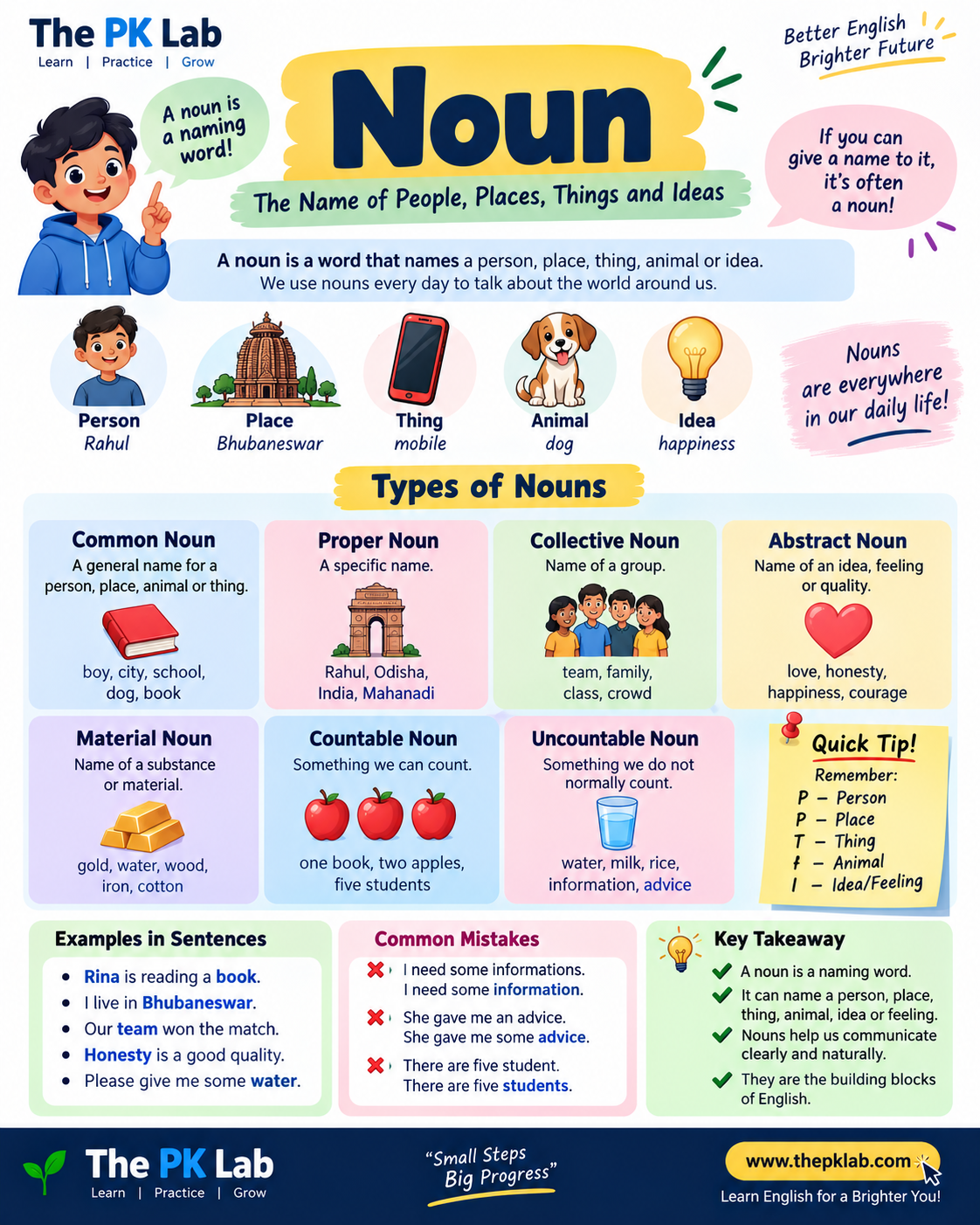
A noun is the name of a person, place, thing, animal, or idea.
Look around you. You will see and hear many names:
- Person: Rahul, teacher, mother
- Place: Odisha, school, Bhubaneswar
- Thing: mobile, book, table
- Animal: dog, elephant, cow
- Idea or feeling: happiness, love, honesty
These naming words are called Nouns.
1. What Is a Noun?
A noun is a word that names someone or something.
For example:
Rina is reading a book.
Here:
- Rina → name of a person → Noun
- book → name of a thing → Noun
Another example:
Bhubaneswar is a beautiful city.
- Bhubaneswar → name of a place → Noun
- city → name of a place → Noun
Easy Way to Understand
Think of a noun as a naming word.
If a word gives a name to someone or something, it is often a noun.
2. Why Do We Need Nouns?
Without nouns, it would be difficult to tell who or what we are talking about.
Imagine saying:
“He went there and bought it.”
We may understand the sentence only if we already know who he, where there, and what it refer to.
Now compare:
Rahul went to the market and bought a mobile phone.
The meaning is much clearer.
Nouns help us identify people, places, things, animals, and ideas.
They are the building blocks of communication.
3. Types of Nouns
There are several important types of nouns.
| Type | Meaning | Examples |
|---|---|---|
| Common Noun | General name | boy, city, school |
| Proper Noun | Specific name | Rahul, Odisha, India |
| Collective Noun | Name of a group | team, family, crowd |
| Abstract Noun | Name of an idea, quality, or feeling | honesty, love, happiness |
| Material Noun | Name of a substance or material | gold, water, wood |
| Countable Noun | Something we can count | book, apple, student |
| Uncountable Noun | Something we normally don’t count individually | water, milk, information |
Let’s understand them one by one.
4. Common Noun
A Common Noun is a general name for a person, place, animal, or thing.
Examples
- boy
- girl
- teacher
- school
- city
- country
- dog
- book
- mobile
For example:
I met a teacher.
“Teacher” is a general name, so it is a common noun.
More Examples
She bought a dress.
My brother works in a bank.
The dog is sleeping.
5. Proper Noun
A Proper Noun is the specific name of a person, place, organization, day, month, etc.
A proper noun normally begins with a capital letter.
Examples
| Common Noun | Proper Noun |
|---|---|
| boy | Rahul |
| city | Bhubaneswar |
| state | Odisha |
| country | India |
| river | Mahanadi |
| school | Government ITI Cuttack |
Compare:
I live in a city.
I live in Bhubaneswar.
“City” is a common noun, while “Bhubaneswar” is a proper noun.
Remember
General name → Common Noun
Specific name → Proper Noun
6. Collective Noun
A Collective Noun names a group of people, animals, or things as one unit.
Examples
- team
- family
- class
- crowd
- committee
- army
- bunch
Examples:
Our team won the match.
My family lives in Odisha.
The class is ready for the test.
Here, “team”, “family”, and “class” refer to groups.
7. Abstract Noun
An Abstract Noun names something that we cannot normally see or touch.
It can be an:
- idea
- feeling
- quality
- emotion
- state
Examples
- love
- honesty
- happiness
- courage
- freedom
- kindness
- knowledge
- friendship
For example:
Honesty is a good quality.
You cannot physically touch “honesty”, but you can understand and experience it.
Another example:
Happiness is important in life.
8. Material Noun
A Material Noun refers to a substance or material from which things are made.
Examples
- gold
- silver
- iron
- wood
- water
- milk
- cotton
Examples:
This ring is made of gold.
The chair is made of wood.
Please give me some water.
9. Countable Nouns
A Countable Noun is something that we can count.
Examples
- one book, two books
- one student, ten students
- one apple, five apples
- one chair, four chairs
We can use numbers with countable nouns.
I have three books.
There are twenty students in the classroom.
Countable nouns can usually have singular and plural forms.
10. Uncountable Nouns
An Uncountable Noun refers to something that we normally do not count as individual units.
Examples:
- water
- milk
- rice
- sugar
- information
- advice
- furniture
We normally don’t say:
❌ two waters
❌ three advices
Instead, we can say:
✅ two glasses of water
✅ three pieces of advice
Example
I need some information.
Not:
❌ I need some informations.
11. Nouns in Everyday Life
Nouns are everywhere.
At Home
My mother is in the kitchen.
- mother → person
- kitchen → place
At School
The teacher gave the students a book.
- teacher → person
- students → people
- book → thing
At the Market
I bought vegetables from the market.
- vegetables → things
- market → place
At Work
The manager called a meeting.
- manager → person
- meeting → event/thing
While Travelling
We visited Puri during our holiday.
- Puri → specific place
- holiday → event/period
12. Find the Nouns
Look at this sentence:
Rahul bought a new laptop from the shop.
Which words are nouns?
Rahul → person → Noun
laptop → thing → Noun
shop → place → Noun
So the nouns are:
Rahul, laptop, shop
13. Noun in a Sentence
A noun can perform different jobs in a sentence.
As the Subject
Riya is studying.
Riya is the person doing the action.
As the Object
Riya is reading a book.
“Book” receives the action.
After a Preposition
The book is on the table.
“Table” is a noun.
So, nouns can appear in different positions in a sentence.
14. Correct vs Incorrect
| Incorrect ❌ | Correct ✅ |
|---|---|
| I need some informations. | I need some information. |
| She gave me an advice. | She gave me some advice. |
| He has two furnitures. | He has two pieces of furniture. |
| I bought a rice. | I bought some rice. |
| There are five student. | There are five students. |
Why Do These Mistakes Happen?
Many learners translate directly from their first language.
English nouns follow their own rules for countability, singular/plural forms, and articles.
Learning these patterns will make your English more natural.
15. Common Mistakes Indian English Learners Should Avoid
Mistake 1: Using “advices”
❌ My teacher gave me many advices.
✅ My teacher gave me a lot of advice.
Mistake 2: Using “informations”
❌ Please give me the informations.
✅ Please give me the information.
Mistake 3: Forgetting plural -s
❌ There are five student in my class.
✅ There are five students in my class.
Mistake 4: Incorrect capitalization
❌ I live in odisha.
✅ I live in Odisha.
“Odisha” is a proper noun, so it begins with a capital letter.
16. Nouns and Spoken English
Nouns are used constantly in everyday conversation.
At Home
A: Where is Mom?
B: She is in the kitchen.
At College
A: Which college do you study in?
B: I study at a college in Bhubaneswar.
At Work
A: Where is the manager?
B: He is in the meeting room.
At a Shop
A: How much is this shirt?
B: It is ₹800.
Notice how many nouns we naturally use while speaking.
17. Quick Memory Trick
Remember:
P – P – T – A – I
P → Person
P → Place
T → Thing
A → Animal
I → Idea/Feeling
Examples:
👨 Person → teacher
📍 Place → Odisha
📱 Thing → mobile
🐕 Animal → dog
❤️ Idea/Feeling → love
If a word names one of these, check whether it is a noun.
18. Practice Exercise
A. Identify the nouns
Find the nouns in each sentence.
- Rahul plays cricket.
- The dog is sleeping.
- My mother is cooking dinner.
- Odisha is a beautiful state.
- Honesty is a great quality.
- The students are in the classroom.
- I bought a new phone.
- The team won the match.
- Gold is an expensive metal.
- Happiness is important in life.
B. Choose the correct word
- I need some ________.
a) informations
b) information - She gave me some ________.
a) advice
b) advices - There are five ________ in the room.
a) student
b) students - He bought a ________.
a) book
b) books - ________ is the capital of Odisha.
a) Bhubaneswar
b) city
19. Answers
A. Nouns
- Rahul, cricket
- dog
- mother, dinner
- Odisha, state
- Honesty, quality
- students, classroom
- phone
- team, match
- Gold, metal
- Happiness, life
B. Answers
- information ✅
- advice ✅
- students ✅
- book ✅
- Bhubaneswar ✅
20. Quick Revision
Let’s remember the most important points:
- A noun is a naming word.
- It can name a person, place, thing, animal, idea, feeling, or quality.
- Common Noun → general name.
- Proper Noun → specific name.
- Collective Noun → name of a group.
- Abstract Noun → idea, feeling, or quality.
- Material Noun → substance or material.
- Countable Noun → can be counted.
- Uncountable Noun → normally not counted individually.
- Proper nouns generally begin with a capital letter.
One sentence to remember:
A noun gives a name to someone or something.
21. FAQs
What is a noun in simple English?
A noun is a word that names a person, place, thing, animal, idea, feeling, or quality.
Is a person’s name a noun?
Yes. A person’s name such as Rahul, Priya, or Ramesh is a proper noun.
Is a place a noun?
Yes. Words such as school, city, India, and Odisha can be nouns.
Is an idea a noun?
Yes. Words such as love, honesty, happiness, and freedom are abstract nouns.
Is “water” a noun?
Yes. “Water” is a noun and is generally treated as an uncountable noun.
How can I identify a noun?
Ask yourself:
“Is this word naming someone or something?”
If yes, it may be a noun.
Key Takeaway
Nouns are the names we use to talk about the world around us.
When you say:
“My friend bought a phone from a shop in Bhubaneswar.”
You are already using nouns naturally.
So don’t think of nouns as just a grammar rule.
Nouns are part of everyday English.