What Is a Pronoun?
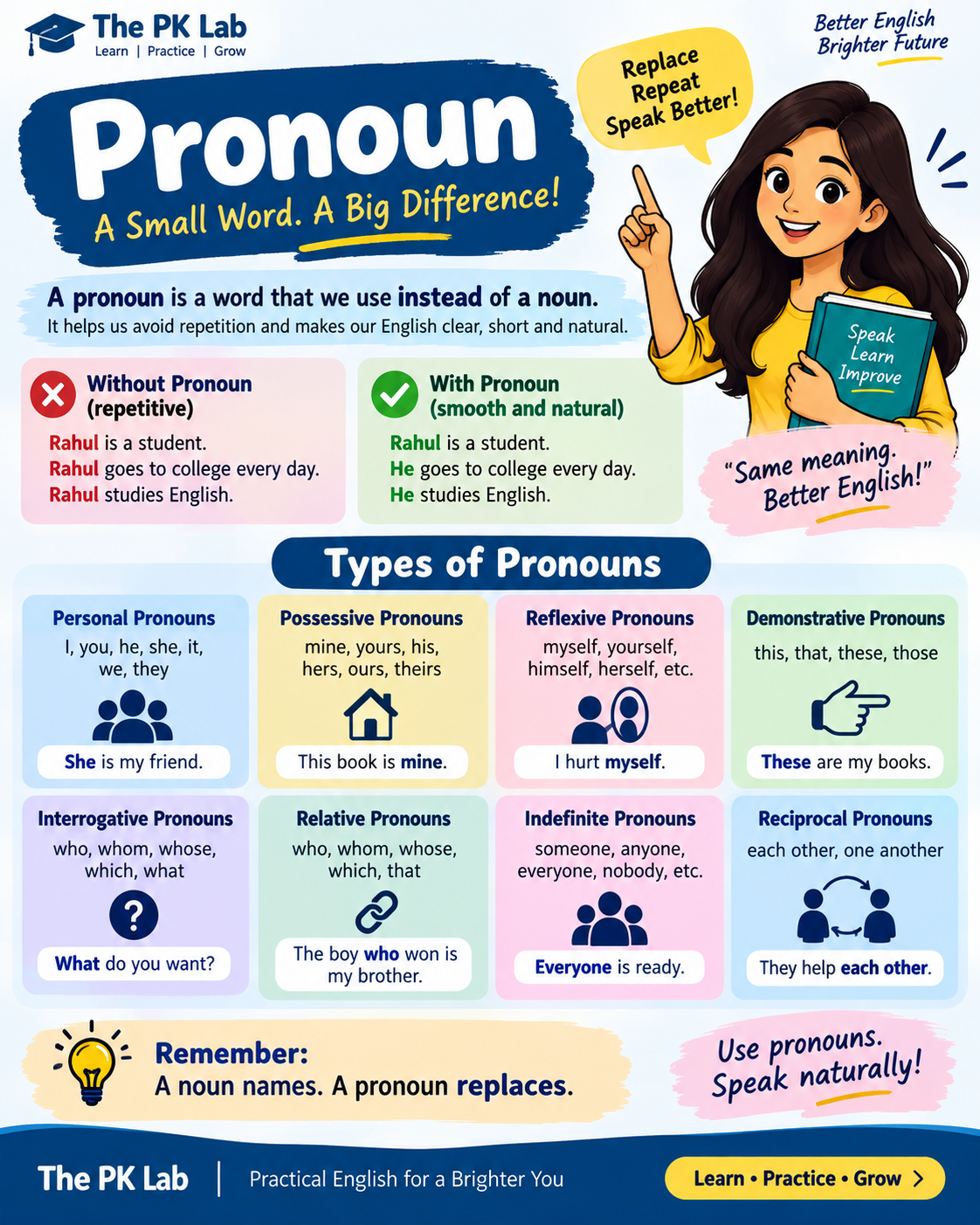
A pronoun is a word that we use instead of a noun.
In simple words:
A pronoun helps us avoid repeating the same noun again and again.
Look at this:
❌ Rahul is a student. Rahul goes to college every day. Rahul studies English.
It sounds repetitive.
Now use a pronoun:
✅ Rahul is a student. He goes to college every day. He studies English.
Here, he replaces Rahul.
So:
Rahul → He
That’s the basic idea of a pronoun.
Why Do We Need Pronouns?
Imagine talking about your friend:
“Priya went to the market. Priya bought vegetables. Priya came home. Priya cooked dinner.”
Repeating “Priya” again and again makes the sentence uncomfortable.
With pronouns:
“Priya went to the market. She bought vegetables. She came home. She cooked dinner.”
Much better!
Pronouns make our English:
- Clearer
- Shorter
- Smoother
- More natural
- Less repetitive
A Simple Way to Understand Pronouns
Think of a pronoun as a replacement word.
| Noun | Pronoun |
|---|---|
| Rahul | He |
| Priya | She |
| The dog | It |
| Rahul and Priya | They |
| The students | They |
| My brother and I | We |
| The book | It |
Example
Rahul is my friend. He is very helpful.
Here:
- Rahul = Noun
- He = Pronoun
Types of Pronouns
There are several types of pronouns in English.
| Type | Examples |
|---|---|
| Personal Pronouns | I, you, he, she, it, we, they |
| Possessive Pronouns | mine, yours, his, hers, ours, theirs |
| Reflexive Pronouns | myself, yourself, himself, herself, itself |
| Demonstrative Pronouns | this, that, these, those |
| Interrogative Pronouns | who, whom, whose, which, what |
| Relative Pronouns | who, whom, whose, which, that |
| Indefinite Pronouns | someone, anyone, everyone, nobody, something |
| Reciprocal Pronouns | each other, one another |
Let’s understand them one by one.
1. Personal Pronouns
Personal pronouns are used to talk about people, animals, or things.
Subject Pronouns
| Person | Pronoun | Example |
|---|---|---|
| First person singular | I | I am a teacher. |
| Second person singular/plural | You | You are my friend. |
| Third person singular | He | He is my brother. |
| Third person singular | She | She is my sister. |
| Third person singular | It | It is a book. |
| First person plural | We | We are students. |
| Third person plural | They | They are my friends. |
Easy Examples
- I am learning English.
- You are very helpful.
- He works in Bhubaneswar.
- She teaches English.
- It is raining.
- We are ready.
- They live in Cuttack.
2. Object Pronouns
Object pronouns are used when someone or something receives the action.
| Subject | Object |
|---|---|
| I | me |
| You | you |
| He | him |
| She | her |
| It | it |
| We | us |
| They | them |
Examples
- Rahul called me.
- I helped him.
- She invited us.
- We saw her.
- The teacher praised them.
- Please give it to me.
Remember
I → me
❌ She called I.
✅ She called me.
He → him
❌ I met he yesterday.
✅ I met him yesterday.
3. Possessive Pronouns
Possessive pronouns show ownership or possession.
Examples:
mine, yours, his, hers, ours, theirs
Examples
- This book is mine.
- That bag is yours.
- This phone is his.
- The blue car is hers.
- This house is ours.
- Those seats are theirs.
Compare
Possessive adjective:
This is my book.
Possessive pronoun:
This book is mine.
A simple way to remember:
My + noun → my book
Mine → This book is mine.
4. Reflexive Pronouns
Reflexive pronouns are used when the subject and object refer to the same person or thing.
Examples:
- myself
- yourself
- himself
- herself
- itself
- ourselves
- yourselves
- themselves
Examples
I hurt myself.
She introduced herself.
He taught himself English.
We enjoyed ourselves.
They prepared themselves for the interview.
Easy Idea
I → myself
He → himself
She → herself
We → ourselves
They → themselves
5. Demonstrative Pronouns
Demonstrative pronouns are used to point to people or things.
The four main demonstrative pronouns are:
This – That – These – Those
| Pronoun | Use |
|---|---|
| This | One thing/person near |
| That | One thing/person far |
| These | More than one near |
| Those | More than one far |
Examples
This is my phone.
That is your bag.
These are my books.
Those are our classrooms.
Memory Trick
Near:
This / These
Far:
That / Those
One:
This / That
More than one:
These / Those
6. Interrogative Pronouns
Interrogative pronouns are used to ask questions.
Common examples:
- Who
- Whom
- Whose
- Which
- What
Examples
Who is your teacher?
Whom did you meet?
Whose bag is this?
Which is your book?
What do you want?
In Everyday English
In modern everyday conversation, who is much more commonly used than whom.
Formal:
Whom did you meet?
Natural conversation:
Who did you meet?
7. Relative Pronouns
Relative pronouns connect a noun with additional information about it.
Common relative pronouns include:
who, whom, whose, which, that
Examples
The boy who won the race is my brother.
This is the book that I bought yesterday.
The woman who teaches us is very kind.
I found the phone which you lost.
The relative pronoun helps connect two parts of a sentence.
8. Indefinite Pronouns
Indefinite pronouns refer to people or things without identifying exactly who or what they are.
Examples:
- someone
- somebody
- anyone
- anybody
- everyone
- everybody
- nobody
- nothing
- something
- everything
Examples
Someone is calling you.
Everyone is ready.
Nobody knows the answer.
I need something to eat.
Everything is fine.
9. Reciprocal Pronouns
Reciprocal pronouns show that two or more people do something to each other.
The main reciprocal pronouns are:
each other
one another
Examples
Rahul and Amit help each other.
The students respect one another.
We should support each other.
In everyday English, each other is very common.
Pronouns in Everyday English
Pronouns are everywhere in spoken English.
At Home
I am going to the kitchen.
She is making dinner.
They are watching television.
At College
We have a class at 10 AM.
He is absent today.
The teacher asked us a question.
At the Workplace
I will send the report.
She is attending the meeting.
Please send it to me.
They will contact you tomorrow.
At a Shop
How much is this?
I don’t want that.
Can I see those?
During an Interview
I have completed my graduation.
I have three years of experience.
I am interested in this position.
Pronoun Agreement
A pronoun should normally agree with the noun it refers to in number and person, and where relevant, gender.
Singular
Rahul is a student. He is hardworking.
Singular female
Priya is a teacher. She is experienced.
Plural
Rahul and Priya are friends. They work together.
Thing
This laptop is new. It works well.
Correct vs Incorrect
| ❌ Incorrect | ✅ Correct |
|---|---|
| Rahul is a student. Rahul studies hard. | Rahul is a student. He studies hard. |
| Priya is my friend. Priya lives nearby. | Priya is my friend. She lives nearby. |
| Me am ready. | I am ready. |
| She called I. | She called me. |
| I met he yesterday. | I met him yesterday. |
| This books are mine. | These books are mine. |
| Those is my bag. | That is my bag. |
| Him is my brother. | He is my brother. |
Common Mistakes Indian Learners Make
Mistake 1: Using “He” instead of “Him”
❌ I spoke to he.
✅ I spoke to him.
Mistake 2: Using “Me” instead of “I”
❌ Me and Rahul went to college.
✅ Rahul and I went to college.
Mistake 3: Confusing This and These
❌ This books are interesting.
✅ These books are interesting.
Mistake 4: Confusing That and Those
❌ Those is my classroom.
✅ That is my classroom.
Mistake 5: Unnecessary Repetition
❌ Rahul went to the office because Rahul had a meeting.
✅ Rahul went to the office because he had a meeting.
Spoken English Tip
In everyday English, pronouns make our speech sound natural and smooth.
Formal/Textbook
Rohan said that Rohan would complete the work.
Natural
Rohan said that he would complete the work.
Similarly:
I do not know.
is grammatically correct, but in everyday conversation:
I don’t know.
Pronouns work naturally with contractions and everyday sentence patterns.
Quick Memory Trick
Remember:
A noun names. A pronoun replaces.
For example:
Rita is a student.
She is a student.
Here:
Rita = Noun
She = Pronoun
Think of a pronoun as a shortcut for a noun.
Practice Exercise
A. Replace the repeated noun with a suitable pronoun.
- Rahul is my friend. Rahul is very helpful.
- Priya is a teacher. Priya teaches English.
- The children are playing. The children are happy.
- My brother and I are going to the market. My brother and I will return soon.
- The dog is hungry. The dog wants food.
B. Choose the correct pronoun.
- ___ am a student.
a) Me
b) I
c) Him - Rina called ___.
a) I
b) me
c) he - Amit is my brother. ___ works in Cuttack.
a) Him
b) He
c) His - ___ are my books.
a) This
b) That
c) These - They invited ___.
a) we
b) us
c) I
Answers
A
- Rahul is my friend. He is very helpful.
- Priya is a teacher. She teaches English.
- The children are playing. They are happy.
- My brother and I are going to the market. We will return soon.
- The dog is hungry. It wants food.
B
- I
- me
- He
- These
- us
Quick Revision
What is a pronoun?
A pronoun is a word used instead of a noun.
Why do we use pronouns?
To avoid repetition and make communication smoother.
Common personal pronouns
I, you, he, she, it, we, they
Object pronouns
me, you, him, her, it, us, them
Possessive pronouns
mine, yours, his, hers, ours, theirs
Reflexive pronouns
myself, yourself, himself, herself, itself, ourselves, yourselves, themselves
Demonstrative pronouns
this, that, these, those
Remember
Noun = Name
Pronoun = Replacement for a noun
FAQs
1. What is a pronoun in simple English?
A pronoun is a word used instead of a noun, such as he, she, it, we, and they.
2. Is “he” a pronoun?
Yes. He is a personal pronoun.
3. Is “Rahul” a pronoun?
No. Rahul is a noun because it is the name of a person.
4. What is the difference between I and me?
I is generally used as a subject, while me is used as an object.
I called him.
He called me.
5. What is the difference between this and these?
This refers to one person or thing, while these refers to more than one.
This is my book.
These are my books.
Key Takeaways
Remember these five points:
- A pronoun replaces a noun.
- Pronouns prevent unnecessary repetition.
- I, you, he, she, it, we, they are common personal pronouns.
- Use the correct pronoun according to its role in the sentence.
- Pronouns make both spoken and written English more natural.
Master pronouns, and your English sentences will immediately become smoother and more natural.