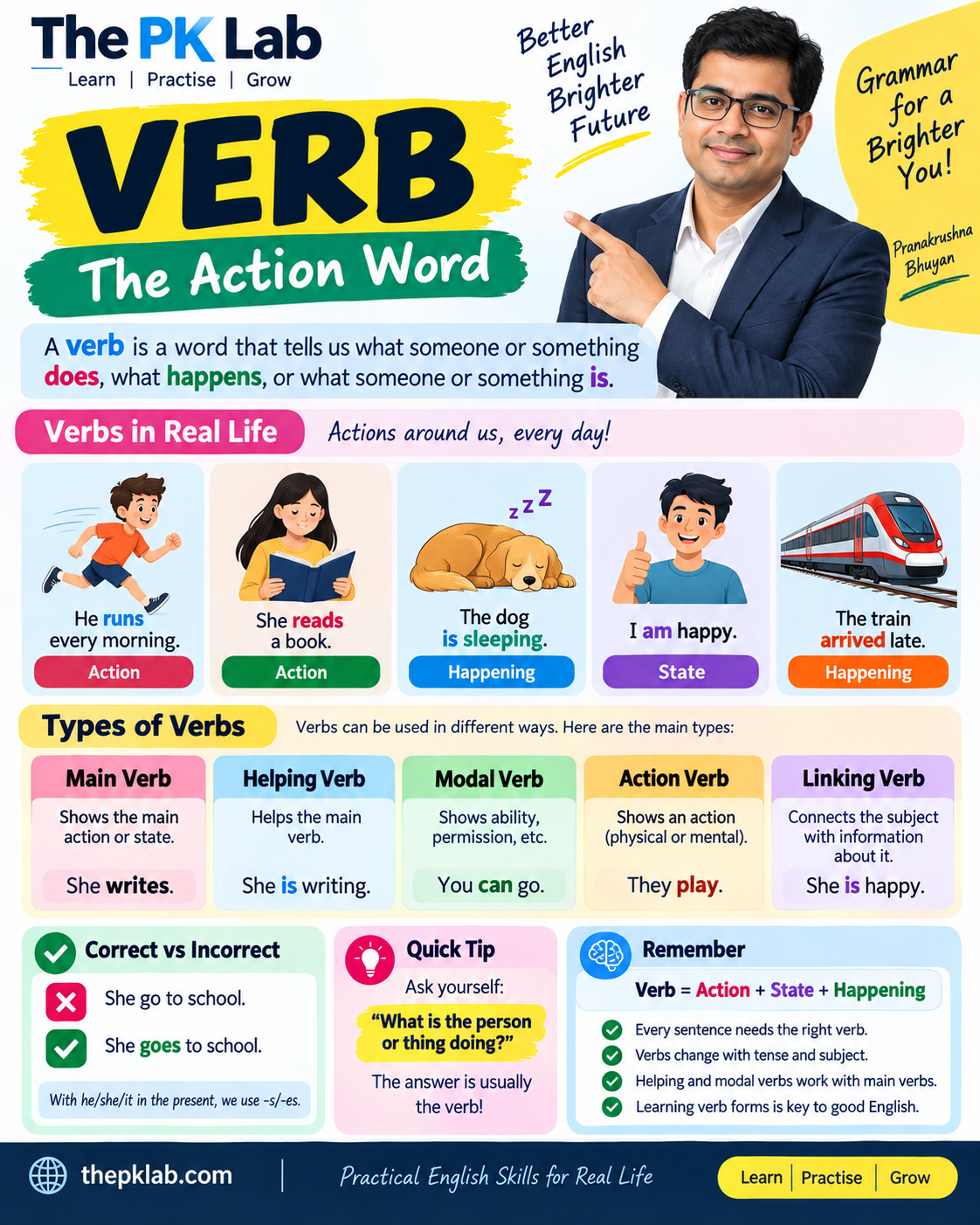
1. What is a Verb?
A verb is a word that tells us what someone or something does, what happens, or what someone or something is.
In simple words:
A verb is a word that shows an action, a state, or an occurrence.
Look at these examples:
- Rahul runs every morning.
- She cooks dinner.
- They play cricket.
- I am happy.
- The baby is sleeping.
- The train arrived late.
The bold words are verbs.
Easy way to identify a verb
Ask:
“What is the person or thing doing?”
Example:
Ravi reads a book.
What is Ravi doing? → reads
So, reads is the verb.
2. Why Do We Need Verbs?
A sentence usually needs a verb to tell us what is happening.
Compare:
❌ Rahul a teacher.
✅ Rahul is a teacher.
❌ She to college every day.
✅ She goes to college every day.
❌ They cricket.
✅ They play cricket.
Without the correct verb, a sentence may be incomplete or grammatically incorrect.
Remember:
A sentence without a proper verb is often like a vehicle without an engine—it cannot move.
3. Basic Types of Verbs
Verbs can be classified in different ways. For beginners, start with these important types:
| Type of Verb | What it does | Example |
|---|---|---|
| Main Verb | Shows the main action/state | She writes. |
| Helping Verb | Helps the main verb | She is writing. |
| Modal Verb | Shows ability, possibility, permission, obligation, etc. | You can go. |
| Action Verb | Shows an action | He runs. |
| Linking Verb | Connects the subject with information about it | She is happy. |
4. Main Verb
The main verb tells us the main action or state in a sentence.
Examples
- I work in an office.
- She teaches English.
- They play football.
- We live in Bhubaneswar.
- He knows the answer.
Here, work, teaches, play, live, and knows are main verbs.
5. Helping Verbs
Helping verbs support the main verb.
Common helping verbs include:
am, is, are, was, were, have, has, had, do, does, did
Examples
- I am learning English.
- She is cooking.
- They are playing cricket.
- He has completed his work.
- We were watching a movie.
For example:
She is reading.
- is → helping verb
- reading → main verb
Together, they form the verb phrase is reading.
6. Modal Verbs
Modal verbs are special helping verbs. They express ideas such as ability, possibility, permission, advice, necessity, or obligation.
Common modal verbs:
can, could, may, might, shall, should, will, would, must
Examples
- I can swim. → ability
- May I come in? → permission
- You should study regularly. → advice
- It might rain today. → possibility
- You must wear a helmet. → necessity
7. Action Verbs
An action verb shows an action.
The action can be physical or mental.
Physical actions
- run
- walk
- eat
- write
- speak
- jump
- open
- close
Example:
She opens the door.
Mental actions
- think
- know
- understand
- remember
- believe
- decide
Example:
I understand the question.
8. Linking Verbs
A linking verb does not show a physical action. It connects the subject to information that describes or identifies it.
Common linking verbs include:
am, is, are, was, were, seem, become, feel, look, appear
Examples
- She is happy.
- Rahul is a student.
- The food looks delicious.
- He became angry.
- I feel tired.
In:
She is happy.
is connects She with happy.
9. Transitive and Intransitive Verbs
This is an important concept for intermediate learners.
Transitive Verb
A transitive verb normally needs an object to complete its meaning.
She bought a phone.
Bought what? → a phone
So bought is transitive.
Other examples:
- He opened the door.
- I read a book.
- She made tea.
- They played cricket.
Intransitive Verb
An intransitive verb does not require a direct object.
- The baby cried.
- He slept.
- The birds flew.
- The children laughed.
You don’t need an object after these verbs.
10. Regular and Irregular Verbs
Verbs can also be divided according to how their past forms are made.
Regular Verbs
Usually form the past tense by adding -ed.
| Present | Past |
|---|---|
| work | worked |
| play | played |
| walk | walked |
| clean | cleaned |
| open | opened |
Irregular Verbs
Their past forms do not follow the regular -ed pattern.
| Present | Past | Past Participle |
|---|---|---|
| go | went | gone |
| eat | ate | eaten |
| see | saw | seen |
| write | wrote | written |
| take | took | taken |
These forms need to be learned through practice.
11. Finite and Non-Finite Verbs
This topic is useful for advanced learners.
Finite Verb
A finite verb changes according to tense or subject.
- I work here.
- She works here.
- They worked here.
Non-Finite Verb
A non-finite verb does not change according to the subject or tense.
Three important forms are:
- Infinitive: to learn
- Gerund: learning
- Participle: learned / learning
Examples:
- I want to learn English.
- Learning English takes practice.
- The broken chair needs repair.
12. Verb Forms
Many English verbs have five commonly taught forms.
Take the verb write:
| Form | Example |
|---|---|
| Base form | write |
| -s/-es form | writes |
| Past form | wrote |
| -ing form | writing |
| Past participle | written |
Another example:
| Base | -s/-es | Past | -ing | Past Participle |
|---|---|---|---|---|
| go | goes | went | going | gone |
| eat | eats | ate | eating | eaten |
| work | works | worked | working | worked |
| speak | speaks | spoke | speaking | spoken |
Understanding verb forms is essential for learning tenses.
13. Verb and Tense
The verb changes to show when an action happens.
Present
I work every day.
Past
I worked yesterday.
Future
I will work tomorrow.
Therefore, verbs are closely connected with tenses.
14. Verb in Everyday English
We use verbs constantly in daily conversations.
At Home
- Please open the door.
- I need some water.
- Mom is cooking.
- Please switch off the fan.
At College
- I attend my classes regularly.
- We have an exam tomorrow.
- She submitted her assignment.
- Please explain this topic.
At Work
- I have completed the report.
- Please check this document.
- We need to discuss this issue.
- I will send the email shortly.
In an Interview
- I have worked in this field for several years.
- I manage a team.
- I can handle multiple responsibilities.
- I would like to learn new skills.
15. Formal vs Natural Spoken English
Grammar is not only about writing. We use verbs constantly when speaking.
| More Formal | Natural Conversation |
|---|---|
| I do not know. | I don’t know. |
| I cannot attend. | I can’t attend. |
| She is not coming. | She isn’t coming. |
| We will not go. | We won’t go. |
Both forms can be grammatically correct.
In formal writing, the full forms may be preferred in some contexts. In everyday conversation, contractions such as don’t, can’t, isn’t, won’t are very common.
16. Correct vs Incorrect
Example 1
❌ She go to college every day.
✅ She goes to college every day.
Why?
With he/she/it in the simple present, the verb generally takes -s/-es.
Example 2
❌ I am go to school.
✅ I am going to school.
Why?
After am/is/are for the present continuous, we use the -ing form.
Example 3
❌ He did not went there.
✅ He did not go there.
Why?
After did/did not, use the base form of the verb.
Example 4
❌ She can sings well.
✅ She can sing well.
Why?
After a modal verb such as can, use the base form.
17. Common Mistakes Made by Indian English Learners
Mistake 1
❌ He don’t know.
✅ He doesn’t know.
Mistake 2
❌ I am having two brothers.
✅ I have two brothers.
Mistake 3
❌ I did not went there.
✅ I did not go there.
Mistake 4
❌ She can speaks English.
✅ She can speak English.
Mistake 5
❌ He is having a car.
✅ He has a car.
The important lesson is:
Do not translate sentences directly from your mother tongue into English. Learn the natural English sentence pattern.
18. Quick Memory Trick
Remember:
Verb = Action + State + Happening
Action
run, eat, write, speak
State
know, like, love, believe
Happening
happen, change, grow, become
And remember:
Every good English sentence needs the right verb in the right form.
19. Practice Exercise
A. Identify the verb
Find the verb in each sentence.
- Rahul plays cricket.
- She reads every day.
- They are watching television.
- I know the answer.
- The baby cried.
- We visited Cuttack.
- He can swim.
- She is happy.
B. Choose the correct verb
- She ___ to school every day.
a) go
b) goes - They ___ football yesterday.
a) play
b) played - He can ___ English.
a) speak
b) speaks - I ___ my work yesterday.
a) completed
b) complete - She is ___ a book.
a) read
b) reading
C. Correct the sentences
- He don’t like tea.
- She go to office every day.
- I did not went there.
- He can speaks English.
- They is playing cricket.
20. Answers
A. Identify the verb
- plays
- reads
- are watching
- know
- cried
- visited
- can swim
- is
B. Choose the correct answer
- goes
- played
- speak
- completed
- reading
C. Correct sentences
- He doesn’t like tea.
- She goes to the office every day.
- I did not go there.
- He can speak English.
- They are playing cricket.
21. Quick Revision
Remember these five points:
- A verb tells us about an action, state, or occurrence.
- Every sentence needs the appropriate verb structure.
- Verbs change according to tense and sometimes the subject.
- Helping and modal verbs work with main verbs.
- Learning verb forms is essential for speaking and writing accurate English.
One-line definition
A verb is a word that tells us what someone or something does, what happens, or what someone or something is.
22. FAQs
What is a verb in simple English?
A verb is a word that shows an action, state, or occurrence.
What is an example of a verb?
In “Ravi plays cricket,” the word plays is the verb.
How can I identify a verb?
Ask yourself: What is the subject doing, experiencing, or being?
Is “is” a verb?
Yes. Is is a form of the verb be and can function as a linking verb or helping verb depending on the sentence.
What are the main types of verbs?
Important categories include main verbs, helping verbs, modal verbs, action verbs, linking verbs, transitive verbs, intransitive verbs, regular verbs, irregular verbs, finite verbs, and non-finite verbs.
Why are verbs important for spoken English?
Because verbs tell listeners what is happening, what happened, what will happen, or what someone is/feels/knows. Correct verb forms make communication clear and natural.