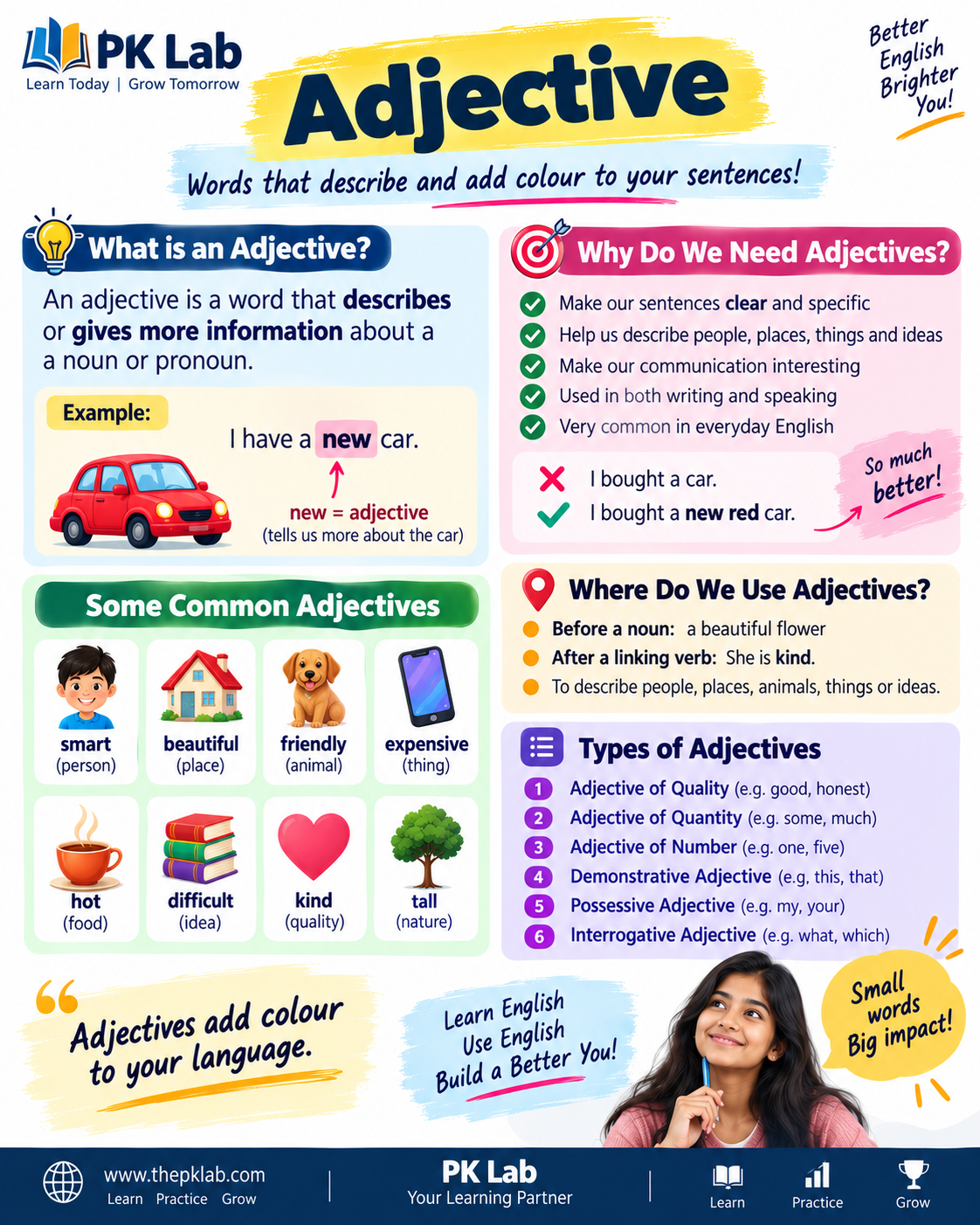
Adjective
Making English More Descriptive
An adjective is a word that gives us more information about a person, place, animal, thing, or idea.
In simple words:
An adjective tells us what someone or something is like, or gives us more information about it.
Compare:
- I have a car.
- I have a new car.
The word new tells us more about the car. Therefore, new is an adjective.
More examples:
| Noun | Adjective + Noun |
|---|---|
| girl | smart girl |
| house | beautiful house |
| phone | expensive phone |
| road | busy road |
| food | delicious food |
| student | hardworking student |
1. What Is an Adjective?
An adjective is a word that describes or gives more information about a noun or pronoun.
Easy Examples
- Rahul is a smart student.
- She has a beautiful dress.
- This is a big house.
- I bought a new phone.
- The tea is hot.
- Bhubaneswar is a clean city.
Here:
- smart → describes Rahul/student
- beautiful → describes dress
- big → describes house
- new → describes phone
- hot → describes tea
- clean → describes city
These describing words are adjectives.
2. Why Do We Need Adjectives?
Without adjectives, our sentences can sound plain and incomplete.
Imagine someone says:
“I bought a car.”
You know the person bought a car, but you don’t know much about it.
Now compare:
“I bought a new red car.”
Now you know more about the car.
Adjectives make our communication:
Clear → Specific → Interesting → Descriptive
Compare
Without adjective:
She lives in a house.
With adjectives:
She lives in a beautiful two-storey house.
The second sentence gives us much more information.
That’s why adjectives are important in both writing and speaking.
3. What Can an Adjective Describe?
Adjectives can give information about many things.
Person
He is a kind man.
Place
Odisha is a beautiful state.
Animal
The dog is friendly.
Thing
I bought a new laptop.
Idea or feeling
It was a difficult decision.
4. Types of Adjectives
There are several types of adjectives.
| Type | What it tells us | Examples |
|---|---|---|
| Adjective of Quality | What someone/something is like | good, beautiful, honest |
| Adjective of Quantity | How much | some, little, enough |
| Adjective of Number | How many / order | one, five, first |
| Demonstrative Adjective | Which one | this, that, these, those |
| Possessive Adjective | Whose | my, your, his, her |
| Interrogative Adjective | Used to ask about a noun | which, what, whose |
| Distributive Adjective | Refers to members individually | each, every, either, neither |
Let’s understand them simply.
5. Adjective of Quality
An adjective of quality tells us what a person or thing is like.
Examples:
- a good teacher
- a beautiful flower
- an honest person
- a large building
- a difficult question
- a comfortable chair
In sentences:
She is a kind person.
This is a difficult question.
He bought an expensive watch.
6. Adjective of Quantity
An adjective of quantity tells us how much of something there is.
Common examples:
some, much, little, enough, sufficient
Examples:
I have some money.
There is little water in the bottle.
We have enough food.
He doesn’t have much time.
Remember
Quantity = How much?
7. Adjective of Number
An adjective of number tells us how many people or things or in what order.
Examples:
I have three books.
There are twenty students in the class.
She stood first in the competition.
He bought two shirts.
Remember
Number = How many? / Which position?
8. Demonstrative Adjectives
Demonstrative adjectives point out which person or thing we are talking about.
The main words are:
this, that, these, those
Examples
This book is interesting.
That car is expensive.
These shoes are comfortable.
Those buildings are old.
Easy Rule
| Near | Far |
|---|---|
| This → singular | That → singular |
| These → plural | Those → plural |
9. Possessive Adjectives
Possessive adjectives tell us who something belongs to.
Common possessive adjectives:
my, your, his, her, its, our, their
Examples:
This is my phone.
Where is your bag?
That is his bike.
She is reading her book.
We completed our work.
They sold their house.
Easy Question
Ask:
Whose?
If the answer is my, your, his, her, our, their, you are probably dealing with a possessive adjective.
10. Interrogative Adjectives
Interrogative adjectives are used with nouns to ask questions.
The common ones are:
what, which, whose
Examples:
What subject do you like?
Which book do you want?
Whose bag is this?
Notice that these words are followed by nouns:
- what subject
- which book
- whose bag
11. Where Do We Use Adjectives?
Adjectives commonly appear before a noun.
Adjective + Noun
a beautiful flower
a smart student
an old building
a new laptop
This is one of the easiest patterns to remember:
Adjective + Noun
12. Adjectives After Linking Verbs
An adjective can also come after a linking verb and describe the subject.
Common linking verbs include:
is, am, are, was, were, seem, look, feel, become
Examples:
The food is delicious.
She is happy.
He looks tired.
I feel better.
The children are excited.
Here, the adjective does not directly come before a noun. It describes the subject.
13. Adjective vs Noun
Sometimes learners confuse adjectives with nouns.
Compare:
He is a teacher.
Teacher = noun
He is a good teacher.
Good = adjective
Teacher = noun
The adjective good describes the noun teacher.
14. Adjective vs Adverb
This is a very common area of confusion.
Adjective → describes a noun/pronoun
She is a careful driver.
Careful describes the driver.
Adverb → describes a verb
She drives carefully.
Carefully describes how she drives.
Compare:
| Adjective | Adverb |
|---|---|
| careful | carefully |
| quick | quickly |
| slow | slowly |
| beautiful | beautifully |
| easy | easily |
Easy memory trick:
Adjective → What is it/person like?
Adverb → How does an action happen?
15. Correct vs Incorrect
Example 1
❌ He is a student intelligent.
✅ He is an intelligent student.
Example 2
❌ She has a beauty dress.
✅ She has a beautiful dress.
Beauty = noun
Beautiful = adjective
Example 3
❌ He is a carefully driver.
✅ He is a careful driver.
A driver is described by an adjective.
Example 4
❌ She speaks beautiful.
✅ She speaks beautifully.
Here we describe the verb speaks, so we need an adverb.
16. Adjectives in Everyday English
You use adjectives every day without even realizing it.
At Home
Give me the blue shirt.
The tea is hot.
This room is clean.
At College
He is a brilliant student.
Today’s class was interesting.
This is a difficult subject.
At Work
We have an important meeting.
Please send the final report.
She gave a clear presentation.
Shopping
I want a black shirt.
This phone is expensive.
Do you have a larger size?
Travel
It is a beautiful place.
The road is crowded.
We stayed in a comfortable hotel.
17. Adjectives in Spoken English
In everyday conversation, adjectives help us express opinions, feelings, experiences, and descriptions.
Conversation
A: How was the movie?
B: It was amazing!
A: How was the food?
B: It was delicious, but a little spicy.
A: How is your new job?
B: It’s interesting and challenging.
These are natural examples of adjectives used in real conversation.
18. Common Mistakes
Mistake 1: Confusing adjective and adverb
❌ He runs quick.
✅ He runs quickly.
Mistake 2: Using a noun instead of an adjective
❌ She is a beauty girl.
✅ She is a beautiful girl.
Mistake 3: Incorrect adjective position
❌ I bought a car new.
✅ I bought a new car.
Mistake 4: Confusing “good” and “well”
❌ I am well student.
✅ I am a good student.
But:
I speak English well.
Good → adjective
Well → usually an adverb when describing how an action is performed.
19. Adjectives and Degrees of Comparison
Adjectives can also be used to compare people or things.
Positive
Rahul is tall.
Comparative
Rahul is taller than Amit.
Superlative
Rahul is the tallest student in the class.
Another example:
| Degree | Example |
|---|---|
| Positive | fast |
| Comparative | faster |
| Superlative | fastest |
We will study Degrees of Comparison separately in detail.
20. Quick Memory Trick
Remember:
Adjective = A word that adds information.
When you see a word describing a person, place, animal, thing, or idea, ask:
“What is it like?”
For example:
a beautiful flower
What is the flower like?
→ Beautiful
a large house
What is the house like?
→ Large
an honest person
What is the person like?
→ Honest
21. Practice Exercise
A. Identify the adjective
Find the adjective in each sentence.
- She is a smart girl.
- I bought a new phone.
- The food is delicious.
- He drives a red car.
- We live in a small house.
- The teacher asked a difficult question.
- They have three children.
- This is my book.
- Those are beautiful flowers.
- He is an honest person.
B. Choose the correct word
- She is a ______ girl.
a) beauty
b) beautiful - He is a ______ driver.
a) careful
b) carefully - I bought a ______ laptop.
a) new
b) newly - This is ______ bag.
a) my
b) me - ______ book do you want?
a) Which
b) Quickly
22. Answers
A
- smart
- new
- delicious
- red
- small
- difficult
- three
- my
- beautiful
- honest
B
- beautiful
- careful
- new
- my
- Which
23. Quick Revision
Let’s remember the most important points:
- Adjective gives more information about a noun or pronoun.
- It can describe quality, quantity, number, ownership, or identification.
- It commonly comes before a noun.
- It can also come after a linking verb.
- Adjectives make sentences clearer, more specific, and more interesting.
- Don’t confuse an adjective with an adverb.
The simplest formula:
Adjective + Noun
beautiful + place
smart + student
new + phone
difficult + question
24. FAQs
What is an adjective in simple words?
An adjective is a word that describes a noun or gives us more information about it.
What are examples of adjectives?
good, bad, beautiful, big, small, intelligent, honest, new, old, expensive, cheap are examples of adjectives.
Where does an adjective come in a sentence?
It often comes before a noun:
She has a beautiful dress.
It can also come after a linking verb:
The dress is beautiful.
Is “beautiful” an adjective?
Yes. Beautiful is an adjective because it describes a person, place, thing, or idea.
What is the difference between an adjective and an adverb?
An adjective usually describes a noun or pronoun.
He is a slow runner.
An adverb usually describes a verb, adjective, or another adverb.
He runs slowly.
Key Takeaway
Adjectives are the words that add colour and detail to our language.
Instead of saying:
“I saw a house.”
we can say:
“I saw a beautiful, large, white house.”
The noun tells us what it is.
The adjective tells us what it is like.
That’s why adjectives make our English clearer, richer, and more expressive.