ADVERB
Learn how to describe how, when, where, and how often an action happens.
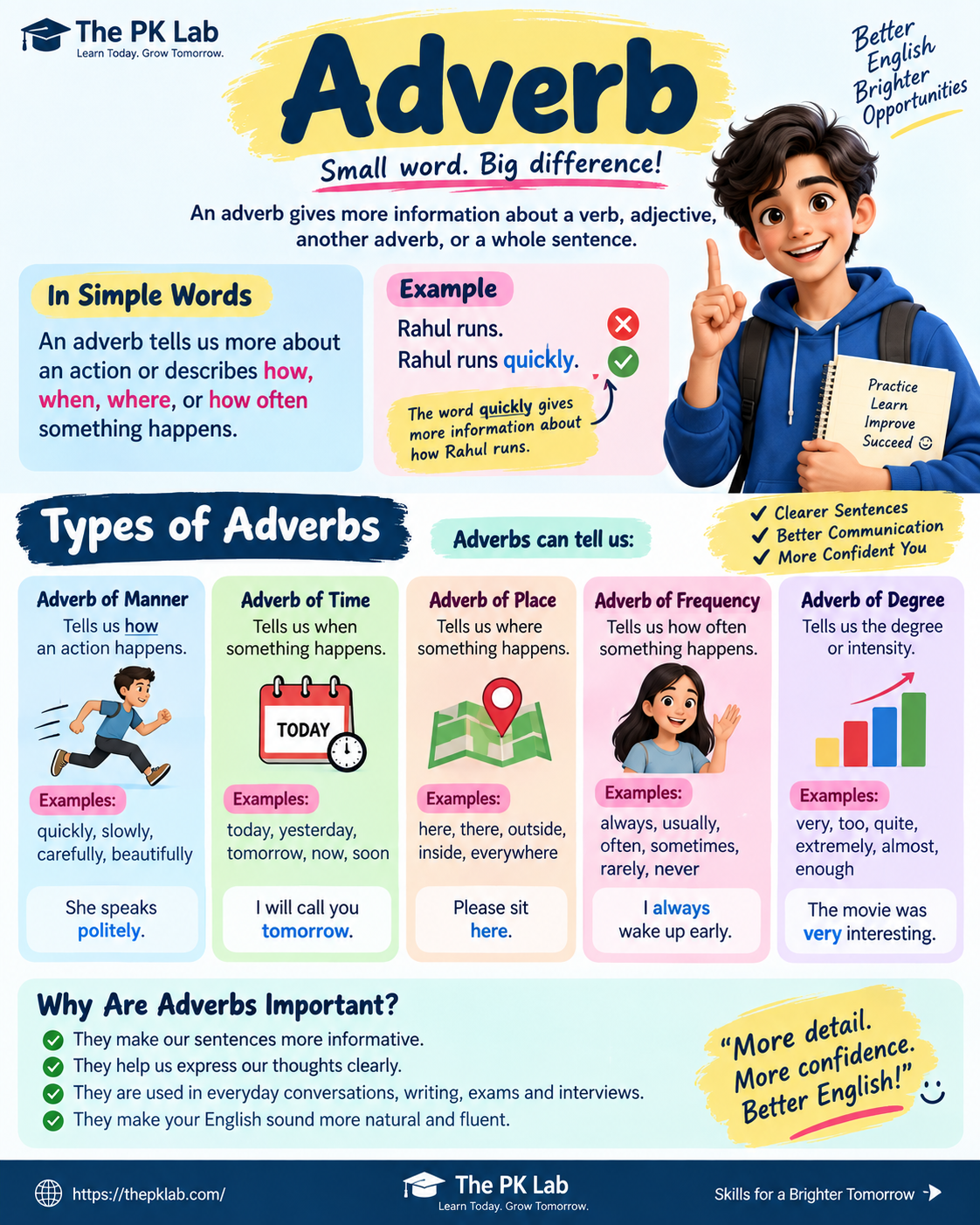
An adverb is a word that gives us more information about a verb, adjective, another adverb, or sometimes a whole sentence.
In simple words:
An adverb tells us more about an action or describes how, when, where, or how often something happens.
Look at the difference:
- Rahul runs.
- Rahul runs quickly.
The word quickly gives us more information about how Rahul runs. Therefore, quickly is an adverb.
1. What is an Adverb?
An adverb is a word that adds extra information to a sentence.
It can answer questions such as:
| Question | Example Adverb |
|---|---|
| How? | slowly, quickly, carefully |
| When? | today, yesterday, soon |
| Where? | here, there, outside |
| How often? | always, often, sometimes |
| To what degree? | very, extremely, quite |
Easy Examples
- She speaks slowly.
- He works carefully.
- We will meet tomorrow.
- Come here.
- I always drink tea in the morning.
- The movie was very interesting.
2. Why Do We Need Adverbs?
Imagine saying:
Ravi drives.
We know Ravi drives, but we don’t know much about his driving.
Now add an adverb:
Ravi drives carefully.
Now we understand how he drives.
Another example:
She arrived.
She arrived late.
The second sentence gives us more useful information.
Think of an adverb as a detail provider.
It makes a sentence more informative and expressive.
3. What Does an Adverb Describe?
Adverbs commonly modify:
A. A Verb
She sings beautifully.
Beautifully tells us how she sings.
B. An Adjective
The bag is very expensive.
Very describes the adjective expensive.
C. Another Adverb
He runs very quickly.
Very describes the adverb quickly.
D. A Whole Sentence
Fortunately, everyone reached home safely.
Fortunately expresses the speaker’s attitude toward the whole sentence.
4. Types of Adverbs
There are several common types of adverbs.
1. Adverb of Manner – How?
It tells us how an action happens.
Examples:
- slowly
- quickly
- carefully
- beautifully
- loudly
- quietly
- politely
Examples
She speaks politely.
The boy answered quickly.
Please drive carefully.
Real-life example
Teacher: “How did you complete the assignment?”
Student:
“I completed it carefully.”
5. Adverb of Time – When?
It tells us when something happens.
Examples:
- today
- yesterday
- tomorrow
- now
- soon
- later
- already
- recently
Examples
I will call you tomorrow.
She arrived yesterday.
We are leaving now.
He will come soon.
Real-life example
Friend: “When will you come to Bhubaneswar?”
You:
“I’ll come tomorrow.”
6. Adverb of Place – Where?
It tells us where something happens.
Examples:
- here
- there
- outside
- inside
- everywhere
- nearby
- upstairs
- downstairs
Examples
Please sit here.
The children are playing outside.
I looked everywhere.
Come inside.
7. Adverb of Frequency – How Often?
It tells us how often something happens.
Examples:
- always
- usually
- often
- sometimes
- rarely
- never
Examples
I always wake up early.
She usually comes by bus.
We often visit our grandparents.
He sometimes plays cricket.
I never smoke.
Frequency Scale
Always → Usually → Often → Sometimes → Rarely → Never
This is an easy way to remember the common adverbs of frequency.
8. Adverb of Degree – How Much?
It tells us the degree or intensity of something.
Examples:
- very
- too
- quite
- extremely
- almost
- enough
- completely
Examples
She is very happy.
The water is too hot.
He is extremely talented.
I am quite tired.
The work is almost finished.
9. Where Does an Adverb Go in a Sentence?
The position of an adverb depends on the type of adverb and what it modifies.
Adverb of Manner
Usually comes after the verb or object:
She speaks clearly.
He completed the work carefully.
Adverb of Time
Often comes at the beginning or end:
Today, I am busy.
I am busy today.
Adverb of Place
Usually comes after the verb or object:
Come here.
They live nearby.
Adverb of Frequency
Usually comes before the main verb:
I always study at night.
But with be, it usually comes after the verb:
She is always punctual.
10. How Are Many Adverbs Formed?
Many adverbs are formed by adding -ly to an adjective.
| Adjective | Adverb |
|---|---|
| quick | quickly |
| slow | slowly |
| careful | carefully |
| beautiful | beautifully |
| polite | politely |
| quiet | quietly |
Example
Adjective: She is a careful driver.
Adverb: She drives carefully.
But remember:
Not every adverb ends in -ly, and not every -ly word is an adverb.
Examples:
- fast
- hard
- late
- well
- often
- never
11. Adjective vs Adverb
This is one of the most important differences to understand.
Adjective → describes a noun or pronoun
He is a careful driver.
Careful describes the noun driver.
Adverb → describes a verb
He drives carefully.
Carefully describes the verb drives.
Remember:
Adjective → What kind?
Adverb → How? When? Where? How often? How much?
12. Correct vs Incorrect
❌ Incorrect:
He runs quick.
✅ Correct:
He runs quickly.
❌ Incorrect:
She speaks English fluent.
✅ Correct:
She speaks English fluently.
❌ Incorrect:
I am always late yesterday.
✅ Correct:
I was late yesterday.
The word yesterday refers to the past, so the verb should also be in the past tense.
13. Common Mistakes
Mistake 1: Using an adjective instead of an adverb
❌ He drives careful.
✅ He drives carefully.
Mistake 2: Thinking every adverb ends in -ly
❌ “Fast” cannot be an adverb.
✅ He runs fast.
Mistake 3: Confusing “good” and “well”
Good is normally an adjective.
Well is commonly used as an adverb.
❌ He sings good.
✅ He sings well.
But:
He is a good singer.
Mistake 4: Incorrect position of frequency adverbs
❌ I go always to college by bus.
✅ I always go to college by bus.
14. Adverbs in Spoken English
Adverbs are everywhere in everyday conversations.
At Home
Please speak slowly.
Come inside.
I’ll do it later.
At College
I usually reach college at 9 AM.
The teacher explained it clearly.
At Work
Please check the document carefully.
I’ll send the report tomorrow.
In an Interview
I always try to learn something new.
I completed the project successfully.
15. Quick Memory Trick
Remember the 5 Questions:
HOW?
quickly, slowly, carefully
WHEN?
today, yesterday, soon
WHERE?
here, there, outside
HOW OFTEN?
always, often, sometimes
HOW MUCH?
very, too, extremely
If a word gives extra information about an action or describes an adjective/adverb, it may be an adverb.
16. Practice Exercise
Identify the adverb in each sentence.
- Rahul runs quickly.
- She speaks politely.
- I will call you tomorrow.
- Please come here.
- He always helps me.
- The water is very cold.
- They are playing outside.
- She sings beautifully.
- I rarely eat fast food.
- He completed the work carefully.
Answers
- quickly
- politely
- tomorrow
- here
- always
- very
- outside
- beautifully
- rarely
- carefully
17. Quick Revision
| Type | Question | Examples |
|---|---|---|
| Manner | How? | slowly, carefully |
| Time | When? | today, soon |
| Place | Where? | here, outside |
| Frequency | How often? | always, often |
| Degree | How much? | very, extremely |
Remember:
An adverb adds detail.
Instead of:
He works.
We can say:
He works hard.
Instead of:
She arrived.
We can say:
She arrived late.
Instead of:
He speaks.
We can say:
He speaks politely.
Adverbs make our sentences more detailed, clear, and expressive.
Frequently Asked Questions
What is an adverb in simple English?
An adverb is a word that gives more information about an action or describes an adjective, another adverb, or sometimes a whole sentence.
What are the main types of adverbs?
The commonly taught types are manner, time, place, frequency, and degree.
Does every adverb end in -ly?
No. Words such as fast, hard, often, never, and well can also function as adverbs.
What is the difference between an adjective and an adverb?
An adjective generally describes a noun or pronoun, while an adverb commonly describes a verb, adjective, another adverb, or a whole sentence.
What is an easy way to identify an adverb?
Ask questions such as:
How? When? Where? How often? How much?
If the word answers one of these questions, it may be an adverb.