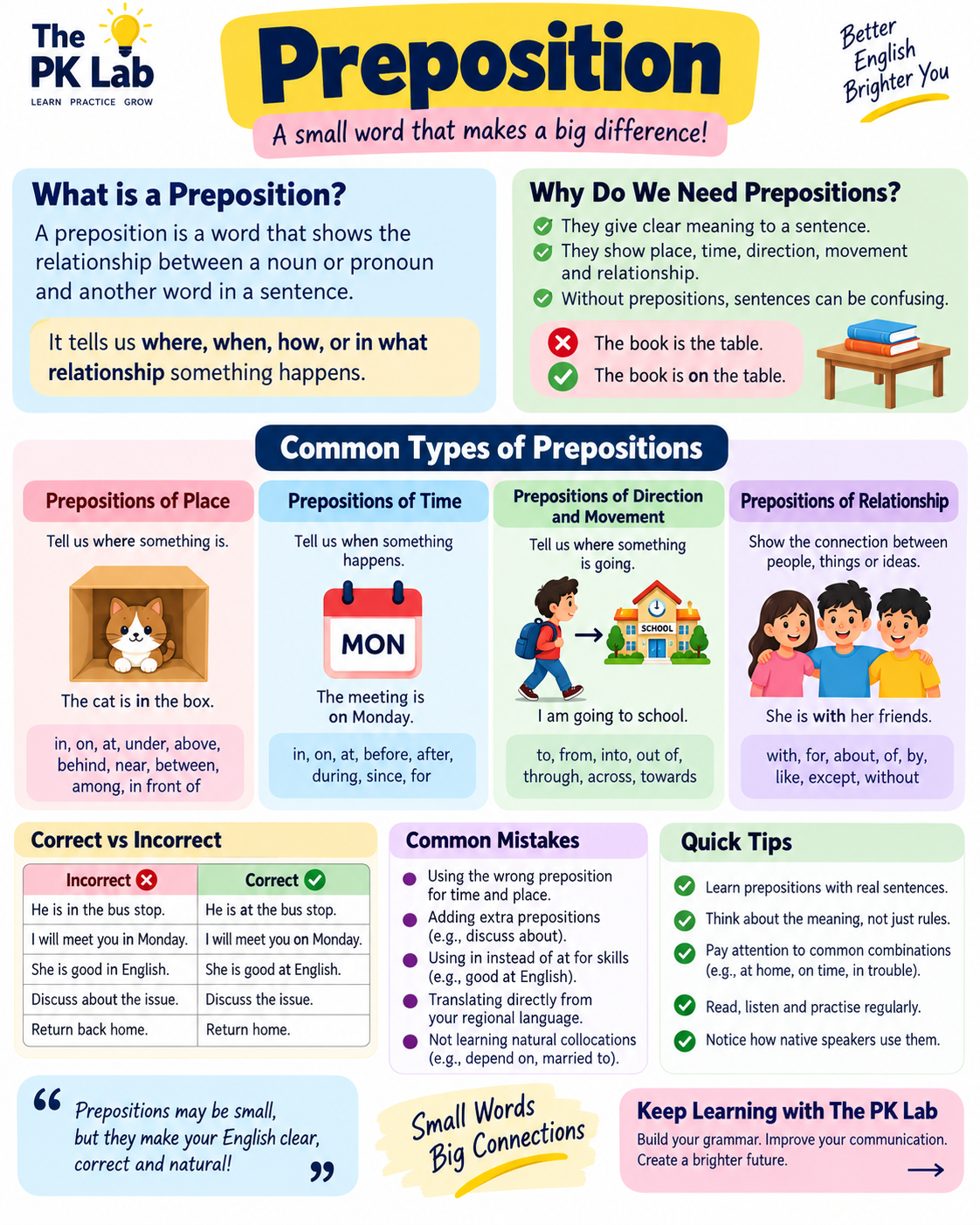
1. What is a Preposition?
A preposition is a word that shows the relationship between a noun/pronoun and another word in a sentence.
In simple words:
A preposition tells us where, when, how, or in what relationship something happens.
For example:
- The book is on the table.
- She is in the classroom.
- We will meet at 5 PM.
- He came from Delhi.
- I am going to college.
Words such as in, on, at, to, from, under, over, with, for, near, between are common prepositions.
2. Why Do We Need Prepositions?
Without prepositions, we often cannot clearly understand the relationship between things.
Compare:
The book is the table. ❌
We don’t know the relationship.
The book is on the table. ✅
Now we understand exactly where the book is.
Prepositions add important information about:
- Place – Where?
- Time – When?
- Direction – Where to?
- Movement – Where/how?
- Position – In what position?
- Relationship – With whom? For whom? From where?
3. Common Prepositions
| Preposition | Common Meaning | Example |
|---|---|---|
| in | inside / within | She is in the room. |
| on | touching a surface | The phone is on the table. |
| at | a specific point/place/time | Meet me at the gate. |
| under | below something | The bag is under the chair. |
| above | higher than | The fan is above my head. |
| over | higher than / across | The plane flew over the city. |
| below | lower than | The temperature is below 20°C. |
| between | in the middle of two | The shop is between the bank and the school. |
| among | surrounded by more than two | She was sitting among her friends. |
| near | close to | My house is near the school. |
| behind | at the back of | He is standing behind me. |
| in front of | before / ahead of | The car is in front of the house. |
| with | together / accompanied by | I went with my friend. |
| for | purpose / benefit | This gift is for you. |
| from | starting point / source | I am from Odisha. |
| to | direction | I am going to Bhubaneswar. |
| by | method / agent / deadline | I travelled by bus. |
| about | concerning | We talked about education. |
4. Prepositions of Place
Prepositions of place tell us where someone or something is.
IN
Use in when something is inside an enclosed space or area.
- The students are in the classroom.
- My mother is in the kitchen.
- There is water in the bottle.
- I live in Odisha.
ON
Use on when something is touching a surface.
- The book is on the table.
- The picture is on the wall.
- Your phone is on the bed.
AT
Use at for a particular point or location.
- I am at the bus stop.
- She is at the office.
- Meet me at the entrance.
Easy Memory Trick
IN = inside
ON = surface
AT = specific point
5. Prepositions of Time
Prepositions can also tell us when something happens.
The three most important ones are:
IN
Use in with:
- Months → in January
- Years → in 2026
- Seasons → in summer
- Parts of the day → in the morning
Examples:
I was born in 1990.
The course starts in July.
I usually study in the morning.
ON
Use on with:
- Days → on Monday
- Dates → on 14 September
- Specific days → on my birthday
Examples:
I will meet you on Monday.
The exam is on 20 September.
AT
Use at with:
- Exact time → at 9 PM
- Certain expressions → at night, at noon, at midnight
Examples:
The class starts at 9 PM.
I usually sleep at night.
Remember:
IN → longer period
ON → day/date
AT → exact time
6. Prepositions of Direction and Movement
These tell us where someone or something is moving.
TO
I am going to college.
She went to the market.
FROM
He came from Delhi.
This train comes from Cuttack.
INTO
Movement from outside to inside:
She walked into the room.
OUT OF
Movement from inside to outside:
He came out of the house.
THROUGH
Movement from one side to another through something:
We walked through the park.
ACROSS
Movement from one side to the other:
He walked across the road.
7. Prepositions of Position
UNDER vs BELOW
These two are often confused.
Under usually describes something directly beneath another thing.
The shoes are under the bed.
Below means at a lower level.
The temperature is below 20°C.
ABOVE vs OVER
Above generally means at a higher position.
The clock is above the door.
Over can mean directly higher than something, or covering/crossing it.
The plane flew over the building.
8. BETWEEN vs AMONG
BETWEEN
Usually used for two people or things.
The bank is between the school and the hospital.
AMONG
Used when someone or something is surrounded by several people or things.
He was sitting among his friends.
Easy trick:
BETWEEN → two or clearly separated items
AMONG → a group
9. Preposition + Noun/Pronoun
A preposition is normally followed by a noun or pronoun.
Examples:
- with me
- for you
- to him
- from her
- about them
Notice:
between you and me ✅
between you and I ❌
After the preposition between, we use the object pronouns me and you.
10. Correct vs Incorrect
| Incorrect ❌ | Correct ✅ |
|---|---|
| He is in the bus stop. | He is at the bus stop. |
| I will meet you in Monday. | I will meet you on Monday. |
| The class starts on 9 PM. | The class starts at 9 PM. |
| She is good in English. | She is good at English. |
| He is married with her. | He is married to her. |
| Discuss about the issue. | Discuss the issue. |
| Return back home. | Return home. |
| He entered into the room. | He entered the room. |
Important: Some preposition patterns depend on the verb or adjective. Learners should learn these as natural combinations rather than translating word-for-word from their first language.
11. Common Preposition Mistakes
Indian learners sometimes translate prepositions directly from their regional language. This can produce unnatural English.
❌ “I am going in the market.”
✅ “I am going to the market.”
❌ “He discussed about the problem.”
✅ “He discussed the problem.”
❌ “She is good in English.”
✅ “She is good at English.”
❌ “I reached at the station.”
✅ “I reached the station.”
But:
I arrived at the station. ✅
The verb matters.
12. Prepositions in Spoken English
Prepositions are everywhere in everyday conversation.
At Home
I am in the kitchen.
The keys are on the table.
My shoes are under the bed.
At College
I am in the classroom.
The teacher is at the board.
The students are sitting on their chairs.
At Work
I have a meeting at 10 AM.
Please send the report by Monday.
I am working on a new project.
While Travelling
I am going to Delhi.
I came from Bhubaneswar.
We travelled by train.
13. A Simple Way to Understand Prepositions
Think of a preposition as a relationship word.
For example:
The phone is ON the table.
The word ON tells us the relationship between:
Phone ↔ Table
Similarly:
I am AT the office.
I ↔ Office
And:
I am going TO college.
I ↔ College
So, whenever you see a preposition, ask:
“What relationship is this word showing?”
14. Quick Memory Chart
PLACE
IN → inside
ON → surface
AT → specific point
UNDER → lower/directly beneath
ABOVE → higher
BEHIND → back
BETWEEN → two/separated items
AMONG → group
TIME
IN → month/year/long period
ON → day/date
AT → exact time
MOVEMENT
TO → destination
FROM → starting point
INTO → movement inside
OUT OF → movement outside
THROUGH → from one side to another inside something
ACROSS → from one side to another
15. Practice Exercise
Choose the correct preposition.
- The book is ___ the table.
a) in
b) on
c) at - I will meet you ___ 7 PM.
a) in
b) on
c) at - She was born ___ 2005.
a) in
b) on
c) at - We are going ___ school.
a) from
b) to
c) at - The shoes are ___ the bed.
a) under
b) on
c) at - He came ___ Odisha.
a) to
b) from
c) on - The exam is ___ Monday.
a) at
b) in
c) on - She is good ___ English.
a) at
b) in
c) on - The bank is ___ the school and the hospital.
a) among
b) between
c) in - I travelled ___ train.
a) by
b) on
c) at
Answers
1. b | 2. c | 3. a | 4. b | 5. a | 6. b | 7. c | 8. a | 9. b | 10. a
16. FAQs
What is a preposition?
A preposition is a word that shows the relationship between a noun/pronoun and another part of a sentence.
What are the most common prepositions?
Some common prepositions are in, on, at, to, from, for, with, by, under, above, between, among, near, behind, through, across.
What is the difference between “in”, “on”, and “at”?
In is commonly used for an enclosed place or longer period, on for surfaces and days/dates, and at for specific points and exact times.
Can one preposition have different meanings?
Yes. The meaning depends on the context.
The book is on the table.
We are on the bus.
The meeting is on Monday.