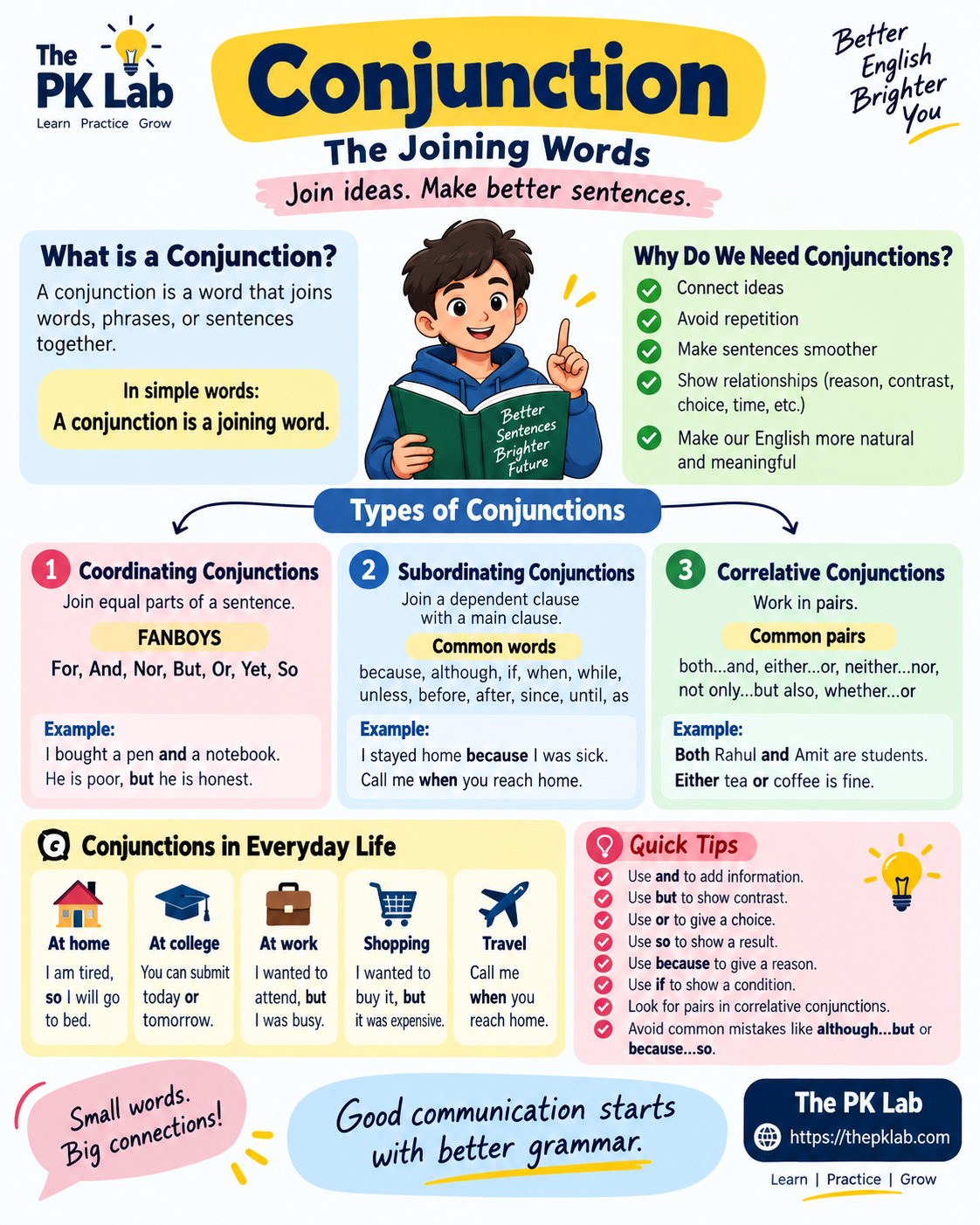
1. What is a Conjunction?
A conjunction is a word that joins words, phrases, or sentences together.
In simple words:
A conjunction is a joining word.
Examples
- Riya and Priya are friends.
- I wanted to go, but it was raining.
- Hurry up, or you will miss the bus.
- I stayed home because I was sick.
Here, and, but, or, because are conjunctions.
2. Why Do We Need Conjunctions?
Without conjunctions, our English can sound repetitive and disconnected.
Without a conjunction:
I went to the market. I bought vegetables. I came home.
With conjunctions:
I went to the market, bought vegetables, and came home.
Conjunctions help us:
- connect ideas
- avoid unnecessary repetition
- make sentences smoother
- show relationships between ideas
- express contrast, choice, reason, condition, time, etc.
Think of conjunctions as bridges between ideas.
3. What Can a Conjunction Join?
A conjunction can join:
A. Words
Tea and coffee
Ram or Shyam
B. Phrases
in the morning and in the evening
C. Sentences / Clauses
I called him, but he did not answer.
4. Main Types of Conjunctions
There are three major types:
| Type | Purpose | Examples |
|---|---|---|
| Coordinating Conjunctions | Join equal elements | and, but, or, so, yet |
| Subordinating Conjunctions | Join a dependent clause to a main clause | because, although, if, when, while |
| Correlative Conjunctions | Work in pairs | either…or, neither…nor, both…and |
Let’s understand each one.
5. Coordinating Conjunctions
Coordinating conjunctions join equal or similar parts of a sentence.
A useful memory trick is:
FANBOYS
F – For
A – And
N – Nor
B – But
O – Or
Y – Yet
S – So
Examples
And — addition
I bought a pen and a notebook.
But — contrast
He is poor, but he is honest.
Or — choice
Would you like tea or coffee?
So — result
It was raining, so we stayed home.
Yet — contrast
She is young, yet she is very responsible.
6. Subordinating Conjunctions
These conjunctions connect a dependent clause to a main clause.
They can show:
- reason
- time
- condition
- contrast
- purpose
- result
Common subordinating conjunctions
because, although, if, unless, when, while, before, after, since, until, as, though
Examples
Reason
I stayed home because I was sick.
Condition
If you work hard, you will succeed.
Time
Call me when you reach home.
Contrast
Although he was tired, he continued working.
Condition
You cannot enter unless you have an ID card.
7. Correlative Conjunctions
Correlative conjunctions work in pairs.
| Pair | Example |
|---|---|
| both…and | Both Rahul and Amit are students. |
| either…or | You can choose either tea or coffee. |
| neither…nor | Neither Ravi nor Suman was present. |
| not only…but also | She is not only intelligent but also hardworking. |
| whether…or | I don’t know whether he will come or not. |
Easy Tip
When you see one part of the pair, look for its partner.
either → or
neither → nor
both → and
not only → but also
8. Conjunctions in Everyday English
Conjunctions are everywhere in daily conversations.
At home
I am tired, so I will go to bed.
At college
You can submit the assignment today or tomorrow.
At work
I wanted to attend the meeting, but I was busy.
While travelling
Call me when you reach Bhubaneswar.
Shopping
I wanted to buy the shirt, but it was too expensive.
With friends
Let’s go out if the weather is good.
9. Correct vs Incorrect
Example 1
❌ I was tired but I went to sleep.
✅ I was tired, so I went to sleep.
Why?
“Being tired” is the reason/result relationship here. So is appropriate.
Example 2
❌ Although he was poor, but he was honest.
✅ Although he was poor, he was honest.
Why?
Do not normally use although and but together for the same contrast.
Example 3
❌ Either Rahul and Amit will come.
✅ Either Rahul or Amit will come.
Why?
The standard pair is either…or.
Example 4
❌ Neither Riya or Priya came.
✅ Neither Riya nor Priya came.
Why?
The standard pair is neither…nor.
10. Common Mistakes
Mistake 1: Using “and” everywhere
❌ I went to the market and it was raining and I came back and I called my friend.
This can sound repetitive.
Better:
I went to the market, but it was raining, so I came back and called my friend.
Mistake 2: “Although…but”
❌ Although he was tired, but he continued working.
✅ Although he was tired, he continued working.
OR
✅ He was tired, but he continued working.
Mistake 3: “Because…so”
❌ Because I was sick, so I stayed home.
✅ Because I was sick, I stayed home.
OR
✅ I was sick, so I stayed home.
11. Spoken English: Formal vs Natural
Conjunctions are also important in natural conversation.
More formal
I wanted to attend the meeting; however, I was unable to do so because I was travelling.
Natural conversation
I wanted to attend the meeting, but I was travelling, so I couldn’t.
For everyday spoken English, simple conjunctions such as and, but, so, because, or, if, when are extremely useful.
12. Quick Memory Trick
Think of conjunctions as bridges.
🌉 Idea 1 → CONJUNCTION → Idea 2
For example:
I was hungry so I ate.
hungry → so → ate
The conjunction tells us how the two ideas are connected.
Remember:
AND → adds
BUT → contrasts
OR → gives a choice
SO → shows a result
BECAUSE → gives a reason
IF → gives a condition
WHEN → shows time
ALTHOUGH → shows contrast
13. Practice Exercise
Fill in the blanks with the correct conjunction.
- Riya ___ Priya are sisters.
- I wanted to go, ___ it was raining.
- Hurry up, ___ you will miss the bus.
- I stayed home ___ I was sick.
- ___ you work hard, you will succeed.
- Call me ___ you reach home.
- You can have tea ___ coffee.
- He is poor, ___ he is honest.
- ___ Rahul nor Amit attended the meeting.
- She is not only intelligent ___ also hardworking.
Answers
- and
- but
- or
- because
- If
- when
- or
- but
- Neither
- but
14. Quick Revision
Conjunction = Joining Word
Three main types:
1. Coordinating
and, but, or, so, yet, for, nor
2. Subordinating
because, although, if, when, while, unless, before, after
3. Correlative
both…and, either…or, neither…nor, not only…but also
Remember:
AND adds.
BUT contrasts.
OR gives a choice.
SO shows a result.
BECAUSE gives a reason.
IF gives a condition.
15. Key Takeaways
- A conjunction connects words, phrases, or clauses.
- Conjunctions make English smoother and more meaningful.
- FANBOYS helps remember coordinating conjunctions.
- Subordinating conjunctions explain relationships such as reason, time, condition, and contrast.
- Correlative conjunctions work in pairs.
- Avoid common combinations such as although…but and because…so.
- Good use of conjunctions makes both spoken and written English more natural.
FAQs
What is a conjunction in simple words?
A conjunction is a joining word that connects words, phrases, or sentences.
What are the most common conjunctions?
Some common conjunctions are and, but, or, so, because, if, when, although, and while.
What is the easiest way to remember conjunctions?
Remember their purpose:
and = addition
but = contrast
or = choice
so = result
because = reason
What are FANBOYS?
FANBOYS is a memory aid for the seven coordinating conjunctions:
For, And, Nor, But, Or, Yet, So.
Can conjunctions be used in spoken English?
Absolutely. Words such as and, but, so, because, if, and when are among the most useful connecting words in everyday conversations.