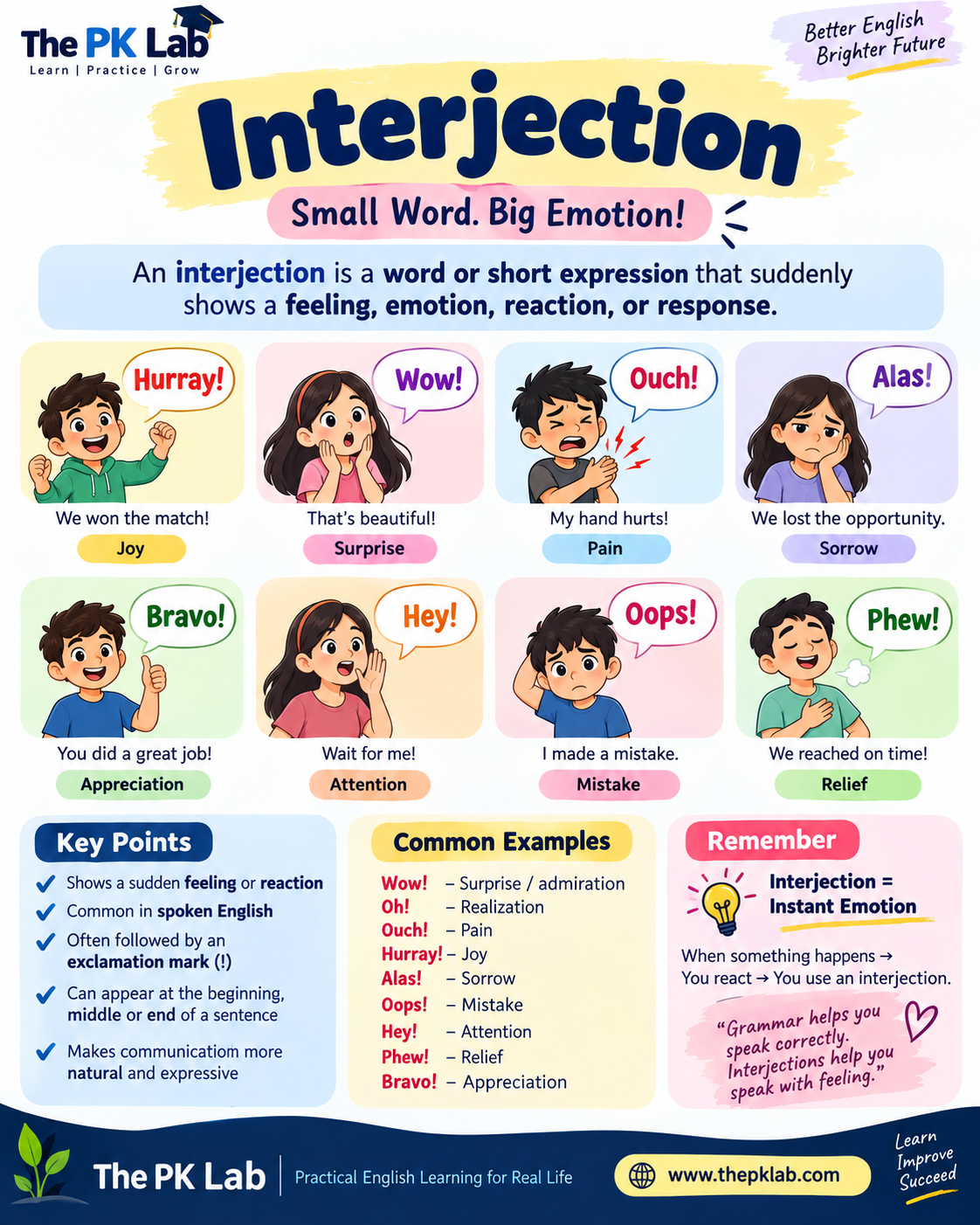
1. What is an Interjection?
Simple Definition
An interjection is a word or short expression that suddenly shows a feeling, emotion, reaction, or response.
In simple words:
An interjection is a word we use to express what we feel or react to something.
Examples
| Interjection | Feeling / Reaction |
|---|---|
| Wow! | Surprise / admiration |
| Oh! | Surprise / realization |
| Ouch! | Pain |
| Hurray! | Joy |
| Alas! | Sorrow |
| Oops! | Small mistake |
| Hey! | Attention |
| Ah! | Relief / realization |
| Hmm! | Thinking / doubt |
| Bravo! | Appreciation |
Example
Wow! Your presentation was excellent.
Here, Wow! shows the speaker’s feeling of admiration.
2. Why Do We Need Interjections?
Imagine someone gives you a wonderful gift.
You could say:
“I am very surprised and happy to receive this gift.”
But in everyday conversation, you might simply say:
“Wow! Thank you!”
That is the power of an interjection.
Interjections make communication:
- More natural
- More expressive
- More emotional
- More conversational
- More interesting
They help us express feelings quickly and naturally.
3. Basic Rule
An interjection usually expresses an immediate:
- Emotion
- Feeling
- Reaction
- Surprise
- Pain
- Joy
- Anger
- Appreciation
- Attention
Interjections are often followed by an exclamation mark (!) when the emotion is strong.
Examples
Wow! That’s amazing!
Ouch! My hand hurts!
Hurray! We won!
Oops! I dropped the glass.
However, not every interjection must use an exclamation mark. In more neutral writing, punctuation depends on the context.
4. Where Does an Interjection Come in a Sentence?
An interjection can appear at the:
Beginning
Wow! You look great.
Middle
This is, oh, much better than I expected.
End
You completed the project on time, bravo!
For beginners, the most common position is at the beginning of a sentence.
5. Common Types of Interjections
Interjections can express different feelings and reactions.
A. Interjections of Joy
These express happiness or excitement.
Examples:
- Hurray!
- Yay!
- Wow!
Sentences:
Hurray! We won the football match.
Yay! Tomorrow is a holiday.
B. Interjections of Surprise
These express sudden surprise or realization.
Examples:
- Oh!
- Wow!
- What!
- Ah!
Sentences:
Oh! You are here already.
Wow! This place is beautiful.
C. Interjections of Pain
These express physical pain.
Examples:
- Ouch!
- Ow!
Sentences:
Ouch! I hurt my finger.
Ow! That was painful.
D. Interjections of Sorrow
These express sadness or grief.
Example:
- Alas!
Sentence:
Alas! We lost the opportunity.
Note: “Alas!” is grammatically correct but sounds quite formal or old-fashioned in everyday spoken English. In normal conversation, people usually say things like “Oh no!” or “That’s so sad.”
E. Interjections of Appreciation or Praise
These express admiration or approval.
Examples:
- Bravo!
- Wow!
- Excellent!
Sentences:
Bravo! You performed very well.
Wow! That’s an excellent presentation.
F. Interjections Used to Get Attention
These are used to attract someone’s attention.
Examples:
- Hey!
- Hello!
- Excuse me!
Sentences:
Hey! Wait for me.
Excuse me! Could you help me?
Important
“Hey!” can sound friendly or rude depending on tone and context. In formal situations, “Excuse me” is usually more appropriate.
G. Interjections for Mistakes
These express a small mistake or accident.
Example:
- Oops!
Sentence:
Oops! I sent the message to the wrong person.
H. Interjections of Relief
These express relief after worry, difficulty, or danger.
Examples:
- Phew!
- Ah!
Sentences:
Phew! We reached the station on time.
Ah! That’s a relief.
6. Interjections in Real Life
Interjections are extremely common in everyday English.
At Home
Oops! I broke the cup.
Oh! I forgot to switch off the fan.
At School
Wow! Your project looks great.
Hurray! We have no class today.
At College
Oh! I didn’t know about the event.
Great! Let’s join the workshop.
At Work
Excellent! You completed the report.
Oops! I attached the wrong file.
While Shopping
Wow! This shirt looks nice.
Oh! That’s more expensive than I expected.
While Travelling
Wow! What a beautiful view!
Phew! We finally reached the destination.
7. Interjections in Spoken English
Interjections are especially common in spoken English because conversations involve immediate reactions.
Example Conversation
A: I got the job!
B: Wow! Congratulations!
A: Thank you!
Here, Wow! shows excitement and surprise.
Another Conversation
A: I forgot my wallet.
B: Oh no! What will you do?
A: I’ll call my brother.
Oh no! is a very common natural expression of concern or disappointment.
8. Formal vs Informal Usage
Not all interjections are equally suitable in every situation.
| Informal / Casual | More Neutral / Formal |
|---|---|
| Wow! | That’s impressive. |
| Oops! | I’m sorry. I made a mistake. |
| Hey! | Excuse me. |
| Yay! | That’s wonderful. |
| Oh no! | Unfortunately, that happened. |
Remember
Interjections are excellent for conversation, but professional writing often uses complete sentences instead.
For example:
Casual:
Wow! You did an amazing job!
Professional:
You did an excellent job on the project.
9. Correct vs Incorrect
Example 1
❌ Wow the view is beautiful.
✅ Wow! The view is beautiful.
The exclamation mark clearly separates the emotional reaction.
Example 2
❌ Ouch I hurt my hand.
✅ Ouch! I hurt my hand.
Example 3
❌ Oops I sent the wrong email.
✅ Oops! I sent the wrong email.
Example 4
❌ Hurray I passed the exam!
✅ Hurray! I passed the exam!
10. Common Mistakes
Mistake 1: Thinking every emotional word is an interjection
Not every word related to emotion is automatically an interjection.
For example:
Wow! That’s amazing.
“Wow” is functioning as an interjection.
But:
She felt happy.
“Happy” is an adjective, not an interjection.
Mistake 2: Using interjections everywhere
Interjections are useful, but too many can make writing sound unnatural.
❌ Wow! Oh! Hey! Great! Amazing! I completed the report.
Better:
✅ Great! I completed the report.
Use interjections when they add a genuine reaction.
Mistake 3: Using informal interjections in formal situations
Instead of:
❌ Hey! Send me the report.
Use:
✅ Excuse me. Could you please send me the report?
Mistake 4: Forgetting punctuation
❌ Oops I made a mistake.
✅ Oops! I made a mistake.
11. Quick Memory Trick
Remember:
Interjection = Instant Emotion
When something happens and you immediately react:
Wow! → Surprise / admiration
Ouch! → Pain
Hurray! → Joy
Oops! → Mistake
Oh! → Surprise / realization
Phew! → Relief
Hey! → Attention
Think:
Something happens → You react → Interjection
12. Practice Exercise
A. Choose the correct interjection
Choose from:
Wow! | Ouch! | Hurray! | Oops! | Phew! | Oh!
- ______ I forgot my keys at home.
- ______ That looks beautiful!
- ______ I hurt my foot.
- ______ We won the competition!
- ______ I sent the message to the wrong person.
- ______ We finally completed the difficult task.
B. Identify the Interjection
Find the interjection in each sentence.
- Wow! Your drawing is beautiful.
- Oops! I dropped my phone.
- Hurray! We passed the examination.
- Ouch! That hurts.
- Oh! I understand now.
C. Fill in the Blank
- ______! I have finally finished my work.
- ______! This is an amazing view.
- ______! I accidentally deleted the file.
- ______! My finger hurts.
- ______! We arrived safely.
D. Make Your Own Sentences
Create one sentence using each:
- Wow!
- Ouch!
- Oops!
- Hurray!
- Phew!
13. Answers
Exercise A
- Oh!
- Wow!
- Ouch!
- Hurray!
- Oops!
- Phew!
Exercise B
- Wow!
- Oops!
- Hurray!
- Ouch!
- Oh!
Exercise C
Possible answers:
- Hurray!
- Wow!
- Oops!
- Ouch!
- Phew!
Other answers may be possible depending on the context.
14. Quick Revision
Let’s remember the key points:
- An interjection expresses a sudden feeling, emotion, or reaction.
- It is common in spoken and informal English.
- It can express joy, surprise, pain, sorrow, appreciation, attention, relief, or other reactions.
- Interjections are often followed by an exclamation mark (!) when the emotion is strong.
- They can appear at the beginning, middle, or end of a sentence.
- Use them naturally—don’t overuse them.
- Choose expressions appropriate to the situation.
The easiest formula:
Event → Feeling → Reaction → Interjection
You win a competition → Happiness → “Hurray!”
You hurt your finger → Pain → “Ouch!”
You make a small mistake → Embarrassment → “Oops!”
You see something amazing → Surprise → “Wow!”
15. Key Takeaways
Interjections make English expressive.
Grammar helps us construct sentences, while interjections help us show how we feel about what we are saying.
Instead of only saying:
“This is beautiful.”
You can naturally say:
“Wow! This is beautiful.”
The word “Wow!” immediately communicates your reaction.
16. Frequently Asked Questions
What is an interjection in simple words?
An interjection is a word or short expression used to show a sudden feeling, emotion, or reaction.
Is “Wow!” an interjection?
Yes. “Wow!” is commonly used as an interjection to express surprise or admiration.
Is an interjection always followed by “!”?
No. An exclamation mark is common when the emotion is strong, but punctuation depends on the context and style of writing.
Can an interjection be used in spoken English?
Yes. Interjections are very common in everyday conversations.
Is “Oops!” an interjection?
Yes. “Oops!” commonly expresses a reaction to a small mistake or accident.
Are interjections important for spoken English?
Yes. They help conversations sound more natural and expressive.