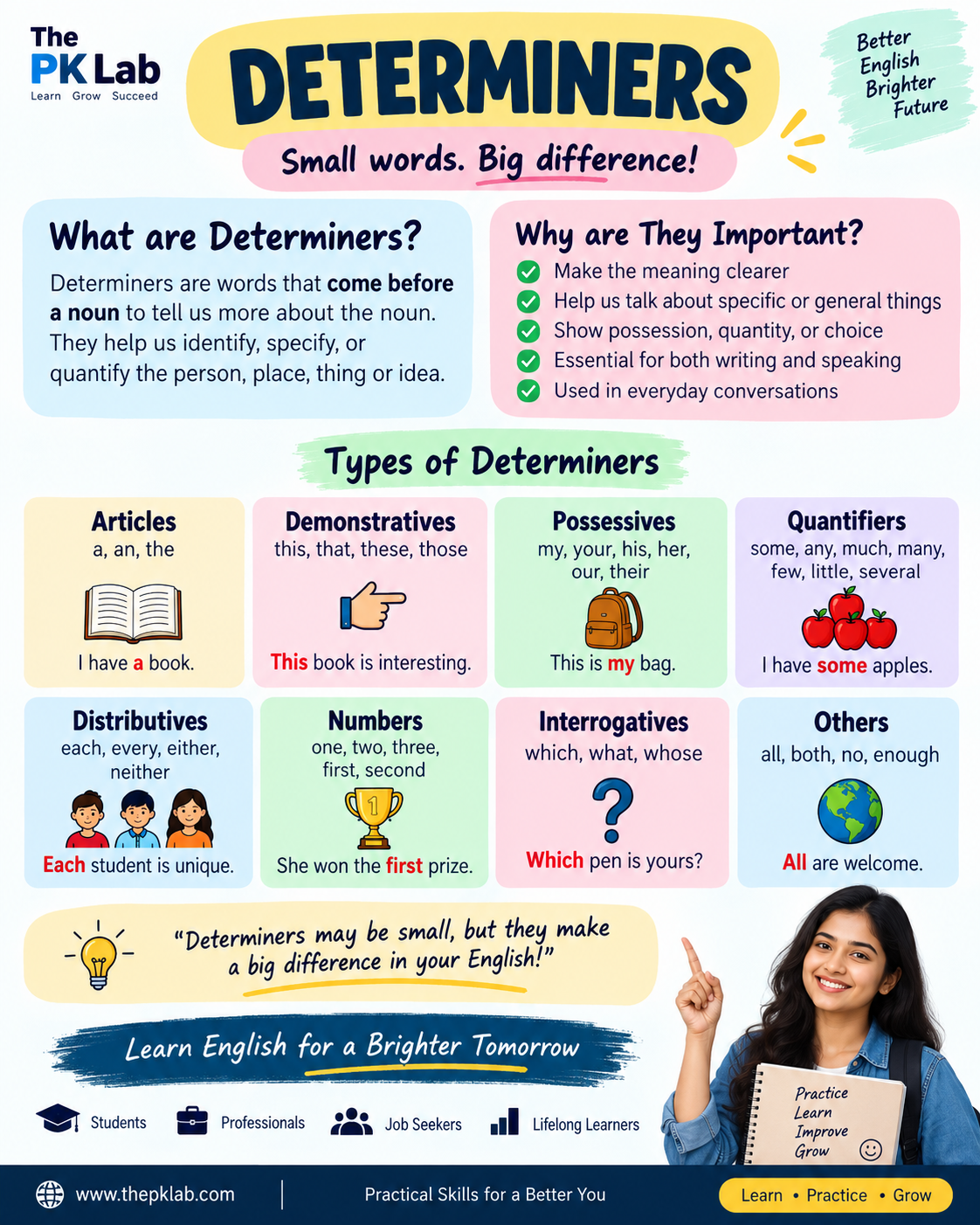
1. What is a Determiner?
A determiner is a word that comes before a noun to tell us more about that noun.
It can tell us:
- which person or thing
- whose person or thing
- how many people or things
- how much of something
- whether we are talking about something specific or general
Simple Examples
- a book
- the book
- my book
- this book
- two books
- some books
- each student
Here, a, the, my, this, two, some, each are determiners.
Easy way to remember:
Determiners help us identify or limit a noun.
2. Why Do We Need Determiners?
Compare these sentences:
❌ Give me book.
✅ Give me a book.
❌ Student is waiting outside.
✅ The student is waiting outside.
The word before the noun makes the meaning clearer.
For example:
I bought a phone.
The phone is expensive.
In the first sentence, we introduce a phone.
In the second sentence, we are talking about the specific phone we already mentioned.
3. Basic Structure
The most common structure is:
Determiner + Noun
| Determiner | Noun | Example |
|---|---|---|
| a | book | a book |
| the | car | the car |
| my | bag | my bag |
| this | pen | this pen |
| some | water | some water |
| many | students | many students |
A determiner normally comes before the noun.
4. Main Types of Determiners
There are several important types of determiners.
| Type | Examples |
|---|---|
| Articles | a, an, the |
| Demonstratives | this, that, these, those |
| Possessives | my, your, his, her, its, our, their |
| Quantifiers | some, any, much, many, few, little, several |
| Distributives | each, every, either, neither |
| Numbers | one, two, three, first, second |
| Interrogatives | which, what, whose |
| Other determiners | all, both, enough, no |
Let’s understand them one by one.
5. Articles as Determiners
The three articles are:
a, an, the
A
Use a before a singular countable noun beginning with a consonant sound.
- a book
- a teacher
- a university
- a car
a university — because university begins with the sound /y/.
An
Use an before a singular countable noun beginning with a vowel sound.
- an apple
- an umbrella
- an engineer
- an hour
an hour — because the h is silent, so the word begins with a vowel sound.
The
Use the when we are talking about a specific or already-known noun.
- The book on the table is mine.
- Please close the door.
- I saw a dog. The dog was very friendly.
Related topic: Articles in English Grammar
6. Demonstrative Determiners
Demonstratives tell us which person or thing we mean.
This
One person/thing near us.
This book is interesting.
That
One person/thing farther away.
That building is our college.
These
More than one person/thing near us.
These books are mine.
Those
More than one person/thing farther away.
Those students are waiting outside.
Quick Table
| Near | Far |
|---|---|
| This — singular | That — singular |
| These — plural | Those — plural |
7. Possessive Determiners
Possessive determiners tell us who owns or is connected with something.
| Person | Determiner | Example |
|---|---|---|
| I | my | my book |
| You | your | your phone |
| He | his | his car |
| She | her | her bag |
| It | its | its tail |
| We | our | our college |
| They | their | their house |
Examples
- This is my pen.
- Where is your phone?
- Her brother is a doctor.
- Our teacher is very helpful.
- Their house is near the market.
Important
❌ This is my.
✅ This is mine.
My is a determiner and normally comes before a noun.
Mine is a possessive pronoun and can stand alone.
8. Quantifiers
Quantifiers tell us how much or how many.
Common quantifiers include:
some, any, much, many, few, a few, little, a little, several, enough, all, both, plenty of
Examples
- many students
- much water
- some money
- a few friends
- a little time
- several books
Many vs Much
Many → countable plural nouns
many students
many books
many cars
Much → uncountable nouns
much water
much money
much time
❌ much students
✅ many students
❌ many water
✅ much water
9. Few, A Few, Little and A Little
These four expressions are especially important.
Few
Means almost none.
Few students attended the meeting.
A few
Means some, but not many.
I have a few friends in Bhubaneswar.
Little
Means almost no amount.
I have little time.
A little
Means some amount.
I have a little time.
Easy Memory Trick
Few → countable
Little → uncountable
Few books
Little water
The addition of a generally makes the meaning more positive:
few = almost none
a few = some
little = almost none
a little = some
10. Distributive Determiners
Distributive determiners talk about people or things one by one or separately.
Common examples:
- each
- every
- either
- neither
Each
Refers to members individually.
Each student received a certificate.
Every
Refers to all members of a group, considered individually.
Every student must attend the class.
Either
Means one of two.
You can choose either option.
Neither
Means not one and not the other of two.
Neither answer is correct.
Important Rule
Each and every are generally followed by a singular countable noun.
✅ Each student
✅ Every student
❌ Each students
❌ Every students
11. Number Determiners
Numbers can determine nouns.
Cardinal Numbers
They tell us how many.
- one student
- two books
- five chairs
- ten employees
Ordinal Numbers
They tell us position or order.
- first prize
- second floor
- third chapter
- fourth question
12. Interrogative Determiners
These are used before nouns to ask questions.
Which
Which book do you want?
What
What subject do you study?
Whose
Whose bag is this?
Notice that which, what, and whose are followed by nouns in these examples.
13. Some and Any
Some
Commonly used in affirmative sentences.
I bought some vegetables.
There is some milk in the fridge.
Any
Commonly used in negative sentences and questions.
I don’t have any money.
Do you have any questions?
However, some can also be used in questions, especially when making an offer or request.
Would you like some tea?
Can I have some water?
14. All, Both, No and Enough
All
Refers to the complete group or amount.
All students must attend the meeting.
Both
Refers to two people or things together.
Both students passed the examination.
No
Means not any.
There is no water in the bottle.
Enough
Means as much or as many as necessary.
We have enough chairs for everyone.
15. Determiner + Adjective + Noun
A determiner can come before an adjective and noun.
Structure:
Determiner + Adjective + Noun
Examples:
- a beautiful house
- the new office
- my old laptop
- those three students
- some useful information
The determiner still relates to the noun, even though an adjective comes between them.
16. Can We Use Two Determiners Together?
Generally, we do not put two central determiners together.
❌ the my book
✅ my book
❌ a this pen
✅ this pen
❌ an your idea
✅ your idea
However, some combinations are possible when the words belong to different determiner categories:
✅ all my books
✅ both these students
✅ the first two chapters
This is why it is important to understand the different types of determiners.
17. Determiners: Correct vs Incorrect
| ❌ Incorrect | ✅ Correct |
|---|---|
| Give me book. | Give me a book. |
| I have much friends. | I have many friends. |
| She has a little books. | She has a few books. |
| Every students are ready. | Every student is ready. |
| This books are new. | These books are new. |
| He forgot the my name. | He forgot my name. |
| I don’t have some money. | I don’t have any money. |
| Each students got a certificate. | Each student got a certificate. |
18. Common Mistakes by Indian English Learners
Mistake 1: Missing a determiner
❌ I bought new mobile.
✅ I bought a new mobile.
Mistake 2: Using much with countable nouns
❌ There are much students in the classroom.
✅ There are many students in the classroom.
Mistake 3: Using every with plural nouns
❌ Every students should attend.
✅ Every student should attend.
Mistake 4: Confusing few and little
❌ I have a little friends.
✅ I have a few friends.
Mistake 5: Using possessive determiners incorrectly
❌ This is my.
✅ This is mine.
19. Determiners in Spoken English
Determiners are everywhere in everyday English.
At Home
Please give me a glass of water.
Where is my phone?
At College
These students are from my class.
Every student has an ID card.
At Work
I have some work to finish.
All employees must attend the meeting.
Shopping
I want to buy a shirt.
Do you have any other colour?
Interview
I have a few years of experience.
I have worked with several organisations.
20. Quick Memory Trick
Remember:
Determiners answer questions about a noun
Which? → this, that, these, those
Whose? → my, your, his, her, our, their
How many? → many, few, several, two
How much? → much, little, some
Which specific one? → the
One of many? → a, an
Every one? → each, every
21. Practice Exercise
Choose the correct determiner.
- I have ___ new book.
a) a
b) many
c) much - There are ___ students in the classroom.
a) much
b) many
c) little - ___ student must submit the assignment.
a) Every
b) Many
c) Few - I don’t have ___ money.
a) some
b) any
c) many - ___ books on this table are mine.
a) This
b) These
c) That - She has ___ friends in Delhi.
a) a few
b) a little
c) much - There is ___ water left in the bottle.
a) a few
b) a little
c) many - ___ students passed the examination.
a) Both
b) Much
c) Little - ___ bag is this?
a) Whose
b) Every
c) Many - You can choose ___ option.
a) either
b) many
c) much
Answers
1-a | 2-b | 3-a | 4-b | 5-b | 6-a | 7-b | 8-a | 9-a | 10-a
22. Quick Revision
Determiners are words placed before nouns to identify, specify, or quantify them.
Remember the major groups:
- Articles: a, an, the
- Demonstratives: this, that, these, those
- Possessives: my, your, his, her, our, their
- Quantifiers: some, any, much, many, few, little
- Distributives: each, every, either, neither
- Numbers: one, two, first, second
- Interrogatives: which, what, whose
- Others: all, both, no, enough
One Simple Formula
Determiner + (Adjective) + Noun
my + new + phone
the + old + building
three + talented + students
23. FAQs
What is a determiner in English grammar?
A determiner is a word used before a noun to identify, specify, or give information about that noun.
Is an article a determiner?
Yes. A, an, and the are articles and function as determiners.
What is the difference between a determiner and an adjective?
A determiner identifies or limits a noun, while an adjective generally describes or gives more information about the noun.
my new car
my = determiner
new = adjective
car = noun
Is “my” a determiner?
Yes. In my book, my is a possessive determiner.
Is “this” a determiner?
Yes, when it comes directly before a noun: this book.