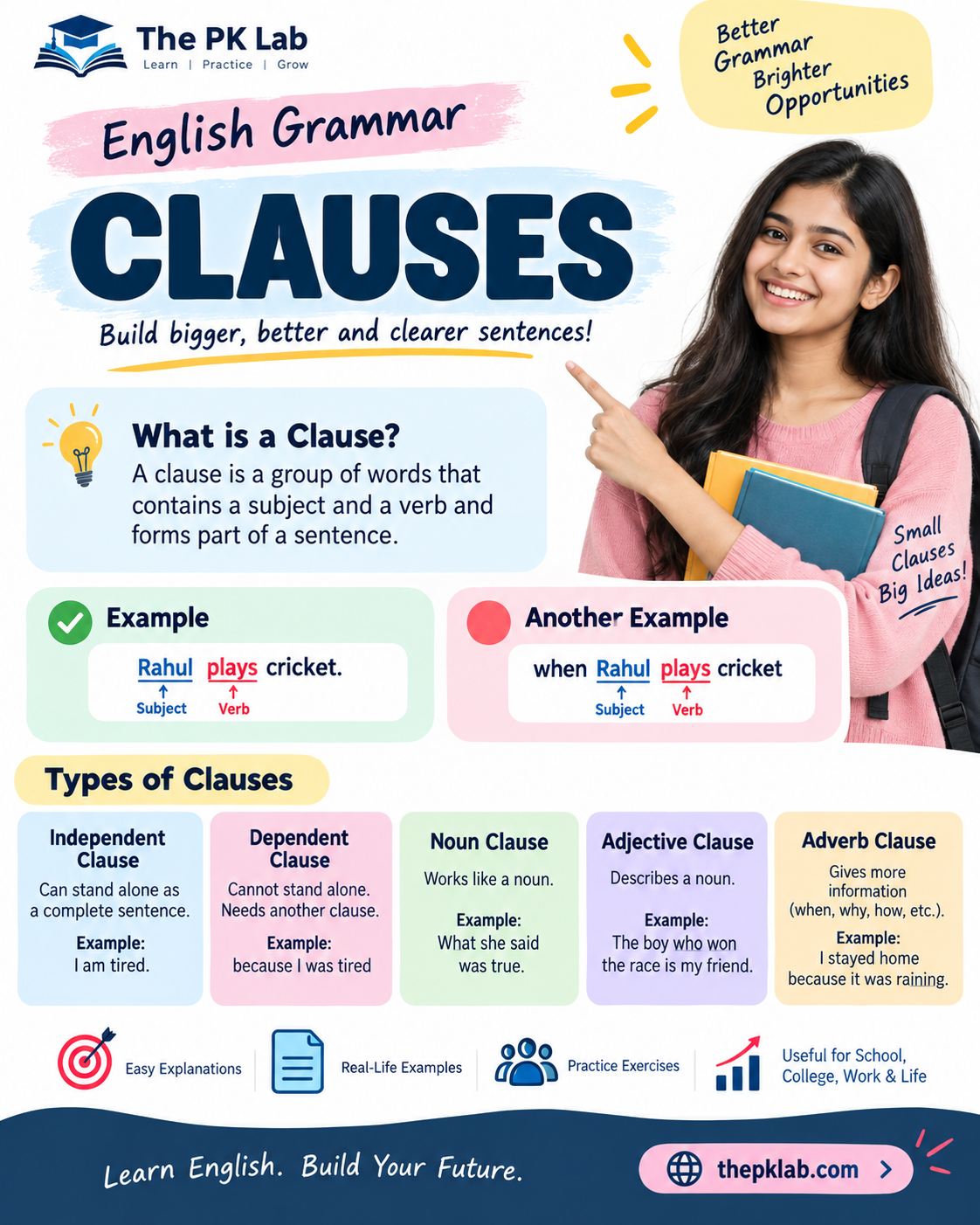
1. What is a Clause?
A clause is a group of words that contains a Subject and a Verb.
Simple Definition
A clause is a group of words that has a subject and a verb and forms part of a sentence.
Examples
- Rahul plays cricket.
- Subject: Rahul
- Verb: plays
- when Rahul plays cricket
- Subject: Rahul
- Verb: plays
Both contain a subject and a verb, so both are clauses. However, the second one does not express a complete thought by itself.
2. Why Are Clauses Important?
Clauses help us:
- Build longer and meaningful sentences
- Connect ideas
- Give reasons
- Show time, condition, purpose, contrast, etc.
- Make our writing and speaking more natural
- Create simple, compound, and complex sentences
Compare:
I stayed at home.
With:
I stayed at home because it was raining.
The second sentence gives us additional information through a clause.
3. Clause vs Phrase
This is one of the most important differences to understand.
| Clause | Phrase |
|---|---|
| Has a subject and a verb | Usually does not have both a subject and a verb |
| Can express a complete or incomplete idea | Acts as part of a sentence |
| She is singing | in the garden |
| because she is tired | after the class |
Example
She is sleeping in the room.
- She is sleeping → Clause
- in the room → Phrase
Easy Memory Trick
Clause = Subject + Verb
If you can identify a subject and a verb, you are probably looking at a clause.
4. Main Types of Clauses
There are two major types of clauses:
- Independent Clause
- Dependent Clause
5. Independent Clause
An independent clause can stand alone as a complete sentence.
It expresses a complete thought.
Examples
- I am tired.
- She works in Bhubaneswar.
- Rahul plays football.
- We went to Cuttack.
- The students are studying.
Each clause has:
Subject + Verb + Complete Meaning
Structure
Subject + Verb + Complete Thought
Example:
The students are studying.
- Subject → The students
- Verb → are studying
- Complete thought → Yes
Therefore, it is an Independent Clause.
6. Dependent Clause
A Dependent Clause, also called a Subordinate Clause, contains a subject and a verb but cannot normally stand alone as a complete sentence.
It depends on another clause to complete its meaning.
Examples
- because I was tired
- when she arrived
- if it rains
- although he was busy
- because they were late
For example:
Because I was tired
We naturally expect more information.
Because I was tired, I went to bed early.
Here:
- Because I was tired → Dependent Clause
- I went to bed early → Independent Clause
Easy Memory Trick
Independent = can stand alone.
Dependent = needs another clause.
7. Independent vs Dependent Clause
| Independent Clause | Dependent Clause |
|---|---|
| Complete thought | Incomplete thought |
| Can stand alone | Cannot normally stand alone |
| Makes sense by itself | Needs another clause |
| I went home. | because I was tired |
| She called me. | when she arrived |
8. Words That Often Introduce Dependent Clauses
Dependent clauses are frequently introduced by words such as:
Time
- when
- while
- before
- after
- until
- since
Example:
When I reached home, I called my mother.
Reason
- because
- since
- as
Example:
I stayed home because it was raining.
Condition
- if
- unless
Example:
If you study hard, you will succeed.
Contrast
- although
- though
- even though
- whereas
Example:
Although he was tired, he continued working.
These words are often called subordinating conjunctions.
9. Types of Dependent Clauses
Dependent clauses can perform different functions in a sentence.
The three important types are:
- Noun Clause
- Adjective Clause
- Adverb Clause
10. Noun Clause
A Noun Clause is a dependent clause that works like a noun.
It can act as a subject, object, or complement.
Example
What she said was true.
Here:
What she said = the subject of the sentence
It works like a noun.
More Examples
- I know that he is honest.
- She explained what happened.
- Tell me where you live.
- I don’t know why he left.
Common Words Introducing Noun Clauses
- that
- what
- who
- whom
- where
- when
- why
- how
- whether
- if
Easy Trick
Ask:
What? / Who?
If the clause answers this question and functions like a noun, it may be a Noun Clause.
Example:
I know what she wants.
Ask:
I know what?
Answer:
what she wants
So it is a noun clause.
11. Adjective Clause
An Adjective Clause describes or gives more information about a noun or pronoun.
It is also called a Relative Clause.
Example
The boy who is wearing a blue shirt is my brother.
The clause:
who is wearing a blue shirt
describes:
the boy
Therefore, it is an Adjective Clause.
More Examples
- I met a girl who speaks French.
- This is the book that I bought yesterday.
- The man who lives next door is a teacher.
- I visited the college where my brother studied.
Common Relative Words
- who
- whom
- whose
- which
- that
- where
- when
Easy Trick
If the clause describes a noun, it is usually an Adjective Clause.
12. Adverb Clause
An Adverb Clause is a dependent clause that gives information about a verb, adjective, or the whole main clause.
It can tell us:
- When?
- Why?
- Where?
- How?
- Under what condition?
- In spite of what?
Example
I stayed home because it was raining.
The clause:
because it was raining
explains why I stayed home.
Therefore, it is an Adverb Clause.
More Examples
Time
I will call you when I reach home.
Reason
She was absent because she was sick.
Condition
If you work hard, you will succeed.
Contrast
Although he was tired, he continued working.
Purpose
He studied hard so that he could pass the exam.
13. Quick Comparison
| Type | Function | Example |
|---|---|---|
| Noun Clause | Works like a noun | I know what he wants. |
| Adjective Clause | Describes a noun | The boy who won the race is my friend. |
| Adverb Clause | Gives information about the action/idea | I stayed home because it was raining. |
Easy Memory Trick
Noun Clause → names/acts like a thing
Adjective Clause → describes
Adverb Clause → explains how, when, why, condition, etc.
14. Clauses in Real-Life English
Clauses are everywhere in everyday conversations.
At Home
I will call you when I reach home.
At College
I couldn’t attend the class because I was unwell.
At Work
Please call me when the meeting starts.
Shopping
I will buy the shirt if the price is reasonable.
Travel
We will leave after the rain stops.
Interview
I believe that I can contribute to your organization.
15. Correct vs Incorrect
Example 1
❌ Because I was tired.
This is a dependent clause presented as a complete sentence.
✅ Because I was tired, I went to bed early.
Example 2
❌ When I reached home.
Incomplete.
✅ When I reached home, I called my mother.
Example 3
❌ The man who lives next door.
Incomplete as a sentence.
✅ The man who lives next door is a teacher.
16. Common Mistakes
Mistake 1: Thinking every group of words is a clause
❌ in the classroom
This is a phrase, not a clause, because it does not contain a subject and verb.
Mistake 2: Using a dependent clause alone
❌ Although I was tired.
✅ Although I was tired, I continued working.
Mistake 3: Confusing a phrase with a clause
❌ after the meeting → Clause
Actually:
after the meeting = Phrase
But:
after the meeting ended = Clause
Why?
Because the meeting ended contains a subject and a verb.
17. Clause and Sentence
A sentence can contain:
One Independent Clause
I work in Bhubaneswar.
Two Independent Clauses
I work in Bhubaneswar, and my brother works in Cuttack.
Independent + Dependent Clause
I stayed home because it was raining.
Multiple Clauses
When I reached the office, I called my manager because I needed some information.
Understanding clauses helps you understand how longer sentences are built.
18. Clauses and Sentence Types
Clauses are closely connected with sentence structure.
Simple Sentence
Usually contains one independent clause.
She works hard.
Compound Sentence
Contains two or more independent clauses.
She works hard, and she earns well.
Complex Sentence
Contains one independent clause + one or more dependent clauses.
She works hard because she wants to succeed.
Compound-Complex Sentence
Contains at least two independent clauses + at least one dependent clause.
She works hard because she wants to succeed, and her brother supports her.
19. Spoken English Usage
In everyday English, clauses help us connect ideas naturally.
Instead of saying:
I was late. I missed the bus. I reached the office late.
We can say:
Because I missed the bus, I reached the office late.
Or:
I reached the office late because I missed the bus.
This makes your English more natural and connected.
Formal vs Natural Spoken English
Formal:
I do not know why he is absent.
Natural conversation:
I don’t know why he’s absent.
The clause structure remains the same; only the style becomes more conversational.
20. Quick Tips / Memory Tricks
Remember these three questions:
1. Does it have a Subject + Verb?
If yes → it may be a clause.
2. Can it stand alone?
If yes → Independent Clause
If no → Dependent Clause
3. What job does the dependent clause do?
- Acts like a noun → Noun Clause
- Describes a noun → Adjective Clause
- Gives information such as time, reason, condition, etc. → Adverb Clause
21. Practice Exercise
A. Identify the Clause
Identify whether the bold part is an Independent Clause or Dependent Clause.
- I went to the market because I needed vegetables.
- I stayed home because it was raining.
- She called me when she reached home.
- If you work hard, you will succeed.
- We will start the class when everyone arrives.
B. Identify the Type
Identify the bold clause as:
Noun Clause / Adjective Clause / Adverb Clause
- I know what he wants.
- The student who won the prize is my friend.
- I stayed home because I was tired.
- Tell me where you live.
- The car that I bought yesterday is new.
C. Complete the Sentences
Complete each sentence with a suitable clause.
- I will call you when __________.
- I stayed at home because __________.
- The person who __________ is my teacher.
- I don’t know why __________.
- If you work hard, __________.
22. Answers
A. Independent / Dependent
- I went to the market → Independent Clause
- because it was raining → Dependent Clause
- She called me → Independent Clause
- If you work hard → Dependent Clause
- when everyone arrives → Dependent Clause
B. Type of Clause
- what he wants → Noun Clause
- who won the prize → Adjective Clause
- because I was tired → Adverb Clause
- where you live → Noun Clause
- that I bought yesterday → Adjective Clause
C. Sample Answers
- I will call you when I reach home.
- I stayed at home because it was raining.
- The person who teaches us English is my teacher.
- I don’t know why he is absent.
- If you work hard, you will succeed.
23. Quick Revision
| Concept | Remember |
|---|---|
| Clause | Group of words with a subject + verb |
| Independent Clause | Can stand alone |
| Dependent Clause | Needs another clause |
| Noun Clause | Works like a noun |
| Adjective Clause | Describes a noun/pronoun |
| Adverb Clause | Gives information such as time, reason, condition, etc. |
| Relative Clause | Another name for an adjective clause |
One-Line Summary
A clause is a building block of a sentence. It contains a subject and a verb, and it may express a complete or incomplete thought.
24. Frequently Asked Questions
What is a clause in simple English?
A clause is a group of words containing a subject and a verb.
What is the difference between a phrase and a clause?
A clause contains a subject and a verb, while a phrase generally does not contain both.
What are the two main types of clauses?
The two main types are Independent Clauses and Dependent Clauses.
What is a dependent clause?
A dependent clause has a subject and a verb but cannot normally express a complete thought by itself.
What are the three types of dependent clauses?
They are Noun Clauses, Adjective Clauses, and Adverb Clauses.
What is a relative clause?
A relative clause is another name for an Adjective Clause because it describes a noun or pronoun.
Why are clauses important?
Clauses help us connect ideas and create clear, meaningful, and more sophisticated sentences.
25. Key Takeaways
Remember:
Clause = Subject + Verb
Then ask:
Can it stand alone?
- Yes → Independent Clause
- No → Dependent Clause
And for dependent clauses:
- Noun Clause → acts like a noun
- Adjective Clause → describes a noun
- Adverb Clause → gives information about time, reason, condition, contrast, purpose, etc.
Once you understand clauses, building longer, clearer, and more natural English sentences becomes much easier.