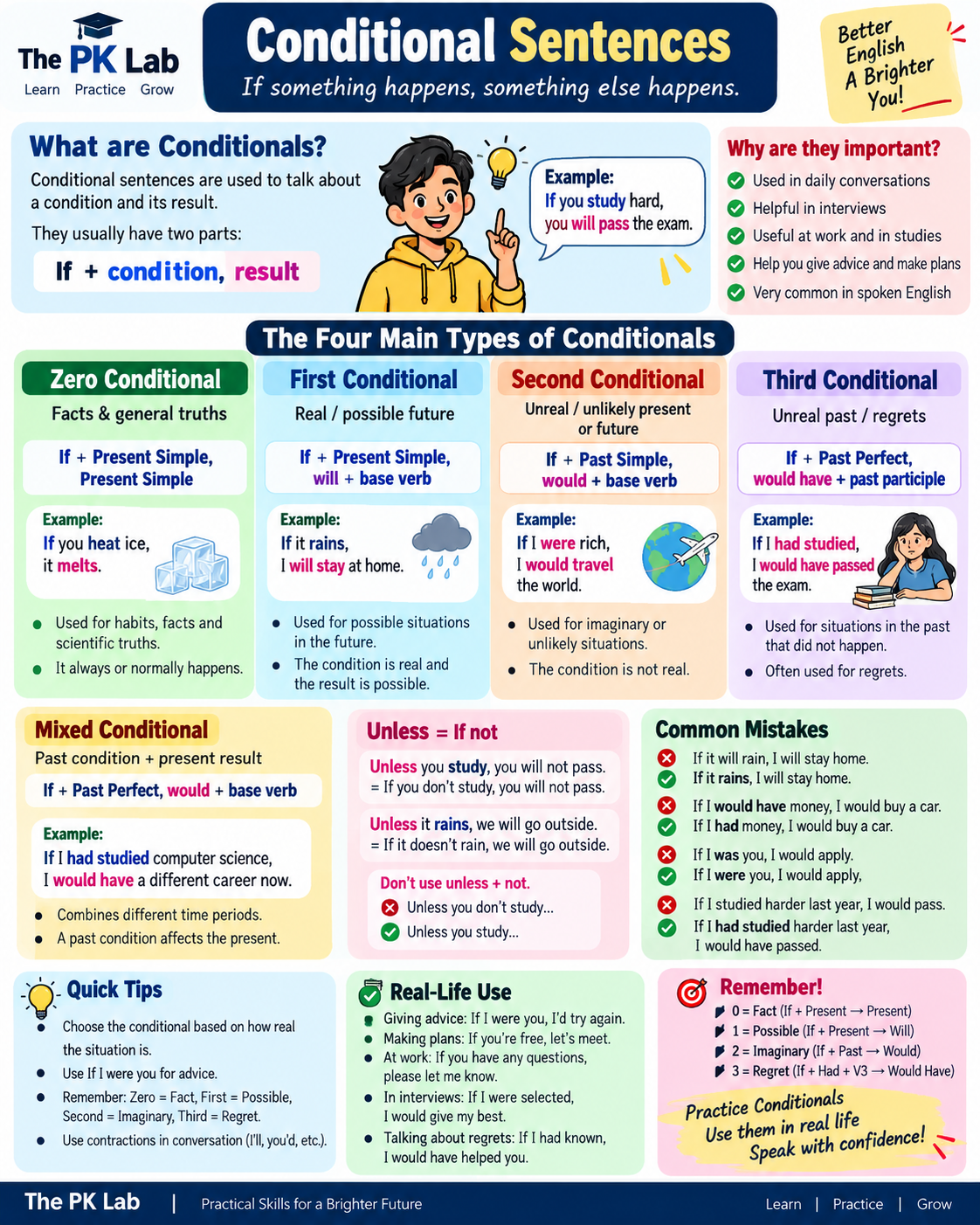
Conditional Sentences (Conditionals)
Conditional sentences are used to talk about a condition and its result.
In simple words:
If something happens, something else happens or will happen.
For example:
- If it rains, I will stay at home.
- If you study hard, you will pass the exam.
- If I had more money, I would buy a car.
Conditionals are very common in daily conversations, interviews, workplaces, advice, plans, and decision-making.
1. What is a Conditional Sentence?
A conditional sentence usually has two parts:
Condition + Result
If + condition, result
If you study hard, you will pass.
- If you study hard → Condition
- you will pass → Result
The condition tells us what must happen first, and the result tells us what happens because of it.
Another example
If I have time, I will call you.
Condition: If I have time
Result: I will call you
2. Basic Structure
A conditional sentence generally contains:
| Part | Meaning |
|---|---|
| If-clause | The condition |
| Main clause | The result |
Example
If you work hard, you will succeed.
If you work hard = condition
You will succeed = result
You can also reverse the order:
You will succeed if you work hard.
Both are correct.
Important punctuation rule
When the if-clause comes first, use a comma:
If you study, you will improve.
When the result comes first, a comma is usually not needed:
You will improve if you study.
3. Four Main Types of Conditionals
There are four commonly taught types:
| Type | Main Use | Example |
|---|---|---|
| Zero Conditional | Facts & general truths | If you heat ice, it melts. |
| First Conditional | Real/possible future | If it rains, I will stay home. |
| Second Conditional | Unreal/unlikely present or future | If I were rich, I would travel the world. |
| Third Conditional | Unreal past / regrets | If I had studied, I would have passed. |
There is also a useful Mixed Conditional, which connects different time periods.
4. Zero Conditional
What is it?
We use the Zero Conditional for:
- General truths
- Scientific facts
- Habits
- Things that are always or normally true
Structure
If + Present Simple, Present Simple
If + subject + verb, subject + verb.
Examples
- If you heat water, it boils.
- If you don’t eat, you feel hungry.
- If you mix red and blue, you get purple.
- If it rains heavily, roads become wet.
- If I drink coffee at night, I can’t sleep.
Real-Life Examples
If you press this button, the machine starts.
If students practice regularly, they improve.
If you don’t charge your phone, the battery dies.
Key idea
Zero Conditional = This generally happens.
5. First Conditional
What is it?
We use the First Conditional for a real or possible situation in the future.
The condition is possible, and its result is also possible.
Structure
If + Present Simple, will + base verb
Examples
- If it rains, I will stay home.
- If you study hard, you will pass.
- If she comes, I will talk to her.
- If we leave now, we will reach on time.
- If you practice English every day, you will improve.
Indian Context Examples
If I get a job in Bhubaneswar, I will move there.
If you prepare well for the interview, you will perform better.
If the train arrives on time, we will reach Cuttack by evening.
Negative Example
If you don’t hurry, you will miss the bus.
Question
What will you do if it rains tomorrow?
Answer:
If it rains tomorrow, I will stay at home.
Key idea
First Conditional = Possible future.
6. Second Conditional
What is it?
We use the Second Conditional for situations that are:
- Unreal
- Imaginary
- Unlikely
- Hypothetical
They usually refer to the present or future.
Structure
If + Past Simple, would + base verb
Examples
If I were rich, I would travel around the world.
If I had more time, I would learn another language.
If she knew the answer, she would tell us.
If I were you, I would accept the opportunity.
Important: “If I were…”
In formal and standard English, we commonly say:
If I were you, I would…
Not:
❌ If I was you…
This structure is especially useful when giving advice.
Examples
If I were you, I would apply for the job.
If I were you, I would practice speaking English every day.
Key idea
Second Conditional = Imaginary or unlikely present/future.
7. Third Conditional
What is it?
We use the Third Conditional to talk about an imaginary past.
The past situation did not happen, so the result also did not happen.
It is often used for:
- Regret
- Criticism
- Missed opportunities
- Imagining a different past
Structure
If + Past Perfect, would have + Past Participle
Examples
If I had studied harder, I would have passed the exam.
Meaning:
I didn’t study harder, so I didn’t pass.
Another example:
If she had left earlier, she would have caught the bus.
Meaning:
She didn’t leave earlier, so she missed the bus.
More examples
- If I had known about the meeting, I would have attended it.
- If we had booked earlier, we would have got better seats.
- If he had prepared well, he would have performed better.
- If you had called me, I would have helped you.
Key idea
Third Conditional = Imaginary past / regret.
8. Mixed Conditional
Mixed Conditionals combine different time periods.
They are useful when a past condition affects the present.
Example
If I had studied computer science, I would have a different career now.
Past condition:
I didn’t study computer science.
Present result:
My career is different.
Structure
If + Past Perfect, would + base verb
Another example:
If I had saved more money, I would be financially comfortable now.
9. Conditional Types at a Glance
| Type | Condition | Result | Use |
|---|---|---|---|
| Zero | Present Simple | Present Simple | Facts |
| First | Present Simple | will + verb | Possible future |
| Second | Past Simple | would + verb | Unreal/imaginary |
| Third | Past Perfect | would have + V3 | Unreal past |
| Mixed | Past Perfect | would + verb | Past condition + present result |
10. Easy Comparison
Look at how the meaning changes:
Zero
If I drink coffee, I feel energetic.
General habit/fact
First
If I drink coffee tonight, I will feel energetic.
Possible future
Second
If I drank coffee every day, I would feel energetic.
Imaginary/unlikely situation
Third
If I had drunk coffee, I would have felt energetic.
Imaginary past
This comparison makes the four types much easier to understand.
11. “Unless” in Conditionals
Unless means if not.
Example
Unless you study, you will not pass.
Meaning:
If you don’t study, you will not pass.
More examples
Unless it rains, we will go outside.
= If it doesn’t rain, we will go outside.
You won’t improve unless you practice.
= You won’t improve if you don’t practice.
Important
Don’t normally use unless + not.
❌ Unless you don’t study…
✅ Unless you study…
12. “If” vs “When”
If means something is possible or conditional.
When suggests that something is expected or certain to happen.
Compare
If I get a job, I will celebrate.
Maybe I will get a job; maybe I won’t.
When I get a job, I will celebrate.
I expect to get a job.
13. “If” vs “Whether”
If can sometimes mean whether, but the meanings are not always interchangeable.
Conditional
If it rains, we will cancel the match.
Two possibilities
I don’t know whether he will come.
Here, whether is more appropriate because we are talking about two possibilities.
14. Common Mistakes
Mistake 1: Using “will” after “if”
❌ If it will rain, I will stay home.
✅ If it rains, I will stay home.
For the normal First Conditional:
If + Present Simple + will
Mistake 2: Using “would” in the if-clause
❌ If I would have money, I would buy a car.
✅ If I had money, I would buy a car.
Mistake 3: Wrong Third Conditional
❌ If I would have studied, I would have passed.
✅ If I had studied, I would have passed.
Mistake 4: “If I was you”
Common in informal speech, but for standard/formal English:
❌ If I was you, I would apply.
✅ If I were you, I would apply.
Mistake 5: Confusing Second and Third Conditional
❌ If I studied harder last year, I would pass the exam.
If talking about a past exam that is already finished:
✅ If I had studied harder last year, I would have passed the exam.
15. Conditional Sentences in Spoken English
Conditionals are extremely useful in everyday conversation.
Giving advice
If I were you, I’d talk to your manager.
Making plans
If you’re free tomorrow, let’s meet.
Making offers
If you need help, just call me.
Talking about possibilities
If the weather is good, we’ll go out.
Talking about regrets
If I had known, I would have told you.
Making promises
If you help me, I’ll help you.
Workplace English
If you have any questions, please let me know.
If we finish this today, we can submit the report tomorrow.
16. Natural Spoken English
In conversation, we often use contractions.
Formal
If I have time, I will call you.
Natural conversation
If I have time, I’ll call you.
Formal
If I were you, I would apply for the position.
Natural conversation
If I were you, I’d apply for the position.
Common contractions:
| Full form | Spoken form |
|---|---|
| I will | I’ll |
| You will | You’ll |
| I would | I’d |
| We would | We’d |
| They would | They’d |
| Will not | Won’t |
| Would not | Wouldn’t |
17. Conditional Sentences for Interviews
Conditionals are useful when answering hypothetical interview questions.
Question:
What would you do if you faced a difficult customer?
Answer:
If I faced a difficult customer, I would remain calm, listen carefully, and try to solve the problem professionally.
Another example:
If I were selected for this position, I would contribute my skills and continue learning.
18. Quick Memory Trick
Remember:
ZERO → FACT
If + Present → Present
If you heat ice, it melts.
FIRST → POSSIBLE
If + Present → Will
If I study, I will pass.
SECOND → IMAGINARY
If + Past → Would
If I were rich, I would travel.
THIRD → REGRET
If + Had + V3 → Would Have + V3
If I had studied, I would have passed.
Easy formula:
0 = Fact
1 = Possible
2 = Imaginary
3 = Regret
19. Practice Exercise
Choose the correct option.
A. Fill in the blanks
- If you heat ice, it ________.
a) melts
b) will melt
c) would melt - If I study hard, I ________ the exam.
a) pass
b) will pass
c) would pass - If I were rich, I ________ a big house.
a) buy
b) will buy
c) would buy - If she had arrived earlier, she ________ the meeting.
a) would attend
b) would have attended
c) will attend - If you don’t hurry, you ________ the bus.
a) will miss
b) would miss
c) missed - If I ________ you, I would accept the offer.
a) am
b) was
c) were - Unless you practice, you ________ improve.
a) will not
b) would not
c) had not - If I had known about the interview, I ________ prepared better.
a) will have
b) would have
c) would
20. Answers
- a) melts
- b) will pass
- c) would buy
- b) would have attended
- a) will miss
- c) were
- a) will not
- b) would have
21. Quick Revision
- Conditional sentences express a condition and its result.
- Zero Conditional → facts and general truths.
- First Conditional → real/possible future situations.
- Second Conditional → imaginary or unlikely situations.
- Third Conditional → imaginary past situations and regrets.
- Mixed Conditional → connects different time periods.
- Unless means if not.
- Use If I were you for standard advice.
- In the normal First Conditional, don’t use will immediately after if.
22. FAQs
What is a conditional sentence?
A conditional sentence describes a condition and its possible or actual result.
How many main types of conditionals are there?
There are four commonly taught types: Zero, First, Second, and Third Conditional. Mixed Conditionals are also used.
What is the easiest conditional to learn first?
Start with the Zero and First Conditionals, because they are frequently used in everyday English.
What is the difference between First and Second Conditional?
The First Conditional describes a real or possible situation:
If I get the job, I will celebrate.
The Second Conditional describes an imaginary or unlikely situation:
If I got the job, I would move to another city.
What is the difference between Second and Third Conditional?
The Second Conditional generally talks about an unreal present/future situation.
If I were rich, I would travel.
The Third Conditional talks about an unreal past.
If I had been rich, I would have travelled.
Can “if” come at the end of a sentence?
Yes.
I will call you if I have time.
23. Key Takeaways
Conditionals help us talk about facts, possibilities, imaginary situations, and past regrets.
Remember:
Zero → Fact
First → Possible
Second → Imaginary
Third → Regret
Once you understand when the condition happens and how real or unreal it is, choosing the correct conditional becomes much easier.