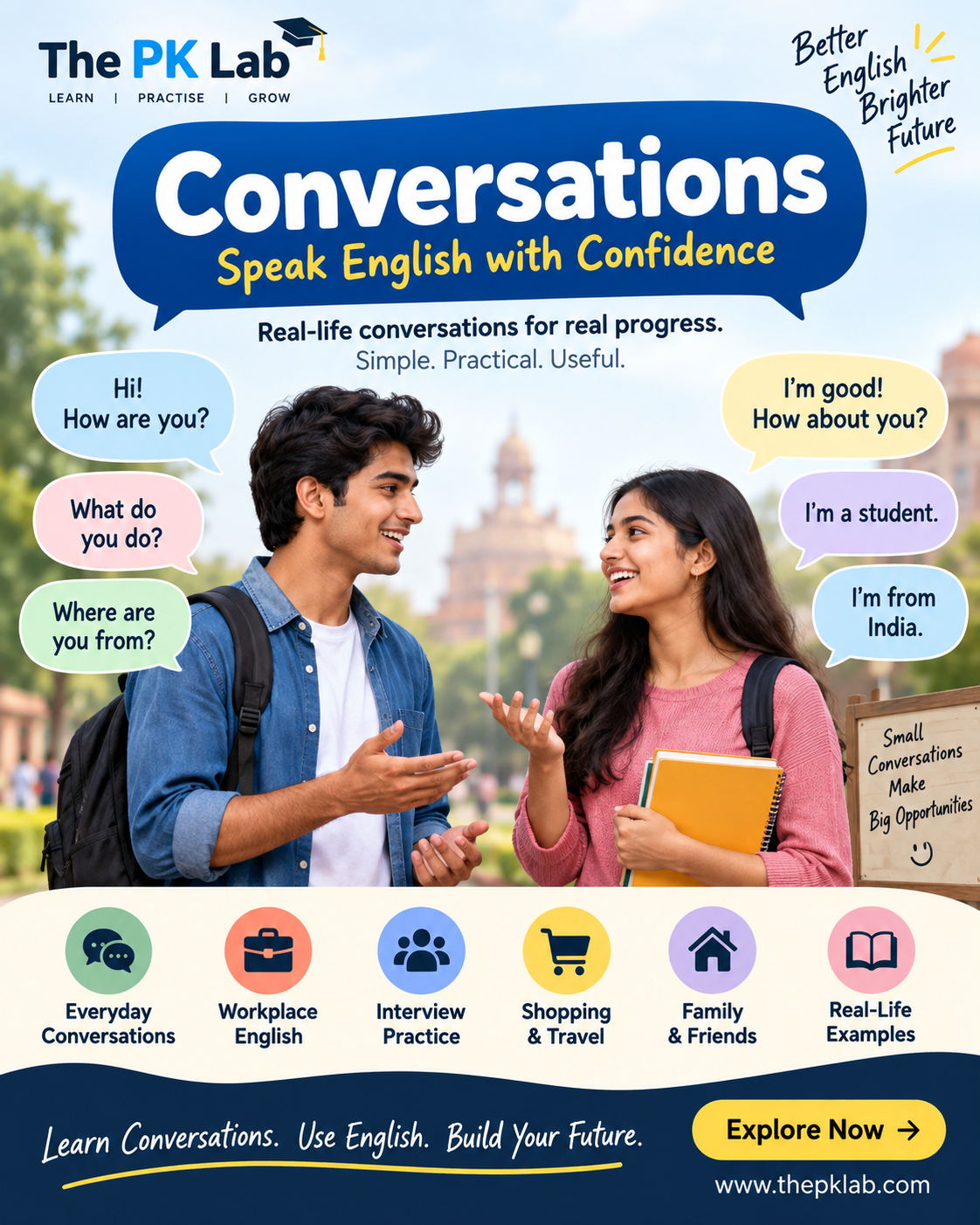
What is a Conversation?
A conversation is a communication between two or more people.
We use conversations every day to ask questions, share information, express feelings, make requests, give opinions, solve problems, and build relationships.
For example:
Rahul: Hi! How are you?
Amit: I’m good. How about you?
Rahul: I’m doing well. What are you doing today?
Amit: I’m going to college.
This is a simple English conversation.
The goal of learning conversations is not only to know grammar rules. It is to learn how to use English naturally in real-life situations.
Why Are Conversations Important?
Knowing grammar and vocabulary is important, but communication requires more than knowing individual words.
Conversation practice helps you learn how to:
- Start a conversation
- Ask and answer questions
- Introduce yourself
- Express your thoughts
- Make requests
- Agree and disagree politely
- Ask for clarification
- Give suggestions
- Talk about your daily routine
- Communicate at school or college
- Speak at the workplace
- Handle interviews
- Talk on the telephone
- Communicate while travelling
- Speak confidently in social situations
Remember:
Grammar helps you build correct sentences. Conversation helps you use those sentences in real life.
Basic Conversation Structure
A simple conversation often follows this pattern:
Greeting → Question → Answer → Follow-up → Response → Closing
Example
A: Good morning! How are you?
B: Good morning! I’m fine, thank you. How are you?
A: I’m doing well. Are you going to the office?
B: Yes, I am. I have a meeting at 10 a.m.
A: Okay. Have a great day!
B: Thank you. You too!
Common Types of Conversations
1. Introducing Yourself
Useful when meeting someone for the first time.
A: Hi! What’s your name?
B: I’m Rakesh. What’s your name?
A: I’m Priya. Nice to meet you.
B: Nice to meet you too.
Useful sentences
- My name is Rahul.
- I’m from Odisha.
- I live in Bhubaneswar.
- I’m a college student.
- I work for a private company.
- Nice to meet you.
- It’s good to meet you.
2. Conversation at Home
Mother: Have you had breakfast?
Son: Not yet.
Mother: Why? You’re getting late.
Son: I’ll have it in five minutes.
Mother: Okay, but don’t be late for college.
Useful expressions
- Have you eaten?
- I’m coming.
- Give me a minute.
- Where is my phone?
- I’ll do it later.
- I’m getting ready.
- What are you doing?
3. Conversation at College
Student 1: Are you attending the English class today?
Student 2: Yes. What time does it start?
Student 1: At 10 o’clock.
Student 2: Okay. Let’s go together.
4. Conversation at a Shop
Customer: How much is this shirt?
Shopkeeper: It’s ₹800.
Customer: Do you have it in blue?
Shopkeeper: Yes, we do.
Customer: Can I try it on?
Shopkeeper: Sure.
Useful expressions
- How much is this?
- Do you have another colour?
- Do you have a smaller size?
- Can I try this on?
- Is there any discount?
- I’ll take it.
- I’m just looking.
5. Conversation at the Workplace
Manager: Good morning. Have you completed the report?
Employee: Good morning. Yes, I’ve completed it.
Manager: Could you send it to me?
Employee: Sure. I’ll send it right away.
Useful workplace expressions
- I’ll check and get back to you.
- Could you please explain this?
- I’ll send it by evening.
- Let’s discuss this later.
- Could you give me a minute?
- I agree with you.
- I have a different opinion.
- Thank you for your help.
6. Conversation During an Interview
Interviewer: Tell me about yourself.
Candidate: My name is Rahul. I have completed my graduation in Commerce. I have three years of experience in customer service. I’m interested in this position because it matches my skills and experience.
Useful interview expressions
- Thank you for giving me this opportunity.
- Let me introduce myself.
- I have experience in…
- My key strength is…
- I’m interested in this role because…
- Could you please repeat the question?
- Thank you for your time.
Formal vs Natural Spoken English
English used in textbooks and English used in everyday conversations can sometimes look different.
| Formal English | Natural Spoken English |
|---|---|
| I do not know. | I don’t know. |
| I cannot understand. | I can’t understand. |
| I am going to leave. | I’m going to leave. |
| Would you like some tea? | Would you like some tea? |
| I will call you later. | I’ll call you later. |
| What are you doing? | What are you doing? |
Important
Contractions such as:
- I am → I’m
- You are → You’re
- He is → He’s
- Do not → Don’t
- Cannot → Can’t
- I will → I’ll
- We are → We’re
are extremely common in everyday spoken English.
However, formal situations may require more formal wording.
Correct vs Incorrect
1. Asking someone’s name
❌ What is your good name?
✅ What’s your name?
Why?
“What is your good name?” is common in Indian English, but it is not the natural standard-English expression.
2. Asking about someone’s arrival
❌ When you will come?
✅ When will you come?
Why?
In a direct question, the auxiliary verb generally comes before the subject:
When + will + you + come?
3. Asking someone to wait
❌ Please wait for few minutes.
✅ Please wait for a few minutes.
4. Asking about understanding
❌ Did you understood?
✅ Did you understand?
Why?
After did, use the base form of the verb.
Did + understand ✅
Did + understood ❌
Common Conversation Mistakes
Indian learners commonly face difficulties such as:
1. Translating directly from the mother tongue
Instead of translating every sentence word-for-word, learn natural English expressions.
2. Focusing too much on grammar while speaking
Grammar is important, but constantly thinking about every rule can make speaking slow.
3. Using complicated vocabulary
Simple English is often better.
Instead of:
“I would like to convey that…”
In an ordinary conversation:
“I want to say that…”
4. Being afraid of mistakes
Mistakes are a normal part of learning.
Speak → Make mistakes → Correct them → Practise → Improve
Useful Conversation Starters
When you don’t know how to begin talking, try:
- Hi! How are you?
- How’s your day going?
- What are you doing?
- Where are you from?
- What do you do?
- How was your weekend?
- Have you been here before?
- What do you think about this?
- Could you help me with something?
- What happened?
Useful Conversation Responses
Instead of repeatedly saying “Yes” or “Okay”, learn different responses.
Showing agreement
- Exactly.
- That’s right.
- I agree.
- Absolutely.
- You’re right.
- I think so too.
Showing uncertainty
- I’m not sure.
- I don’t know.
- I’m not certain.
- Let me check.
- I’ll find out.
Asking for clarification
- Could you repeat that?
- Sorry, I didn’t catch that.
- Could you speak a little slowly?
- What do you mean?
- Could you explain that?
Quick Tips for Better Conversations
Tip 1: Listen before responding
Good communication is not only about speaking.
Listen → Understand → Respond
Tip 2: Use short sentences
Don’t try to speak complicated English.
“I’m tired. I’ll take a short break.”
is perfectly good English.
Tip 3: Learn phrases, not only words
Don’t just learn:
decision
Learn:
make a decision
Don’t just learn:
interested
Learn:
interested in
Tip 4: Practise aloud
Reading silently is not enough.
Speak the sentences aloud.
Tip 5: Think in English
Start with simple thoughts:
I am hungry.
I need water.
I’m going to work.
I need to call my friend.
Gradually, your brain becomes more comfortable forming English sentences.
Practice Exercise
Complete the conversations.
Exercise 1
A: Hi! What’s your ______?
B: My name is Amit.
Exercise 2
A: Where ______ you from?
B: I’m from Odisha.
Exercise 3
A: Did you ______ the email?
B: Yes, I did.
Exercise 4
A: Could you please ______ that?
B: Sure. I’ll explain it again.
Exercise 5
A: How much ______ this bag?
B: It’s ₹1,200.
Answers
- name
- are
- receive / read
- explain / repeat
- is
Conversation Practice Challenge
Try this 5-minute daily practice:
Minute 1 — Greeting
Practise:
Good morning! How are you?
Minute 2 — Introduction
Talk about yourself.
My name is ____.
I’m from ____.
I work/study at ____.
Minute 3 — Daily Routine
I usually wake up at ____.
I have breakfast at ____.
I go to work/college at ____.
Minute 4 — Question & Answer
Ask yourself:
What did I do yesterday?
What am I doing today?
What will I do tomorrow?
Minute 5 — Free Speaking
Talk about anything:
My family
My college
My job
My hometown
My favourite food
My goals
FAQs
Is conversation practice necessary for learning English?
Yes. Grammar and vocabulary provide the foundation, but conversation practice helps you use English spontaneously.
Should beginners speak English every day?
Yes. Even 5–10 minutes of daily speaking practice can be useful when done consistently.
Do I need perfect grammar before speaking?
No. You should improve grammar while practising communication. Waiting until your English is “perfect” can delay speaking practice.
How can I improve my English conversation skills?
Listen to English, learn useful phrases, speak aloud, practise conversations, and gradually increase the complexity of your sentences.
What should I do if I forget a word while speaking?
Don’t stop completely. Explain the idea using simpler words.
For example, if you forget “umbrella”, you might say:
“The thing we use when it rains.”
Communication is more important than finding the perfect word immediately.
Quick Revision
Conversation = Real-life use of English
Remember:
Listen → Understand → Speak → Respond → Practise
Good conversation requires:
- Vocabulary
- Grammar
- Pronunciation
- Listening
- Confidence
- Practice
Don’t learn English only to pass an exam. Learn English to communicate.