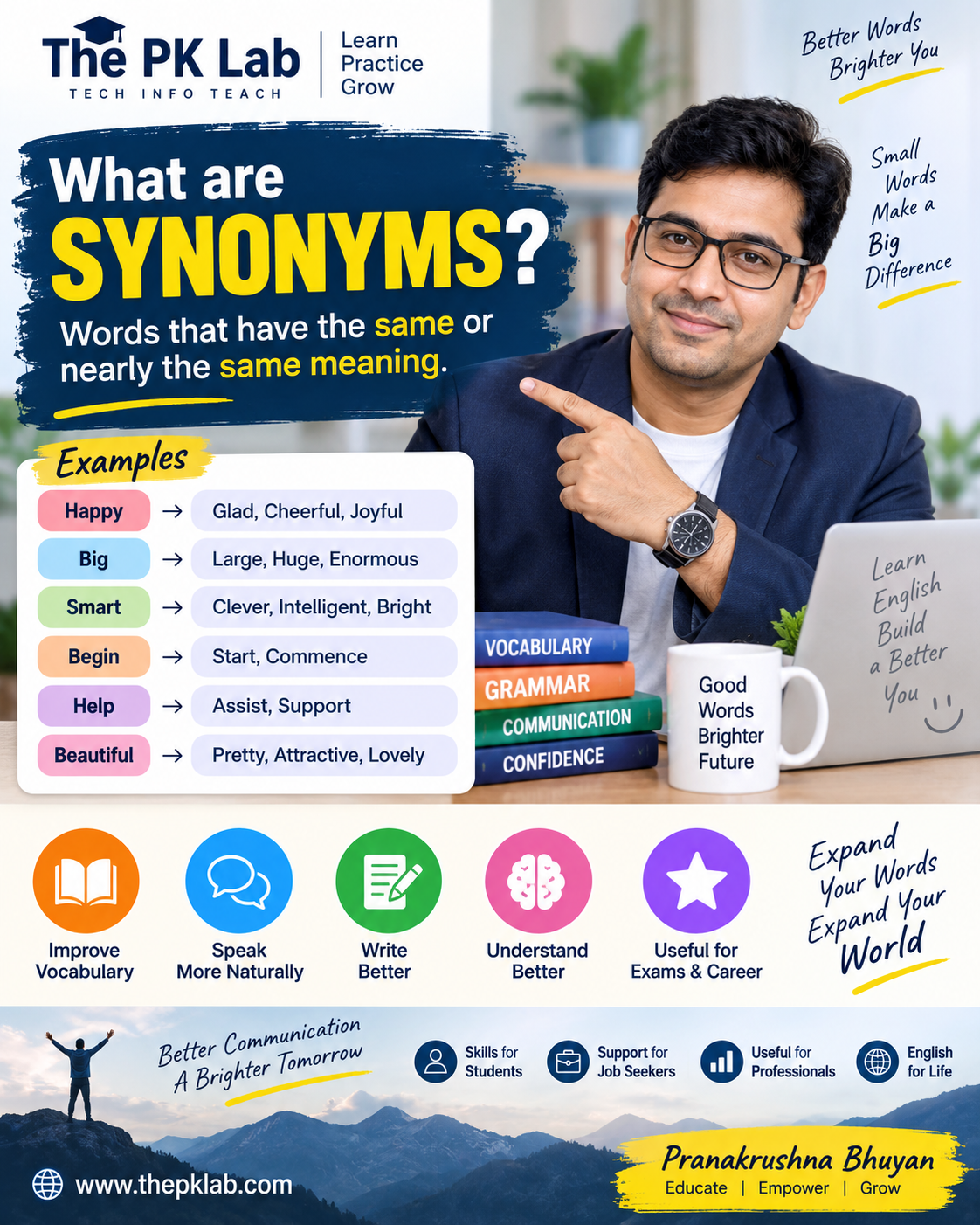
What are Synonyms?
Synonyms are words that have the same or nearly the same meaning.
They help us avoid repeating the same word and make our English more interesting, natural, and expressive.
For example:
- Happy → Glad, Joyful, Cheerful
- Big → Large, Huge, Enormous
- Begin → Start, Commence
- Smart → Clever, Intelligent
Easy idea:
If two words have similar meanings, they are called synonyms.
Why Are Synonyms Important?
Learning synonyms helps you:
- Improve your vocabulary
- Speak English more naturally
- Write better sentences
- Avoid repetition
- Understand books, articles, and conversations
- Perform better in exams
- Communicate more effectively at school and work
Example
Instead of saying:
Rahul is happy. His friends are happy too.
We can say:
Rahul is happy. His friends are cheerful too.
The second version sounds more varied and expressive.
Common Synonyms
| Word | Synonyms |
|---|---|
| Happy | Glad, Cheerful, Joyful |
| Sad | Unhappy, Sorrowful, Upset |
| Big | Large, Huge, Enormous |
| Small | Little, Tiny, Miniature |
| Fast | Quick, Rapid, Speedy |
| Smart | Clever, Intelligent, Bright |
| Easy | Simple, Effortless |
| Difficult | Hard, Challenging |
| Begin | Start, Commence |
| End | Finish, Complete |
| Help | Assist, Support |
| Ask | Question, Enquire |
| Buy | Purchase, Get |
| Angry | Mad, Furious, Annoyed |
| Beautiful | Pretty, Attractive, Lovely |
| Important | Significant, Essential |
| Rich | Wealthy, Affluent |
| Brave | Courageous, Fearless |
| Honest | Truthful, Sincere |
| Quiet | Silent, Peaceful |
Synonyms in Real Life
At Home
Please help me.
→ Please assist me.
At College
The exam was difficult.
→ The exam was challenging.
At Work
We need to start the meeting.
→ We need to begin the meeting.
While Shopping
I want to buy this shirt.
→ I want to purchase this shirt.
In an Interview
I am happy to join your organisation.
→ I am glad to join your organisation.
Synonyms Are Not Always Interchangeable
This is an important point.
Two words may have similar meanings, but they may not work in exactly the same sentence.
For example:
- Big mistake ✅
- Large mistake ⚠️ Possible, but less natural in many contexts.
Similarly:
- Strong rain ❌
- Heavy rain ✅
Although strong and heavy can both relate to intensity, we normally say heavy rain.
So, don’t learn synonyms only as word pairs. Learn them in sentences and understand their natural usage.
Formal vs Everyday Synonyms
Some synonyms are more common in formal English.
| Everyday English | More Formal English |
|---|---|
| Help | Assist |
| Buy | Purchase |
| Start | Commence |
| Ask | Enquire |
| Get | Obtain |
| Need | Require |
| Tell | Inform |
| About | Regarding |
| Use | Utilise |
| End | Terminate |
Example
Everyday:
Please help me with this work.
Formal:
Please assist me with this work.
For everyday conversation, help is usually more natural. In formal writing, assist may be appropriate.
Common Mistakes
Mistake 1: Assuming every synonym can replace the original word
❌ I am making a big rain.
✅ It is raining heavily.
Mistake 2: Using difficult words just to sound intelligent
❌ I utilised a pen to write my name.
✅ I used a pen to write my name.
Tip: Good English is not about using the most complicated word. It is about using the right word in the right situation.
Mistake 3: Ignoring context
The best synonym depends on:
- Meaning
- Situation
- Tone
- Formality
- Sentence structure
Synonyms for Better Spoken English
Instead of repeatedly using very, try learning stronger and more precise words.
| Basic Expression | Better Expression |
|---|---|
| Very happy | Delighted |
| Very angry | Furious |
| Very tired | Exhausted |
| Very big | Huge |
| Very small | Tiny |
| Very good | Excellent |
| Very bad | Terrible |
| Very hungry | Starving |
| Very scared | Terrified |
| Very beautiful | Gorgeous |
Example
Instead of:
I am very tired after work.
You can say:
I am exhausted after work.
This makes your vocabulary more precise.
Quick Memory Trick
SYNONYM = SIMILAR MEANING
Think:
Synonyms = Similar words
For example:
Happy → Glad → Cheerful → Joyful
All express a similar idea of happiness.
Practice Exercise
Choose the correct synonym.
1. Happy
a) Sad
b) Glad
c) Angry
d) Weak
2. Difficult
a) Easy
b) Simple
c) Challenging
d) Small
3. Begin
a) Finish
b) Start
c) Stop
d) End
4. Brave
a) Courageous
b) Afraid
c) Weak
d) Quiet
5. Help
a) Ignore
b) Assist
c) Refuse
d) Stop
Answers
- b) Glad
- c) Challenging
- b) Start
- a) Courageous
- b) Assist
Frequently Asked Questions
1. What is a synonym?
A synonym is a word that has the same or nearly the same meaning as another word.
2. Are synonyms exactly the same?
Not always. Many synonyms have similar meanings but differ in usage, tone, or context.
3. Why should I learn synonyms?
They improve your vocabulary, speaking, writing, reading, and communication skills.
4. Can I use any synonym anywhere?
No. Always consider the context and natural usage of the word.
5. Are synonyms useful for exams?
Yes. Synonyms are commonly useful in vocabulary questions, reading comprehension, competitive examinations, and writing.