Introduction
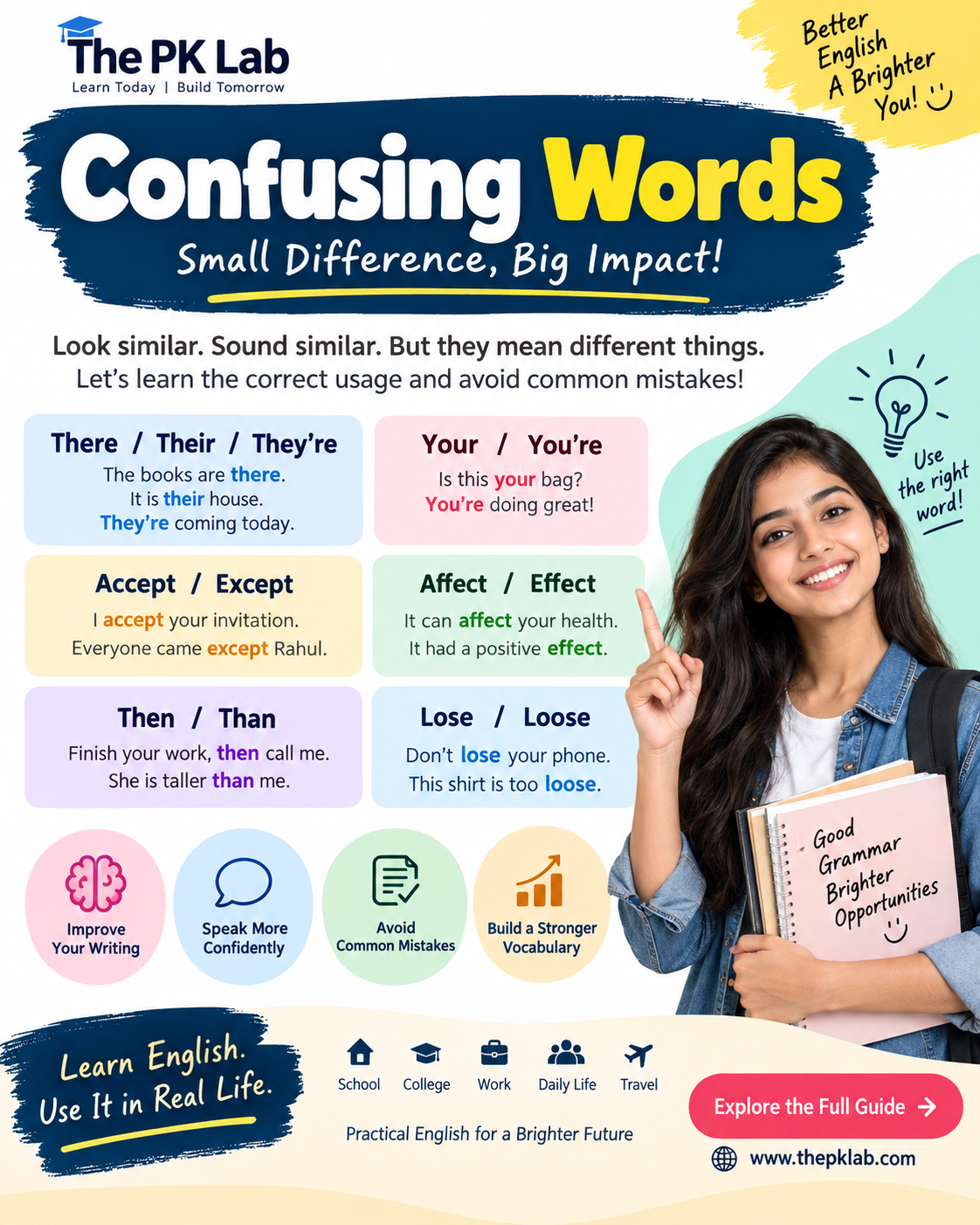
Have you ever written “their” when you meant “there”, or “accept” when you meant “except”?
Don’t worry—you are not alone.
English has many words that look similar, sound similar, or have similar meanings, but they are used differently. These are called confusing words or commonly confused words.
Learning these words will help you:
- Speak English more naturally
- Write grammatically correct sentences
- Avoid common mistakes
- Improve your vocabulary
- Write better emails and messages
- Communicate confidently at school, college, and work
- Perform better in interviews and competitive examinations
1. What Are Confusing Words?
Confusing words are words that learners often mix up because they look, sound, or mean something similar.
For example:
| Word | Meaning | Example |
|---|---|---|
| There | In/at a place | Your bag is there. |
| Their | Belonging to them | This is their house. |
| They’re | They are | They’re coming today. |
The words there, their, and they’re sound similar, but their meanings and uses are different.
Easy Memory Trick
Think:
There → Place
Their → Possession
They’re → They are
2. Why Are Confusing Words Important?
Using the wrong word can change the meaning of a sentence.
Example:
❌ Their is a problem.
✅ There is a problem.
Here, there is needed because we are introducing the existence of something.
Another example:
❌ I accept everyone students.
✅ I accept everyone except Rahul.
Accept and except may sound similar, but they have completely different meanings.
3. Commonly Confused Words
A. There – Their – They’re
There
Used for a place or to introduce something.
The books are there.
There is a meeting today.
Their
Shows possession.
They brought their laptops.
The students completed their assignments.
They’re
Short form of they are.
They’re ready.
They’re working on a project.
Quick Test
If you can replace the word with “they are”, use they’re.
B. Your – You’re
Your
Shows possession.
Is this your phone?
Where is your notebook?
You’re
Short form of you are.
You’re very helpful.
You’re doing a great job.
Memory Trick
Your = belongs to you
You’re = you are
❌ Your very kind.
✅ You’re very kind.
C. Its – It’s
Its
Shows possession.
The company changed its policy.
It’s
Short form of it is or it has.
It’s raining.
It’s been a busy day.
Memory Trick
If you can say “it is”, use it’s.
D. Accept – Except
Accept
Means to receive, agree to, or approve something.
I accept your invitation.
She accepted the job offer.
Except
Means excluding or leaving out someone or something.
Everyone came except Rahul.
I like all fruits except papaya.
Memory Trick
Accept = receive
Except = exclude
E. Affect – Effect
These two words confuse even advanced learners.
Affect
Usually used as a verb meaning “to influence.”
Lack of sleep can affect your concentration.
The weather affected our travel plans.
Effect
Usually used as a noun meaning “result.”
The medicine had a positive effect.
What was the effect of the new rule?
Easy Memory Trick
Affect → Action
Effect → End result
Something affects you → it produces an effect.
F. Then – Than
Then
Used for time, sequence, or result.
Finish your work, then call me.
We went to college and then went home.
Than
Used when comparing things.
Rahul is taller than Amit.
This book is better than that one.
Memory Trick
Then = Time
Than = Comparison
G. To – Too – Two
To
Used for direction or before a verb.
I am going to school.
I want to learn English.
Too
Means also or excessively.
I want to come too.
This bag is too heavy.
Two
The number 2.
I have two brothers.
Memory Trick
To → direction/action
Too → also/excessive
Two → number 2
H. Lose – Loose
Lose
Means to misplace, fail to keep, or not win.
Don’t lose your phone.
Our team may lose the match.
Loose
Means not tight.
This shirt is too loose.
The screw is loose.
Memory Trick
Lose = opposite of win
Loose = opposite of tight
I. Advice – Advise
Advice
A noun meaning a suggestion or recommendation.
Thank you for your advice.
Advise
A verb meaning to give advice.
I advise you to practise every day.
Memory Trick
Advice = thing
Advise = action
J. Practice – Practise
In American English, “practice” is commonly used as both noun and verb.
In British English, which is commonly followed in Indian English:
- Practice = noun
- Practise = verb
Examples
Regular practice improves your English.
You should practise speaking every day.
Easy Memory Trick
Practice = thing
Practise = action
K. Principal – Principle
Principal
Usually means a head of a school/college or something most important.
The principal addressed the students.
Safety is our principal concern.
Principle
Means a basic rule, belief, or standard.
Honesty is an important principle.
Memory Trick
Principal = person / main
Principle = rule or belief
L. Stationary – Stationery
Stationary
Means not moving.
The car remained stationary.
Stationery
Means writing materials.
I bought some stationery for college.
Memory Trick
Stationery → E for Envelope
Stationary → A for At rest
M. Weather – Whether
Weather
Conditions of the atmosphere.
The weather is pleasant today.
Whether
Used when talking about alternatives or uncertainty.
I don’t know whether he will come.
Memory Trick
Weather = sky
Whether = choice/possibility
N. Quiet – Quite
Quiet
Means making little or no noise.
Please be quiet in the library.
Quite
Means fairly, rather, or completely, depending on context.
The movie was quite interesting.
Memory Trick
Quiet = no noise
Quite = degree
O. Beside – Besides
Beside
Means next to.
She sat beside me.
Besides
Means in addition to or apart from.
Besides English, he speaks Hindi and Odia.
Memory Trick
Beside = next to
Besides = additionally
P. Borrow – Lend
These words describe the same exchange from different sides.
Borrow
Take something from someone temporarily.
Can I borrow your pen?
Lend
Give something to someone temporarily.
Can you lend me your pen?
Memory Trick
Borrow = take
Lend = give
Q. Bring – Take
Bring
Move something towards the speaker or a particular place.
Please bring your documents to the office.
Take
Move something away from the speaker or current place.
Please take these documents to the manager.
Memory Trick
Bring = come with it
Take = go with it
R. Say – Tell
Say
Focuses on the words spoken.
She said, “I am busy.”
Tell
Usually needs a person/object who receives the information.
She told me that she was busy.
❌ She told that she was busy.
✅ She told me that she was busy.
S. Hear – Listen
Hear
To receive sound naturally.
I can hear music.
Listen
To deliberately pay attention to sound.
Listen to your teacher carefully.
Memory Trick
Hear = sound reaches you
Listen = you pay attention
T. Look – See – Watch
These three are related to vision but are used differently.
| Word | Basic Meaning | Example |
|---|---|---|
| Look | Direct your eyes | Look at the board. |
| See | Notice with your eyes | I can see a bird. |
| Watch | Observe something for some time | We watched a movie. |
Easy Way to Remember
Look → direct your eyes
See → notice
Watch → observe over time
Correct vs Incorrect
| ❌ Incorrect | ✅ Correct |
|---|---|
| Your very helpful. | You’re very helpful. |
| Their is a problem. | There is a problem. |
| I am taller then him. | I am taller than him. |
| Can I lend your pen? | Can I borrow your pen? |
| Please borrow me your book. | Please lend me your book. |
| Everyone came accept Rahul. | Everyone came except Rahul. |
| The shirt is lose. | The shirt is loose. |
| Please be quite. | Please be quiet. |
| I need some stationary. | I need some stationery. |
| She told that she was busy. | She told me that she was busy. |
Confusing Words in Spoken English
Confusing words are especially important when speaking because some words sound almost identical.
For example:
“I don’t know whether he will come.”
“The weather is good today.”
The words whether and weather sound alike, but their meanings are different.
Practical Conversation
A: Can I borrow your notebook?
B: Sure. But please bring it back tomorrow.
A: Is this your phone?
B: No, it’s their phone.
A: Are you going to the meeting?
B: Yes. I’ll go there after lunch.
Common Mistakes Made by English Learners
1. Confusing Your and You’re
❌ Your doing well.
✅ You’re doing well.
2. Confusing There and Their
❌ Their are many students here.
✅ There are many students here.
3. Confusing Borrow and Lend
❌ Can you borrow me ₹500?
✅ Can you lend me ₹500?
4. Confusing Then and Than
❌ She is older then me.
✅ She is older than me.
5. Confusing Advice and Advise
❌ He gave me a good advise.
✅ He gave me good advice.
Quick Tips to Avoid Confusing Words
Tip 1: Look at the Meaning
Don’t choose a word just because it sounds right.
Ask:
What do I actually mean?
Tip 2: Check the Part of Speech
Is the word a:
- Noun?
- Verb?
- Adjective?
- Adverb?
This can often help you choose the correct word.
Tip 3: Use a Replacement Test
For example:
You’re → you are
If “you are” fits, use you’re.
You’re happy.
You are happy. ✅
Tip 4: Learn Words in Pairs
Don’t memorise:
borrow
Instead learn:
borrow ↔ lend
Don’t learn:
lose
Learn:
lose ↔ loose
This makes the difference easier to remember.
Practice Exercise
Choose the correct word.
1. ______ going to the office today.
a) Your
b) You’re
2. The students brought ______ books.
a) their
b) there
3. Can I ______ your laptop for an hour?
a) borrow
b) lend
4. Please ______ me your notes.
a) borrow
b) lend
5. Rahul is taller ______ Amit.
a) then
b) than
6. Please be ______ in the library.
a) quiet
b) quite
7. Everyone attended the meeting ______ Rakesh.
a) accept
b) except
8. I bought some office ______.
a) stationary
b) stationery
9. Regular ______ is necessary to improve English.
a) practice
b) practise
10. The manager ______ me to apply.
a) advice
b) advised
Answers
- You’re
- their
- borrow
- lend
- than
- quiet
- except
- stationery
- practice
- advised
Quick Revision
Remember these important pairs:
| Confusing Words | Remember |
|---|---|
| There / Their / They’re | Place / Possession / They are |
| Your / You’re | Possession / You are |
| Its / It’s | Possession / It is |
| Accept / Except | Receive / Exclude |
| Affect / Effect | Influence / Result |
| Then / Than | Time / Comparison |
| To / Too / Two | Direction / Also-or-too-much / Number |
| Lose / Loose | Fail to keep / Not tight |
| Advice / Advise | Noun / Verb |
| Principal / Principle | Head/main / Rule |
| Stationary / Stationery | Not moving / Writing materials |
| Weather / Whether | Atmosphere / Choice |
| Quiet / Quite | Silent / Degree |
| Beside / Besides | Next to / In addition |
| Borrow / Lend | Take / Give |
| Bring / Take | Towards / Away |
| Say / Tell | Words / Information to someone |
| Hear / Listen | Receive sound / Pay attention |
| Look / See / Watch | Direct eyes / Notice / Observe |
FAQs
What are confusing words in English?
Confusing words are words that learners often mix up because they have similar spelling, pronunciation, or meaning.
Why do English learners confuse these words?
Many confusing words sound similar or have closely related meanings. Learners may also translate directly from their first language, which can lead to incorrect usage.
How can I improve my use of confusing words?
Learn them in pairs or groups, understand their meanings, study example sentences, and practise using them in real conversations.
What is the difference between “your” and “you’re”?
Your shows possession, while you’re is the short form of you are.
What is the difference between “borrow” and “lend”?
Borrow means to take something temporarily from someone. Lend means to give something temporarily to someone.
Key Takeaways
✅ Don’t learn confusing words only by memorising spelling.
✅ Understand the meaning and function of each word.
✅ Learn commonly confused words together.
✅ Practise them in real-life sentences.
✅ Pay attention to context.
✅ Use short replacement tests such as you’re → you are.
✅ Regular practice will make correct usage automatic.
The goal is not to memorise hundreds of confusing words. The goal is to understand the difference and use the right word naturally.