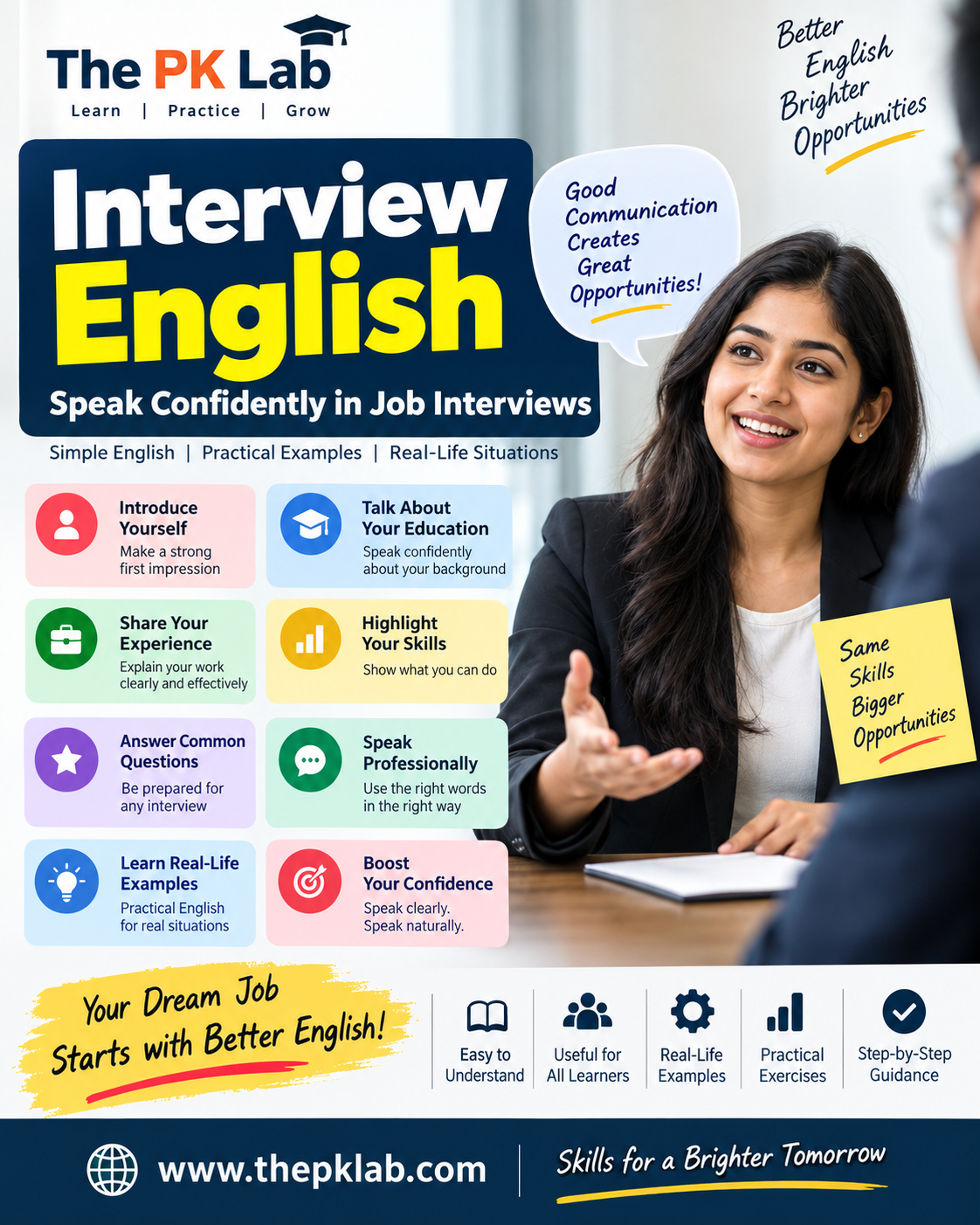
Interview English: Speak Confidently in Job Interviews
Introduction
A job interview is not only about your qualifications. The way you communicate also matters.
You may have good knowledge and skills, but if you cannot explain your experience, answer questions clearly, or speak confidently, it can become difficult to create a good impression.
Interview English means the English you use before, during, and after a job interview.
It includes:
- Introducing yourself
- Talking about your education
- Explaining your experience
- Describing your skills
- Answering common interview questions
- Talking about strengths and weaknesses
- Asking questions politely
- Speaking professionally
- Handling difficult questions
- Ending an interview confidently
The goal is not to speak complicated English.
The goal is to speak clear, correct, natural, and confident English.
1. Why Is Interview English Important?
Good interview communication helps you:
- Make a positive first impression
- Explain your qualifications clearly
- Show confidence
- Present your achievements
- Answer questions professionally
- Communicate with recruiters and interviewers
- Avoid misunderstandings
- Demonstrate workplace communication skills
Remember:
Simple English + Clear Ideas + Confidence = Effective Interview Communication
You do not need a foreign accent or difficult vocabulary to perform well in an interview.
2. Before the Interview
Good English communication begins before you enter the interview room.
Useful sentences
| Situation | Useful English |
|---|---|
| Greeting the interviewer | Good morning, sir/ma’am. |
| Introducing yourself | Thank you for giving me this opportunity. |
| Joining an online interview | Can you hear me clearly? |
| Facing a technical problem | I’m sorry, I’m having a small connectivity issue. |
| Waiting for the interviewer | Thank you for your time. |
Avoid
❌ “What is the interview about?”
Instead:
✅ “Could you please tell me a little about the interview process?”
3. How to Introduce Yourself
One of the most common interview questions is:
“Tell me about yourself.”
Do not tell your entire life story.
A good introduction should normally include:
- Your name
- Your educational background
- Your experience
- Your important skills
- Your current role
- Why you are interested in the opportunity
Simple Structure
Name → Education → Experience → Skills → Current Role → Career Goal
Example
“Good morning. My name is Rahul Kumar. I have completed my graduation in Commerce. I have three years of experience in customer service. In my current role, I handle customer queries and maintain daily reports. I am a good communicator and enjoy working with people. I am now looking for an opportunity where I can develop my skills and take on greater responsibilities.”
4. How to Talk About Your Education
You may be asked:
“Tell me about your educational background.”
Useful sentences
- “I have completed my graduation in Commerce.”
- “I completed my MBA in Human Resources.”
- “I graduated from Utkal University.”
- “I completed my diploma in Electrical Engineering.”
- “My specialization was Marketing.”
- “During my studies, I developed an interest in management.”
Avoid common mistakes
❌ “I am completed my graduation.”
✅ “I have completed my graduation.”
❌ “I have passed out in 2022.”
✅ “I graduated in 2022.”
❌ “My education qualification is MBA.”
✅ “I have an MBA degree.”
5. How to Talk About Your Work Experience
A common question is:
“Tell me about your work experience.”
Use this simple structure:
Company/Organization → Position → Responsibilities → Achievement → Learning
Example
“I have five years of experience in project coordination. In my current role, I coordinate with team members, monitor project activities, prepare reports, and communicate with stakeholders. I have also supported several training and placement initiatives. This experience has helped me improve my leadership, communication, and problem-solving skills.”
Useful phrases
- “I am responsible for…”
- “My key responsibilities include…”
- “I have experience in…”
- “I worked closely with…”
- “I coordinated with…”
- “I handled…”
- “I successfully completed…”
- “I contributed to…”
- “I learned how to…”
6. Talking About Your Skills
The interviewer may ask:
“What are your key skills?”
Do not simply list ten skills.
Choose 3–5 relevant skills and briefly explain them.
Example
“My key strengths are communication, team coordination, problem-solving, and time management. In my current role, I regularly coordinate with different stakeholders, which has helped me develop strong communication and organizational skills.”
Useful vocabulary
- Communication skills
- Leadership
- Teamwork
- Problem-solving
- Time management
- Adaptability
- Decision-making
- Project management
- Analytical thinking
- Presentation skills
- Customer service
- Technical skills
7. How to Answer “What Are Your Strengths?”
A good answer should contain:
Strength → Example → Result
Example
“One of my strengths is communication. I can communicate effectively with people from different backgrounds. In my current role, I regularly interact with team members and stakeholders, which helps me coordinate work smoothly.”
More examples
Strength: Teamwork
“I work well in a team. I enjoy sharing ideas, supporting colleagues, and working together to achieve common goals.”
Strength: Adaptability
“I am adaptable and comfortable learning new tools and processes. When I face a new responsibility, I try to understand it quickly and improve through practice.”
8. How to Answer “What Is Your Weakness?”
Do not say:
❌ “I don’t have any weaknesses.”
Everyone has areas for improvement.
Instead:
Weakness → Improvement Strategy → Progress
Example
“Earlier, I sometimes spent too much time making sure that my work was perfect. I have been improving this by setting priorities and managing my time more effectively.”
Another example:
“I used to feel nervous while speaking in front of a large audience. To improve, I started participating in presentations and practicing regularly.”
Remember
Do not choose a weakness that directly makes you unsuitable for the job.
9. Why Do You Want to Join Our Company?
A common question is:
“Why do you want to join our company?”
Avoid:
❌ “Because the salary is good.”
Instead, connect your answer to:
Company + Role + Skills + Growth
Example
“I am interested in this opportunity because the role matches my experience and skills. I also believe the organization will provide an environment where I can learn, contribute, and grow professionally.”
10. Why Should We Hire You?
This question gives you an opportunity to show your value.
Simple formula
Skills + Experience + Contribution
Example
“I believe I would be a good fit for this position because I have relevant experience, strong communication skills, and a willingness to learn. I can contribute to the team while continuing to develop my professional skills.”
Avoid sounding overconfident.
❌ “You should definitely hire me because I am the best.”
Better:
✅ “I believe my experience and skills make me a strong candidate for this position.”
11. Talking About Achievements
Instead of saying:
❌ “I have done many things.”
Be specific.
Useful expressions
- “One of my key achievements was…”
- “I successfully completed…”
- “I helped improve…”
- “I contributed to…”
- “I was responsible for…”
- “As a result…”
- “This helped the team…”
Example
“One of my key achievements was successfully coordinating a training programme for a large group of learners. I coordinated with different stakeholders and ensured that the activities were completed on schedule.”
12. Talking About Challenges
Interviewers may ask:
“Tell me about a challenge you faced.”
Use the STAR method:
S – Situation
What happened?
T – Task
What was your responsibility?
A – Action
What did you do?
R – Result
What happened because of your action?
Example
“In my previous role, we faced a delay in receiving important data. My responsibility was to ensure that the report was completed on time. I coordinated with the concerned team members, followed up regularly, and consolidated the information as soon as it became available. As a result, we were able to submit the report within the required timeline.”
13. When You Do Not Understand a Question
You do not need to panic.
Politely ask the interviewer to repeat or clarify the question.
Useful sentences
- “Could you please repeat the question?”
- “Could you please explain the question?”
- “I’m sorry, could you please clarify what you mean?”
- “If I understand correctly, you are asking about…”
- “Could you please elaborate on that?”
Avoid
❌ “What?”
❌ “I don’t understand.”
Better:
✅ “I’m sorry, could you please repeat the question?”
14. When You Need Time to Think
Do not immediately say:
❌ “I don’t know.”
Use professional phrases.
Examples
- “That’s an interesting question.”
- “Let me think about that for a moment.”
- “Based on my experience…”
- “From my understanding…”
- “I would approach it in the following way…”
- “I haven’t faced that situation directly, but I would…”
These phrases give you time while maintaining confidence.
15. If You Don’t Know the Answer
Never invent an answer.
You can say:
“I don’t have direct experience with that yet, but I am willing to learn.”
Or:
“I’m not completely familiar with that concept, but I understand the basics and would be happy to learn more.”
This shows honesty + willingness to learn.
16. Formal English vs Natural Spoken English
Interview English should be professional, but it does not need to sound unnatural.
| Formal | Natural Professional English |
|---|---|
| I do not know. | I don’t know. |
| I am unable to attend. | I won’t be able to attend. |
| I would like to know… | I’d like to know… |
| I have not worked on it. | I haven’t worked on it. |
| I cannot remember. | I can’t remember. |
Important
Contractions such as I’m, I’ve, don’t, can’t, won’t are natural in spoken English.
However, avoid slang and overly casual expressions in a formal interview.
17. Common Indian English Mistakes in Interviews
Mistake 1
❌ “Myself Rahul.”
✅ “My name is Rahul.”
Mistake 2
❌ “I am belonging to Odisha.”
✅ “I am from Odisha.”
Mistake 3
❌ “I have five years experience.”
✅ “I have five years of experience.”
Mistake 4
❌ “I am working here since 2020.”
✅ “I have been working here since 2020.”
Mistake 5
❌ “I did my graduation from Utkal University.”
This can be understood, but a more natural option is:
✅ “I graduated from Utkal University.”
Mistake 6
❌ “I am having good communication skills.”
✅ “I have good communication skills.”
Mistake 7
❌ “I want to do a job in your company.”
✅ “I would like to work for your organization.”
Mistake 8
❌ “I am interested for this position.”
✅ “I am interested in this position.”
18. Useful Interview Vocabulary
| Word/Phrase | Meaning |
|---|---|
| Qualification | Education or certification |
| Experience | Knowledge gained through work |
| Responsibility | Work or duty assigned to you |
| Achievement | Something successfully accomplished |
| Strength | A strong ability or quality |
| Weakness | An area that needs improvement |
| Opportunity | A favourable possibility |
| Contribution | Something you add to a team or organization |
| Challenge | A difficult situation |
| Stakeholder | A person or group connected with a project |
| Deadline | The final time/date for completing something |
| Career goal | What you want to achieve professionally |
| Teamwork | Working effectively with others |
| Adaptability | Ability to adjust to change |
19. Questions You Can Ask the Interviewer
At the end, the interviewer may ask:
“Do you have any questions for us?”
Avoid saying:
❌ “No.”
If appropriate, ask a meaningful question.
Examples
“Could you please tell me more about the responsibilities of this role?”
“What would success look like in this position during the first six months?”
“Could you tell me about the team I would be working with?”
“What are the next steps in the selection process?”
20. How to End the Interview
End professionally.
Useful sentences
“Thank you for your time. It was a pleasure speaking with you.”
“Thank you for the opportunity. I enjoyed learning more about the role.”
“I appreciate your time and consideration.”
For an online interview:
“Thank you for your time. It was great speaking with you. Have a great day.”
21. Complete Sample Interview
Interviewer:
Tell me about yourself.
Candidate:
“Good morning. My name is Rahul Kumar. I have completed my graduation in Commerce and have three years of experience in customer service. In my current role, I handle customer queries, maintain reports, and coordinate with different teams. I have strong communication and problem-solving skills. I am now looking for an opportunity where I can use my experience and continue to grow professionally.”
Interviewer:
What are your strengths?
Candidate:
“My main strengths are communication, teamwork, and problem-solving. I enjoy working with people and finding practical solutions to challenges.”
Interviewer:
What is your weakness?
Candidate:
“Earlier, I sometimes found it difficult to delegate tasks because I wanted to make sure everything was completed correctly. I have been working on this by improving my planning and trusting my team members more.”
Interviewer:
Why do you want to join our organization?
Candidate:
“I am interested in this position because it matches my experience and career goals. I also believe this organization will give me an opportunity to learn, contribute, and take on new responsibilities.”
Interviewer:
Why should we hire you?
Candidate:
“I believe my experience, communication skills, and willingness to learn make me a suitable candidate for this role. I can contribute to the team and take responsibility for my work.”
Interviewer:
Do you have any questions for us?
Candidate:
“Yes. Could you please tell me more about the key responsibilities of this position and the next steps in the selection process?”
Interviewer:
Thank you.
Candidate:
“Thank you for your time. It was a pleasure speaking with you.”
22. Quick Tips for Better Interview English
Before the interview
✔ Research the company
✔ Read the job description
✔ Prepare your introduction
✔ Practise common questions
✔ Learn important vocabulary
✔ Prepare 2–3 questions for the interviewer
During the interview
✔ Listen carefully
✔ Speak slowly and clearly
✔ Keep your answers focused
✔ Use simple English
✔ Give examples
✔ Maintain professional body language
✔ Ask for clarification when necessary
Avoid
❌ Memorising long answers word-for-word
❌ Speaking too fast
❌ Using complicated words unnecessarily
❌ Giving one-word answers
❌ Using slang
❌ Pretending to know something you don’t know
❌ Criticising your previous employer
23. Memory Trick: The 5C Rule
Remember the 5 Cs of Interview English:
C – Clear
Speak clearly.
C – Concise
Do not give unnecessarily long answers.
C – Correct
Use reasonably accurate grammar.
C – Confident
Speak with confidence.
C – Connected
Connect your answer to the job.
Clear + Concise + Correct + Confident + Connected = Strong Interview English
24. Practice Exercise
A. Fill in the blanks
- My name ___ Rahul Kumar.
- I have ___ three years of experience.
- I am interested ___ this position.
- I graduated ___ Utkal University.
- I am looking ___ an opportunity to grow.
- I am responsible ___ preparing reports.
- I have been working here ___ 2022.
- I would like to learn ___ the role.
Answers
- is
- about
- in
- from
- for
- for
- since
- more about
B. Correct the sentences
- Myself Suresh.
- I am having five years experience.
- I am interested for this job.
- I am working here since 2021.
- I want to do job in your company.
Answers
- My name is Suresh.
- I have five years of experience.
- I am interested in this job.
- I have been working here since 2021.
- I would like to work for your company.
25. Practice Speaking
Record yourself answering these questions:
- Tell me about yourself.
- What are your educational qualifications?
- Tell me about your work experience.
- What are your strengths?
- What is your weakness?
- Why do you want this job?
- Why should we hire you?
- Where do you see yourself in five years?
- Tell me about one achievement.
- Tell me about a challenge you faced.
Self-check
After recording, ask yourself:
- Did I speak clearly?
- Did I speak too quickly?
- Did I use complete sentences?
- Did I repeat words?
- Did I use unnecessary fillers such as “actually”, “basically”, or “like”?
- Did I answer the question directly?
- Did I sound confident?
26. Quick Revision
Remember these useful sentences:
Introduction
“My name is…”
Education
“I have completed…”
Experience
“I have ___ years of experience in…”
Responsibility
“I am responsible for…”
Strength
“One of my strengths is…”
Weakness
“I am currently working on improving…”
Interest
“I am interested in this position because…”
Unknown answer
“I don’t have direct experience with that yet, but I am willing to learn.”
Clarification
“Could you please repeat the question?”
Ending
“Thank you for your time. It was a pleasure speaking with you.”
FAQs: Interview English
1. What is Interview English?
Interview English is the practical English used to communicate professionally during job interviews.
2. Do I need advanced English to pass an interview?
No. Clear, understandable, relevant, and confident communication is more important than using difficult vocabulary.
3. How can I improve my interview English?
Practise common interview questions, record your answers, learn useful sentence patterns, and improve your vocabulary and pronunciation.
4. What should I say when I don’t understand an interview question?
You can politely say:
“I’m sorry, could you please repeat the question?”
5. Should I memorise my interview answers?
It is better to prepare and practise ideas rather than memorise every sentence. Memorised answers can sound unnatural.
6. Can I use contractions such as “I’m” and “I’ve”?
Yes. Contractions are natural in spoken English. However, maintain a professional tone and avoid slang.
7. What is the most important English skill during an interview?
Clear communication. The interviewer should easily understand what you mean.
8. How can I sound more confident?
Speak at a comfortable pace, use complete sentences, maintain appropriate eye contact, and avoid unnecessary filler words.
Key Takeaways
Interview English is not about speaking complicated English.
It is about:
- Speaking clearly
- Answering directly
- Using correct grammar
- Giving relevant examples
- Showing confidence
- Communicating professionally
- Listening carefully
- Being honest
- Showing willingness to learn
You don’t need perfect English to perform well in an interview. You need clear, confident, and professional communication.