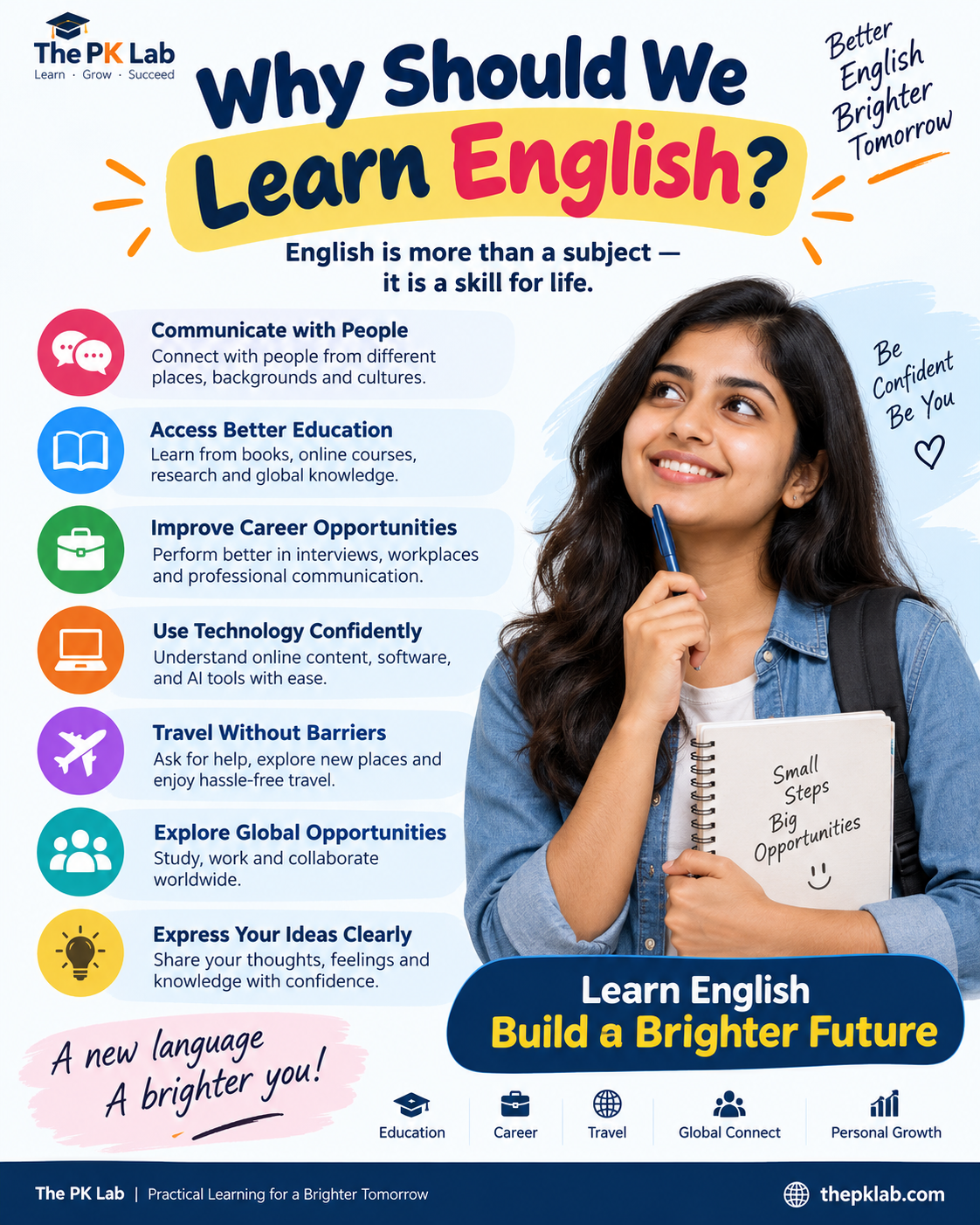
Why Should We Learn English?
English Is More Than a Subject — It Is a Skill for Life
Have you ever wanted to speak to someone confidently but struggled to find the right English words?
Have you ever understood what someone was saying in English but found it difficult to reply?
You are not alone.
For millions of learners, English is not difficult because they are not intelligent. It is difficult because they have not had enough opportunities to understand, practise, and use English in real-life situations.
That is why learning English is important.
English is not just a language to study. It is a skill to use.
🌍 Why Is English Important?
English is one of the most widely used languages for education, communication, technology, business, travel, employment, and global interaction.
Learning English can help you:
- Communicate with more people
- Access more educational resources
- Perform better in interviews
- Improve workplace communication
- Understand digital content
- Travel more confidently
- Participate in global conversations
- Express your ideas more clearly
- Build confidence in professional situations
But remember:
Learning English does not mean becoming someone else. It means gaining one more way to express yourself.
1. English Helps You Communicate
The most important purpose of any language is communication.
English can help you communicate with people from different regions, states, countries, and backgrounds.
For example, imagine you are travelling to another state in India.
You may not know the local language, and the other person may not know your language.
English can often become a common language.
Example
You: Excuse me, could you please tell me where the railway station is?
Person: Yes. Go straight and take the first left.
A simple knowledge of English can make communication easier.
2. English Opens the Door to Education
A huge amount of educational content is available in English.
Books, research papers, online courses, tutorials, documentation, lectures, and educational videos are often available in English.
If you understand English, you can learn from a much larger pool of knowledge.
For example:
You want to learn:
- Computer programming
- Artificial Intelligence
- Digital Marketing
- Business
- Science
- Communication Skills
- Data Analytics
- Entrepreneurship
You will find enormous amounts of learning material in English.
The better your English, the more knowledge you can access.
3. English Can Improve Your Career Opportunities
Today’s workplace is increasingly connected.
Companies work with customers, partners, employees, and professionals from different locations.
Good English communication can therefore be valuable in many careers.
You may need English for:
- Job applications
- Interviews
- Emails
- Meetings
- Presentations
- Reports
- Customer communication
- Team discussions
- Professional networking
Example
Compare these two interview responses:
❌ “Sir, I have experience in this work. I can do this.”
✅ “I have experience in this area, and I believe I can contribute effectively to this role.”
The second response communicates the same basic idea, but more clearly and professionally.
4. English Builds Confidence
English itself does not create confidence.
Knowledge + Practice + Successful Communication = Confidence
When you learn how to form sentences and use them correctly, you become less afraid of making mistakes.
For example, instead of thinking:
“What if I say something wrong?”
You gradually begin to think:
“I can express my idea. Let me try.”
That change in attitude is extremely important.
Remember:
Don’t wait to become perfect before speaking English. Speak, learn, correct, and improve.
5. English Helps You in the Digital World
We live in a digital world.
A large amount of online content is created in English.
You encounter English when using:
- Websites
- Mobile applications
- Computers
- AI tools
- YouTube
- Online courses
- Software
- Search engines
- Professional platforms
- Technical documentation
Today, even tools based on Artificial Intelligence often require users to communicate through written or spoken instructions.
For example:
“Create a presentation about climate change.”
“Explain this concept in simple language.”
“Write an email to my manager.”
The better you understand English, the more effectively you can use digital tools.
6. English Helps You Use AI More Effectively
Artificial Intelligence is changing how we learn and work.
Tools such as AI assistants can help with:
- Learning
- Writing
- Research
- Coding
- Presentations
- Communication
- Problem-solving
To get useful results, you often need to explain what you want clearly.
Simple Prompt
Explain photosynthesis.
Better Prompt
Explain photosynthesis in simple English with an everyday example suitable for a Class 8 student.
The second instruction is more specific and easier for an AI system to interpret.
Therefore:
Better English → Better instructions → Better communication with technology.
7. English Helps You in Interviews
Knowing your subject is important.
But during an interview, you also need to communicate what you know.
You may be asked:
- Tell me about yourself.
- What are your strengths?
- Why should we hire you?
- What are your career goals?
- Tell us about your experience.
- Why do you want to join our organisation?
Good English can help you present your knowledge and experience more clearly.
Example
Instead of:
“My strength is hardworking.”
Say:
“One of my strengths is that I am hardworking and committed to completing my responsibilities.”
The goal is not to use difficult words.
The goal is to express your thoughts clearly.
8. English Helps You in the Workplace
English is commonly used in many professional environments.
You may need to communicate through:
Email → Meetings → Presentations → Reports → Phone Calls → Messages
For example:
Informal
Send me the report.
Professional
Could you please share the report when you get a chance?
Both sentences communicate a similar request, but the second sounds more appropriate in many professional situations.
Learning English also helps you understand the difference between casual, polite, formal, and professional communication.
9. English Helps You Travel
English can be extremely useful while travelling.
You may need to:
- Ask for directions
- Book a hotel
- Order food
- Buy tickets
- Ask for information
- Talk to other travellers
- Handle unexpected situations
Useful Travel English
Where is the nearest bus stop?
How much does this ticket cost?
Could you help me?
I have a reservation.
What time does the train leave?
These are simple sentences, but they can be very useful.
10. English Gives You Access to Global Opportunities
The world is becoming more connected.
You can study, work, collaborate, learn, and communicate with people from different countries.
English can help you participate in:
- International courses
- Global conferences
- Online communities
- Professional networks
- International workplaces
- Global projects
- Online learning platforms
You don’t necessarily need perfect English.
You need functional English—English that helps you understand and communicate.
11. English Helps You Express Your Ideas
Knowing English grammar and vocabulary is not only about passing examinations.
It is about being able to say:
What I think.
What I feel.
What I need.
What I know.
What I want.
For example:
Basic
I don’t like this idea.
More developed
I understand the idea, but I have a different opinion.
The second sentence gives you more space to communicate your thoughts.
12. English Is a Skill, Not a Measure of Intelligence
This is one of the most important things every learner should understand.
Speaking English fluently does not automatically mean someone is intelligent.
And making mistakes in English does not mean someone is less intelligent.
You may have excellent knowledge, skills, ideas, or experience and still struggle with English.
English is simply a communication skill.
Like any other skill, it can be learned through:
Learning → Practice → Mistakes → Correction → Improvement
13. Do I Need Perfect English?
No.
You do not need perfect English to communicate effectively.
Your first goal should be:
Understand → Speak → Communicate → Improve
Do not focus on using complicated vocabulary.
Instead of trying to say:
“I would like to elucidate my perspective…”
You can simply say:
“I would like to explain my point.”
Simple English is often better English.
Clarity is more important than complexity.
14. Why Should We Learn English Grammar?
Learning English vocabulary helps you know words.
Learning grammar helps you understand how to put those words together correctly.
For example:
Words:
She / school / go / every day
Grammar helps us form:
She goes to school every day.
Grammar gives structure to a language.
Think of it this way:
Words are the building materials. Grammar is the structure that puts them together.
That is why grammar is an important part of learning English.
15. English + Grammar + Practice = Better Communication
Learning English does not happen by memorising grammar rules alone.
You need three things:
📚 Knowledge
Learn words, grammar, sentence structures, and expressions.
🗣️ Practice
Use English in speaking and writing.
🔄 Consistency
Practise regularly instead of studying only occasionally.
For example:
10–15 minutes every day can be more useful than studying for several hours once a month.
Common Misunderstandings About Learning English
❌ “My English must be perfect before I speak.”
No.
Speak first. Improve through practice.
❌ “I need very difficult vocabulary.”
No.
Simple and clear English is powerful.
❌ “Making mistakes is embarrassing.”
No.
Mistakes are part of learning.
❌ “Grammar is only for exams.”
No.
Grammar helps you understand how English sentences work.
❌ “I am too old to learn English.”
No.
Language learning is possible at different ages.
How Can I Start Learning English?
You don’t need to learn everything at once.
Start with the basics.
Step 1 — Learn Words
Understand common English words.
Step 2 — Learn Sentence Structure
Learn how words combine to form sentences.
Step 3 — Learn Basic Grammar
Start with:
- Nouns
- Pronouns
- Verbs
- Adjectives
- Adverbs
- Prepositions
- Articles
Step 4 — Learn Tenses
Understand how English talks about:
- Present
- Past
- Future
Step 5 — Build Everyday Sentences
Practise sentences you can actually use.
Step 6 — Speak
Start speaking, even if your English is not perfect.
Step 7 — Listen
Listen to English conversations, videos, podcasts, and educational content.
Step 8 — Read
Read simple articles, stories, news, and educational material.
Step 9 — Write
Write short sentences, messages, emails, and paragraphs.
Step 10 — Keep Practising
Progress comes from consistency.
🌟 The PK Lab Learning Philosophy
At The PK Lab, we believe English should not be learned only as a collection of rules.
It should be understood, practised, and used.
Our approach is simple:
Learn → Understand → Practise → Use → Improve
We will take you from the basics of English to practical communication step by step.
Whether you are a school student, college learner, job seeker, working professional, or simply someone who wants to improve English, start from where you are.
You don’t have to know everything today.
You just have to start.
Quick Takeaways
Remember these five things:
- English is a communication skill.
- English can expand your access to education and information.
- English can support academic and professional communication.
- You do not need perfect English to communicate effectively.
- Regular practice is more important than memorising everything.
One Final Thought
Don’t learn English just to speak English. Learn English so that you can express your knowledge, ideas, feelings, and abilities with greater confidence.
Your English journey starts with one word, one sentence, and one conversation at a time.
Frequently Asked Questions
1. Why should students learn English?
English can help students access educational resources, communicate more effectively, prepare for higher education, and develop skills useful for future careers.
2. Is English necessary for getting a job?
Not every job requires the same level of English. However, English communication can be valuable in many workplaces, particularly when interacting with customers, colleagues, technology, or international teams.
3. Can I learn English without knowing grammar?
You can learn some English through exposure and practice without formally studying grammar. However, understanding basic grammar can help you form sentences accurately and understand why sentences work the way they do.
4. How long does it take to learn English?
There is no single timeline. It depends on your current level, goals, exposure, practice, and consistency.
5. What is the best way to improve English?
Combine listening, speaking, reading, writing, vocabulary, grammar, and regular practice.
6. Should I be afraid of making mistakes?
No. Mistakes are a natural part of learning a language. The important thing is to notice, correct, and learn from them.