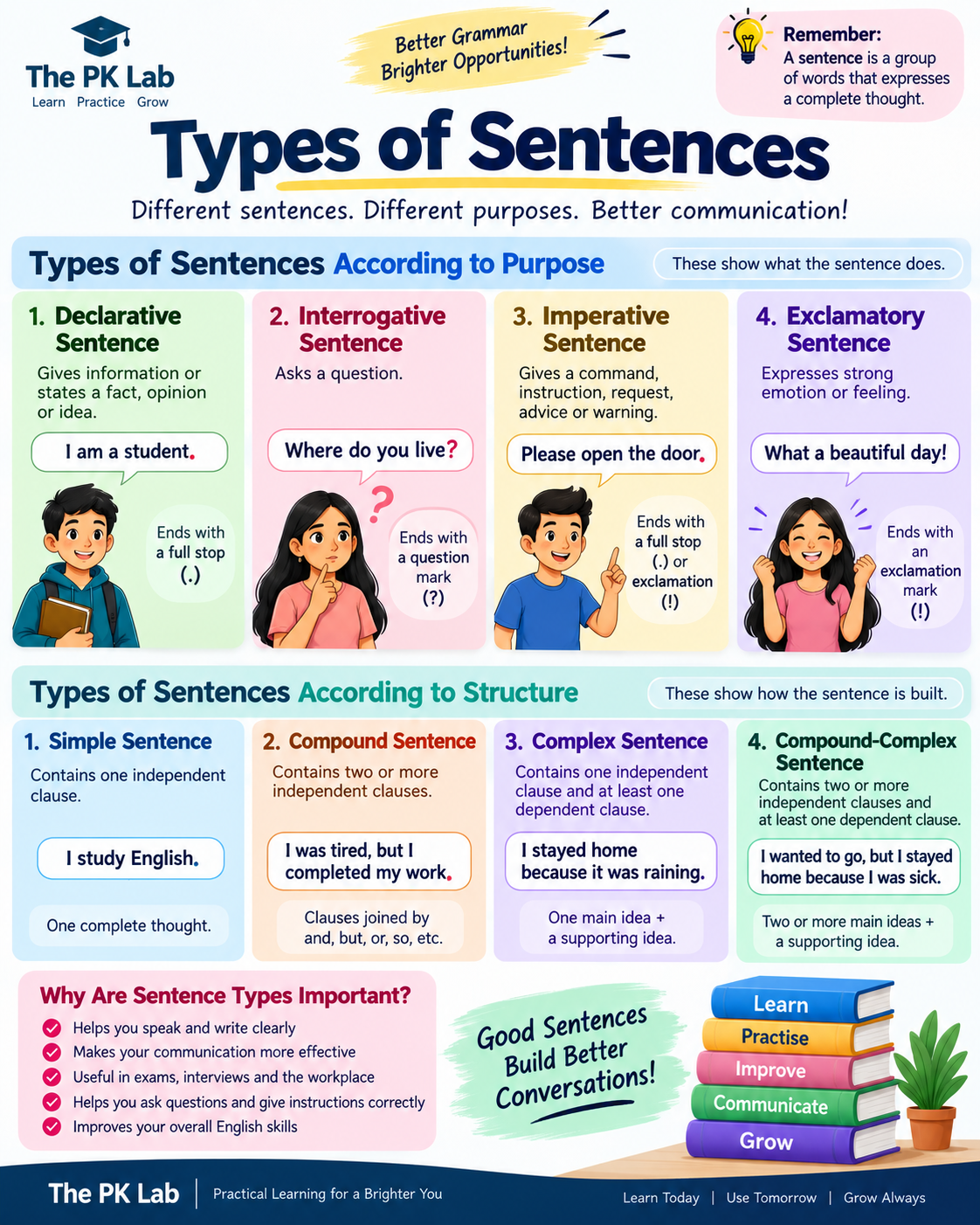
1. What Are the Types of Sentences?
There are two common ways to classify English sentences.
A. According to their purpose or function
There are four main types:
- Declarative Sentence – makes a statement
- Interrogative Sentence – asks a question
- Imperative Sentence – gives a command, instruction, request, or advice
- Exclamatory Sentence – expresses strong emotion
B. According to their structure
There are also four structural types:
- Simple Sentence
- Compound Sentence
- Complex Sentence
- Compound-Complex Sentence
Important: These two classifications are different.
A sentence can be declarative + simple, or interrogative + complex, etc.
Part 1: Types of Sentences According to Purpose
1. Declarative Sentence
What is a Declarative Sentence?
A declarative sentence gives information or states a fact, opinion, idea, or belief.
In simple words:
A declarative sentence tells us something.
It normally ends with a full stop (.)
Examples
- I am a teacher.
- Rahul lives in Cuttack.
- The sun rises in the east.
- She likes English.
- Odisha is a beautiful state.
- I think this book is useful.
Real-Life Examples
At home:
- My mother is cooking dinner.
- The children are studying.
At college:
- Our class starts at 10 a.m.
- The teacher explained the lesson.
At work:
- The meeting starts at 3 p.m.
- I have completed the report.
While travelling:
- The train is late.
- Our bus leaves at 7 p.m.
Positive and Negative Statements
A declarative sentence can be affirmative or negative.
| Affirmative | Negative |
|---|---|
| I like tea. | I do not like tea. |
| She is happy. | She is not happy. |
| He works here. | He does not work here. |
| They have a car. | They do not have a car. |
Correct vs Incorrect
❌ He don’t like tea.
✅ He doesn’t like tea.
❌ She are a student.
✅ She is a student.
2. Interrogative Sentence
What is an Interrogative Sentence?
An interrogative sentence asks a question.
In simple words:
An interrogative sentence asks us something.
It normally ends with a question mark (?)
Examples
- What is your name?
- Where do you live?
- Are you ready?
- Do you like coffee?
- When will the class start?
- Why are you late?
Two Common Types of Questions
A. Yes/No Questions
These questions usually require yes or no as the answer.
- Are you a student?
- Do you speak English?
- Is she at home?
- Have you finished your work?
Example:
Q: Are you ready?
A: Yes, I am.
B. WH-Questions
These questions begin with words such as:
| Question Word | Purpose | Example |
|---|---|---|
| What | Thing/information | What is your name? |
| Who | Person | Who is your teacher? |
| Where | Place | Where do you live? |
| When | Time | When will you come? |
| Why | Reason | Why are you late? |
| Which | Choice | Which book do you want? |
| Whose | Possession | Whose pen is this? |
| How | Manner/condition | How are you? |
Real-Life Conversation
At a shop:
Customer: How much does this shirt cost?
Shopkeeper: It costs ₹800.
At college:
Student: When will the examination begin?
Teacher: It will begin at 10 a.m.
At an interview:
Interviewer: Why do you want this job?
Candidate: I want to develop my skills and contribute to the organisation.
Common Mistake
❌ Where you are going?
✅ Where are you going?
❌ What you are doing?
✅ What are you doing?
❌ Why he is late?
✅ Why is he late?
3. Imperative Sentence
What is an Imperative Sentence?
An imperative sentence gives a:
- Command
- Instruction
- Request
- Advice
- Warning
In simple words:
An imperative sentence tells someone what to do or not to do.
The subject “you” is usually understood rather than written.
Examples
- Open the door.
- Sit down.
- Please wait here.
- Follow me.
- Take your seat.
- Study regularly.
- Don’t make noise.
- Be careful.
Command
- Stop talking.
- Come here.
- Close the window.
Request
Adding please makes a command more polite.
- Please open the door.
- Please wait for me.
- Please send me the report.
Advice
- Eat healthy food.
- Exercise regularly.
- Practise English every day.
- Be honest.
Warning
- Be careful!
- Don’t touch that wire.
- Don’t cross the road without looking.
Negative Imperative
Use:
Don’t + base form of verb
Examples:
- Don’t worry.
- Don’t shout.
- Don’t be late.
- Don’t touch the machine.
- Don’t waste your time.
Common Mistake
❌ Don’t to make noise.
✅ Don’t make noise.
❌ Please to sit down.
✅ Please sit down.
4. Exclamatory Sentence
What is an Exclamatory Sentence?
An exclamatory sentence expresses a strong emotion or feeling.
It may express:
- Joy
- Surprise
- Excitement
- Anger
- Sorrow
- Admiration
- Shock
It normally ends with an exclamation mark (!)
Examples
- What a beautiful view!
- What a wonderful idea!
- How beautiful the flower is!
- Wow! You did it!
- What a great achievement!
- How lucky you are!
Real-Life Examples
After receiving good news:
What wonderful news!
After seeing a beautiful place:
What a beautiful place!
After winning a competition:
We won the competition!
Exclamation vs Statement
Compare:
Declarative:
The movie is amazing.
Exclamatory:
What an amazing movie!
The first simply gives information.
The second expresses strong emotion.
Quick Comparison: Four Types by Purpose
| Type | Main Purpose | Ending | Example |
|---|---|---|---|
| Declarative | Gives information | . | She is a doctor. |
| Interrogative | Asks a question | ? | Is she a doctor? |
| Imperative | Gives command/request/advice | . / ! | Please sit down. |
| Exclamatory | Expresses strong emotion | ! | What a beautiful dress! |
Easy Memory Trick
Remember:
D-I-I-E
D = Declare
I = Inquire
I = Instruct
E = Express emotion
Or simply:
Tell → Ask → Tell someone to do → Feel
Part 2: Types of Sentences According to Structure
Now let’s look at another important classification.
A sentence can be classified according to how it is constructed.
The four structural types are:
- Simple
- Compound
- Complex
- Compound-Complex
1. Simple Sentence
What is a Simple Sentence?
A simple sentence contains one independent clause.
An independent clause can stand alone as a complete sentence.
Examples
- I study English.
- She is happy.
- Rahul plays football.
- The children are playing.
- My brother works in a bank.
A simple sentence does not necessarily mean a short sentence.
For example:
The young boy with a blue bag is waiting outside the classroom.
This is still a simple sentence because it has one independent clause.
Basic Structure
Subject + Verb + Object
Example:
Rahul + reads + books.
2. Compound Sentence
What is a Compound Sentence?
A compound sentence contains two or more independent clauses joined together.
Common coordinating conjunctions include:
for, and, nor, but, or, yet, so
These are often remembered as FANBOYS.
Examples
- I wanted to go, but it was raining.
- She studied hard, so she passed the examination.
- Rahul plays football, and his brother plays cricket.
- Hurry up, or you will miss the bus.
Look at this example:
I was tired, but I completed my work.
Clause 1: I was tired.
Clause 2: I completed my work.
Connector: but
Both clauses can stand alone.
3. Complex Sentence
What is a Complex Sentence?
A complex sentence contains:
- One independent clause
- At least one dependent clause
A dependent clause cannot normally stand alone as a complete sentence.
Examples
- I stayed at home because it was raining.
- When I reached the station, the train had left.
- I will call you when I arrive.
- Although he was tired, he continued working.
Common Subordinating Conjunctions
| Word | Example |
|---|---|
| because | I stayed home because I was sick. |
| although | Although it was raining, we went outside. |
| when | Call me when you arrive. |
| if | I will help you if you need me. |
| while | She listened while I was speaking. |
| before | Finish your work before you leave. |
| after | We went home after the class ended. |
| unless | You cannot succeed unless you practise. |
Easy Way to Understand
Think of it like this:
Main idea + supporting idea
Example:
I stayed home because it was raining.
Main idea: I stayed home.
Reason: because it was raining.
9. Compound-Complex Sentence
What is a Compound-Complex Sentence?
A compound-complex sentence contains:
- At least two independent clauses
- At least one dependent clause
It combines the features of compound and complex sentences.
Example
I wanted to attend the meeting, but I stayed at home because I was sick.
Independent clause 1:
I wanted to attend the meeting.
Independent clause 2:
I stayed at home.
Dependent clause:
because I was sick.
Another Example
When the teacher arrived, the students became quiet, and the class began.
Dependent clause:
When the teacher arrived
Independent clauses:
- The students became quiet.
- The class began.
Simple vs Compound vs Complex
| Type | Structure | Example |
|---|---|---|
| Simple | 1 independent clause | I studied. |
| Compound | 2+ independent clauses | I studied, and I passed. |
| Complex | 1 independent + dependent clause | I passed because I studied. |
| Compound-Complex | 2+ independent + 1+ dependent | I studied because I had an exam, and I passed. |
10. One Idea in Four Sentence Structures
Understanding the difference becomes easier when we compare them.
Simple
I was tired.
Compound
I was tired, but I continued working.
Complex
I continued working although I was tired.
Compound-Complex
Although I was tired, I continued working, and I completed the report.
This is a useful way to learn sentence structures.
11. Purpose + Structure: They Can Work Together
Remember that purpose and structure are separate classifications.
For example:
Declarative + Simple
I work in Bhubaneswar.
Declarative + Compound
I work in Bhubaneswar, and my brother works in Cuttack.
Interrogative + Simple
Do you speak English?
Interrogative + Complex
Do you know where he lives?
Imperative + Simple
Open the door.
Exclamatory + Simple
What a beautiful day!
So, don’t think that “declarative” and “simple” are competing categories. They describe different aspects of a sentence.
12. Common Mistakes
Mistake 1: Confusing a statement with a question
❌ You are coming today?
✅ Are you coming today?
In informal spoken English, the first can occur with rising intonation, but Are you coming today? is the standard grammatical question.
Mistake 2: Using “don’t” incorrectly
❌ Don’t to worry.
✅ Don’t worry.
Mistake 3: Incorrect question structure
❌ Where you live?
✅ Where do you live?
❌ What he is doing?
✅ What is he doing?
Mistake 4: Missing punctuation
❌ Where are you going.
✅ Where are you going?
❌ What a beautiful place.
✅ What a beautiful place!
Mistake 5: Confusing compound and complex sentences
Compound:
I was hungry, so I ate dinner.
Two independent clauses are joined by so.
Complex:
I ate dinner because I was hungry.
One independent clause + one dependent clause.
13. Spoken English: How We Actually Use These Sentences
In everyday conversation, we constantly move between different sentence types.
At Home
Statement:
Dinner is ready.
Question:
Are you hungry?
Request:
Please wash your hands.
Exclamation:
What a delicious meal!
At Work
Statement:
The meeting starts at 10.
Question:
Have you completed the report?
Request:
Please send me the file.
Exclamation:
What a great presentation!
In an Interview
Interviewer:
Tell me about yourself.
Candidate:
I have experience in project management.
Interviewer:
Why do you want this position?
Candidate:
I want to use my experience and develop professionally.
Notice how natural English uses statements, questions, requests, and other sentence types together.
14. Formal vs Natural Spoken English
Grammar is not only about writing. We also use sentence structures differently depending on the situation.
Formal
I do not understand the question.
Natural conversation
I don’t understand the question.
Both are grammatically correct.
Another example:
Formal
Could you please explain this point?
Everyday
Can you explain this?
The choice depends on the situation, relationship, and level of politeness.
15. Quick Tips to Identify a Sentence
Ask yourself these questions:
Question 1
Is the sentence giving information?
→ Declarative
Question 2
Is it asking something?
→ Interrogative
Question 3
Is it giving an instruction, command, request, advice, or warning?
→ Imperative
Question 4
Is it expressing strong emotion?
→ Exclamatory
Then ask:
How many clauses does it have?
- One independent clause → Simple
- Two or more independent clauses → Compound
- Independent + dependent clause → Complex
- Two or more independent + dependent clause → Compound-Complex
16. Practice Exercise
A. Identify the Type by Purpose
Identify each sentence as Declarative, Interrogative, Imperative, or Exclamatory.
- I live in Odisha.
- Where are you going?
- Please close the window.
- What a beautiful flower!
- She works in a hospital.
- Do you like English?
- Don’t touch the machine.
- How wonderful this news is!
- We have completed the project.
- Can you help me?
Answers
- Declarative
- Interrogative
- Imperative
- Exclamatory
- Declarative
- Interrogative
- Imperative
- Exclamatory
- Declarative
- Interrogative
17. Practice Exercise: Identify the Structure
Identify each sentence as Simple, Compound, Complex, or Compound-Complex.
- I study English.
- I studied hard, and I passed the test.
- I passed the test because I studied hard.
- Although I was tired, I finished my work, and I went home.
- She likes tea.
- He was hungry, so he ordered food.
- When the rain stopped, we went outside.
- I called him, but he did not answer because he was busy.
Answers
- Simple
- Compound
- Complex
- Compound-Complex
- Simple
- Compound
- Complex
- Compound-Complex
18. Quick Revision
Four Types by Purpose
Declarative → tells something
Interrogative → asks something
Imperative → tells someone to do something
Exclamatory → expresses strong emotion
Four Types by Structure
Simple → one independent clause
Compound → two or more independent clauses
Complex → independent + dependent clause
Compound-Complex → two or more independent + dependent clause
Remember
Purpose tells us what the sentence does.
Structure tells us how the sentence is built.
This distinction is one of the most important things to understand when learning sentence types.
Frequently Asked Questions
1. How many types of sentences are there in English?
According to purpose, there are four main types: declarative, interrogative, imperative, and exclamatory.
According to structure, there are four: simple, compound, complex, and compound-complex.
2. What is a declarative sentence?
A declarative sentence makes a statement or gives information.
Example:
She is a teacher.
3. What is an interrogative sentence?
An interrogative sentence asks a question.
Example:
Where do you live?
4. What is an imperative sentence?
An imperative sentence gives a command, instruction, request, advice, or warning.
Example:
Please sit down.
5. What is an exclamatory sentence?
An exclamatory sentence expresses strong emotion.
Example:
What a beautiful place!
6. What is the difference between a simple and compound sentence?
A simple sentence has one independent clause, while a compound sentence has two or more independent clauses, usually joined by a coordinating conjunction.
7. Can one sentence be both declarative and complex?
Yes. These classifications describe different things.
For example:
I stayed home because it was raining.
It is declarative because it gives information and complex because it contains an independent clause and a dependent clause.